


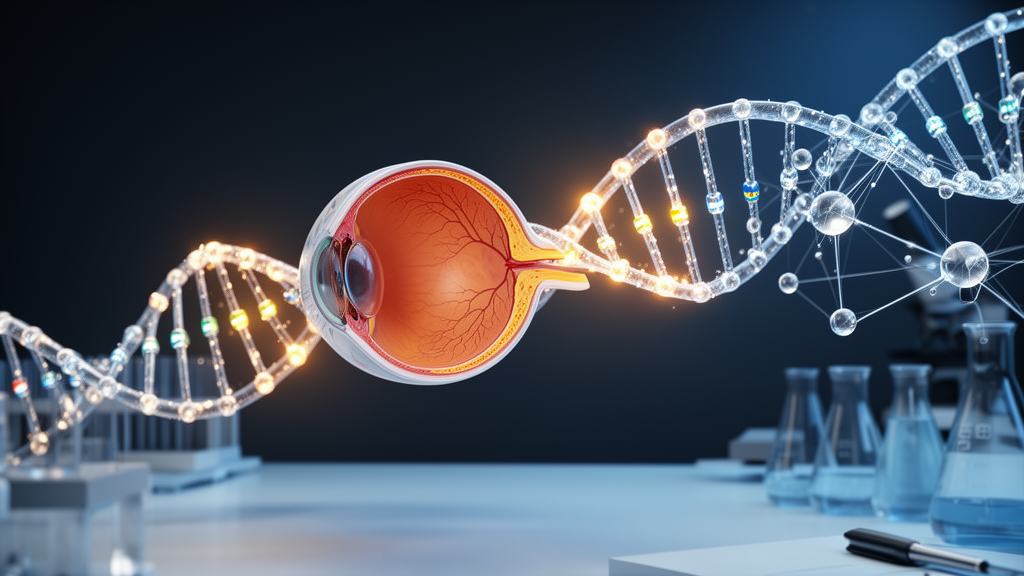
Researchers at The University of Texas at Arlington have launched an ambitious computational biology project that could reshape how scientists understand and ultimately treat blinding diseases. Funded by a four-year, $1.96 million grant from the National Eye Institute, the effort centers on building artificial intelligence and advanced statistical tools capable of identifying and characterizing the biological control switches that keep the eye healthy and pinpointing what goes wrong when vision fails. The project, led by Xinlei (Sherry) Wang, the Jenkins Garrett Professor of statistics and data science in UT Arlington’s Department of Mathematics, reflects a growing conviction in biomedical research that the answers to complex diseases are buried inside enormous genomic datasets, waiting for the right algorithms to surface them.
The central challenge the team is tackling is one of scale and specialization. The eye is not a single uniform organ but a collection of highly specialized tissues and cell types, including the retina’s photoreceptors, retinal pigment epithelial cells, corneal cells, lens cells, and vascular tissues, all of which must coordinate precisely to make vision possible. Each of these cell types relies on its own repertoire of transcriptional regulators, the proteins and regulatory elements that determine which genes are switched on or off at any given moment. When these regulatory programs malfunction, the consequences can include degenerative conditions such as age-related macular degeneration, glaucoma, and diabetic retinopathy, which together affect hundreds of millions of people worldwide. Understanding the relationship between tissue-specific transcriptional regulators and visual function, Wang argues, is a cornerstone of vision research.
Wang’s collaborator on the project is Lin Xu, an assistant professor at UT Southwestern Medical Center. The partnership brings together complementary expertise that spans Bayesian statistics, bioinformatics, single-cell sequencing, omics data analysis, ocular biology, and clinical experience. This interdisciplinary approach is increasingly seen as essential in modern genomics, where the raw data generated by sequencing instruments far outstrip the capacity of traditional analytical methods. Bayesian statistical frameworks, which allow researchers to formally quantify uncertainty and integrate prior biological knowledge into their models, are particularly well suited to the noisy, high-dimensional, and often incomplete datasets that characterize contemporary eye research.
The award builds on Wang’s established record of leveraging artificial intelligence and advanced statistical methods to help scientists make sense of complex diseases. Her research program focuses on creating computational tools that uncover important biological patterns hidden within massive datasets, patterns that would be practically impossible for human analysts to detect by inspection. By identifying these patterns, the tools help researchers narrow down which genes, regulatory elements, and molecular pathways deserve the closest scrutiny as potential targets for future study and therapeutic intervention. In an era when a single experiment can generate terabytes of genomic information, the bottleneck in biomedical discovery has shifted from data generation to data interpretation, and that is precisely the bottleneck Wang’s methods are designed to relieve.
To advance the study, the researchers will develop two distinct computational tools, each addressing a different layer of the problem. The first is a scalable analytical engine designed to process very large genomic datasets and identify the regulators that are key to ocular health and disease. Scalability is not a trivial requirement in genomics. Modern studies routinely profile thousands of samples across dozens of tissue types and conditions, and algorithms that perform well on small pilot datasets often collapse under the computational weight of full-scale data. Wang has emphasized that the algorithm needs to run smoothly on very large collections of data, a constraint that shapes everything from the mathematical formulation of the model to the software engineering choices behind its implementation.
The second tool tackles a problem that has long frustrated researchers studying complex organs: signal mixing. Eye tissue samples, like samples from most biological organs, contain many different cell types with distinct functions, and standard bulk sequencing methods measure the average gene activity across all of those cells simultaneously. When researchers analyze a whole tissue sample, the signals from individual cell types are blended together, obscuring the very cell-type-specific regulatory behavior that matters most for understanding disease. The new deconvolution tool will computationally separate those mixed signals, estimating how a particular transcriptional regulator behaves in each constituent cell type without requiring expensive single-cell experiments for every regulator under investigation.
The significance of this second tool is difficult to overstate. Single-cell sequencing technologies, which measure gene expression in individual cells, have revolutionized biology by revealing cellular heterogeneity that bulk methods average away. However, they remain costly, technically demanding, and impractical to deploy for every regulator, tissue, and disease condition a researcher might want to study. A reliable computational deconvolution method offers a middle path: researchers can continue to generate relatively inexpensive bulk data while using the algorithm to infer cell-type-specific regulatory activity, reserving single-cell experiments for the most promising hypotheses. By pinpointing the key regulators that behave abnormally in specific cell populations, the tools will help researchers focus on the most promising targets, saving both time and resources in the search for therapies.
Together, the two tools will allow the team to study the eye at two complementary levels: the overall tissue level, where regulators can be assessed across large collections of samples and disease conditions, and the individual cell-type level within each tissue, where the mechanistic details of health and disease actually play out. Wang has described the long-term goal as improving understanding of eye disease mechanisms and helping the field identify promising directions for future diagnostics and targeted therapies. Targeted therapies, which act on specific molecular pathways rather than broadly suppressing symptoms, represent one of the most promising frontiers in ophthalmology, but they depend on knowing exactly which molecular switches to flip and in which cells. The computational framework under development is intended to provide exactly that kind of mechanistic roadmap.
The National Eye Institute’s support for the project underscores a broader strategic bet within federal vision research: that computational and data-driven approaches will increasingly drive the next generation of discoveries about how the eye works and why it fails. The institute, part of the National Institutes of Health, funds research aimed at preserving and improving vision, and grants of this size typically signal confidence that the proposed methods can yield tools of lasting value to the wider research community. Morteza Khaledi, dean of UT Arlington’s College of Science, called the grant an outstanding achievement and a testament to the strength, significance, and growing impact of Wang’s interdisciplinary research program, reflecting the university’s investment in statistical and data science approaches to biomedical problems.
The project also fits into a larger portfolio of AI-driven biomedical work at UT Arlington. Wang is co-leading a related effort with Junzhou Huang, a professor in the university’s College of Engineering, on a study that combines artificial intelligence and Bayesian learning to accelerate drug design, an area where machine learning methods are already compressing discovery timelines that once stretched over decades. Taken together, these initiatives position the university at the intersection of statistics, computer science, and medicine, where the tools of data science are being forged into instruments of biological discovery. If the new eye-focused tools perform as intended, they could give researchers around the world a clearer view of the molecular circuitry of vision, and a better chance of protecting it when disease threatens.
Subject of Research: AI-driven identification of transcriptional regulators controlling ocular health and eye disease
Article Title: UT Arlington uses AI to uncover drivers of eye disease
Article References: UT Arlington uses AI to uncover drivers of eye disease. (n.d.). Original publication
Image Credits: AI Generated
DOI: Not provided
Keywords: artificial intelligence, eye disease, National Eye Institute, transcriptional regulators, Bayesian statistics, single-cell sequencing, genomics, bioinformatics, UT Arlington, vision research, targeted therapies, deconvolution
Cite Scienmag News
Juliet Wilcox. (October 9, 2026). AI-Powered Statistics Project Aims to Decode the Genetic Switches Behind Eye Disease. Scienmag. https://scienmag.com/ai-powered-statistics-project-aims-to-decode-the-genetic-switches-behind-eye-disease/
Juliet Wilcox. "AI-Powered Statistics Project Aims to Decode the Genetic Switches Behind Eye Disease." Scienmag, 9 October 2026, https://scienmag.com/ai-powered-statistics-project-aims-to-decode-the-genetic-switches-behind-eye-disease/. Accessed 9 October 2026.
Juliet Wilcox. "AI-Powered Statistics Project Aims to Decode the Genetic Switches Behind Eye Disease." Scienmag. October 9, 2026. https://scienmag.com/ai-powered-statistics-project-aims-to-decode-the-genetic-switches-behind-eye-disease/


