


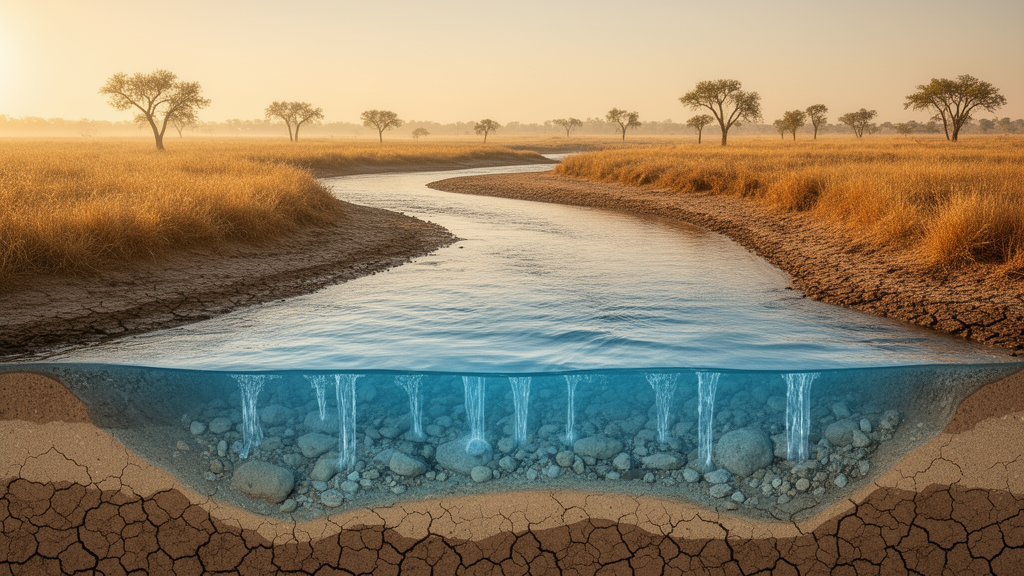
When a river shrinks during a long dry spell, the water that still trickles through its channel usually does not come from the sky. It comes from below. A new global analysis published in Communications Earth & Environment has quantified, for the first time at planetary scale, just how much of a river’s flow during drought is supplied by baseflow, the slow release of water from groundwater and other catchment storage into the stream network. The answer is striking: during severe meteorological drought, nearly three quarters of the world’s monitored river gauging stations show that baseflow becomes the dominant, and in many cases overwhelming, contributor to what remains of the stream. The finding reframes drought not simply as a rainfall deficit but as a slow-motion drain on underground reservoirs, and it suggests that the hidden water held in soils, aquifers and bedrock fractures is the ultimate insurance policy for ecosystems, water supplies and agriculture when the rains fail.
The research team, led by Muhammad Abrar Faiz and Liangliang Zhang of Northeast Agricultural University in Harbin, China, together with colleagues across China, the United Arab Emirates, Pakistan and Vietnam, confronted a long-standing uncertainty in hydrology. Scientists have known for decades that rivers are fed by two distinct pathways: quickflow, the rapid runoff generated when rain falls faster than the ground can absorb it, and baseflow, the delayed discharge of water that infiltrated the landscape weeks, months or even years earlier. What remained unclear was how strongly baseflow buffers rivers during droughts, and whether that buffering behaves consistently across different climates, geologies and continents. Without that knowledge, drought forecasts and water management plans risked misjudging how long rivers can keep flowing once the precipitation stops.
To resolve the question, the team assembled three complementary streams of evidence: observations from a global network of streamflow gauges, satellite-derived estimates of terrestrial water storage, and simulations from the CMIP6 generation of climate models used in international assessments. From these they constructed two new metrics. The first, the drought-sustained fraction, or DSF, expresses the share of drought-period streamflow that is contributed by baseflow. The second, the additive baseflow buffering index, or BBI, measures how much the baseflow fraction during drought departs from the climatological baseflow index, the long-term average proportion of river flow that comes from slow storage release. Together, the two indices allow researchers to distinguish between rivers that lean harder on groundwater when drought bites and rivers whose slow-flow contribution collapses along with everything else.
The results paint a coherent global picture. Under severe meteorological drought, 74.2 percent of the stations analyzed showed a positive buffering index, meaning the relative contribution of baseflow to streamflow strengthened as conditions dried. A further 12.7 percent of stations showed little change, while 13.1 percent actually registered a decline in the baseflow fraction, a signal that in some catchments even the stored water reserves become depleted or disconnected from the channel. In other words, at most of the world’s monitored rivers, drought does not simply shrink the stream; it transforms the character of the water in it, shifting the balance decisively toward old, slowly released groundwater rather than fresh surface runoff.
The mechanics behind this shift are rooted in the different response times of the two flow pathways. Quickflow depends on recent rainfall and near-surface saturation, so it collapses quickly once precipitation ceases. Baseflow, by contrast, is governed by the gradual drainage of water stored in soils, shallow aquifers and deeper geological formations, which continues to release water to channels long after the storm clouds have gone. The study found that the buffering index increased with low-flow severity and with the magnitude of the streamflow deficit, while baseflow retention declined. That combination indicates that quickflow generally decreased more rapidly than baseflow during droughts, so even as the absolute volume of baseflow diminished, its share of the shrinking river grew. The river becomes, in effect, a progressively more groundwater-dominated system as the drought deepens.
Perhaps the most consequential finding concerns the future. By comparing present-day flow partitioning with CMIP6 climate projections, the researchers discovered that how a catchment divides its water between quickflow and baseflow today constrains how its slow-flow behavior will unfold under warming. Catchments that currently rely heavily on storage release are likely to maintain that character, and the vulnerabilities embedded in present-day storage dynamics will carry forward into a hotter, more drought-prone world. This persistence means that the baseflow buffering observed now is not a transient curiosity but a structural property of each landscape, one that water managers can measure today and use to anticipate tomorrow’s low-flow regimes.
The implications ripple outward well beyond hydrology. Environmental flows that sustain fish, mussels and riverine vegetation during dry seasons depend almost entirely on baseflow in most of the world’s rivers, so the study provides a physical basis for setting drought-era flow thresholds. Water utilities drawing from rivers during droughts are, often unknowingly, harvesting groundwater discharged to the surface, which links surface-water allocation decisions directly to aquifer management. Agricultural regions that irrigate from shrinking streams are tapping the same slow-release reserves, and the 13 percent of stations where the baseflow fraction declined serve as a warning: where storage is exhausted or the connection between aquifer and channel is broken, even the groundwater safety net can fail.
The work also carries a methodological lesson for the modeling community. Because terrestrial water storage observations from satellite gravimetry were woven together with gauge records and climate model output, the study demonstrates how multi-source data can constrain processes that no single dataset captures alone. Climate models have historically struggled to represent groundwater discharge and storage-release dynamics realistically, and the finding that present-day partitioning predicts future slow-flow behavior offers a benchmark against which model simulations can be evaluated. Regions flagged by the analysis as having weak buffering, where baseflow declines during drought, deserve particular scrutiny in projections, since rivers there may lose flow faster than average models suggest.
As climate change intensifies the hydrological cycle, droughts are expected to become more frequent, longer and more severe in many regions, placing unprecedented demands on the storage reservoirs that sustain baseflow. This global inventory of drought buffering gives scientists and policymakers a baseline against which to track whether that resilience is eroding. It also elevates groundwater from an invisible afterthought to the central actor in drought narratives: the quiet, slow, subterranean release of stored water is what keeps rivers flowing, wetlands wet and ecosystems breathing when the sky withholds its share. Protecting recharge areas, managing aquifer withdrawals and preserving the landscape’s capacity to store water are therefore not peripheral concerns but the front line of drought adaptation for the majority of the world’s rivers.
Subject of Research: Global quantification of baseflow contribution to river flow during hydrological droughts
Article Title: Baseflow dominates river flow during droughts across the global streamflow network
Article References: Faiz, M. A., Zhang, L., Liu, D., Fu, Q., Li, M., Zhang, Y., Ma, N., Qi, X., Li, T., Cui, S., Baig, F., Naz, F., & Viet Ha, T. T. (2026). Baseflow dominates river flow during droughts across the global streamflow network. Communications Earth & Environment. https://doi.org/10.1038/s43247-026-04107-5
Image Credits: AI Generated
DOI: 10.1038/s43247-026-04107-5
Keywords: baseflow, hydrological drought, groundwater, streamflow, CMIP6, terrestrial water storage, river flow, low-flow, catchment storage, climate change, hydrology, drought buffering
Cite Scienmag News
Violet Maxwell. (October 9, 2026). Groundwater quietly keeps the world’s rivers alive when drought strikes. Scienmag. https://scienmag.com/groundwater-quietly-keeps-the-worlds-rivers-alive-when-drought-strikes/
Violet Maxwell. "Groundwater quietly keeps the world’s rivers alive when drought strikes." Scienmag, 9 October 2026, https://scienmag.com/groundwater-quietly-keeps-the-worlds-rivers-alive-when-drought-strikes/. Accessed 9 October 2026.
Violet Maxwell. "Groundwater quietly keeps the world’s rivers alive when drought strikes." Scienmag. October 9, 2026. https://scienmag.com/groundwater-quietly-keeps-the-worlds-rivers-alive-when-drought-strikes/


