


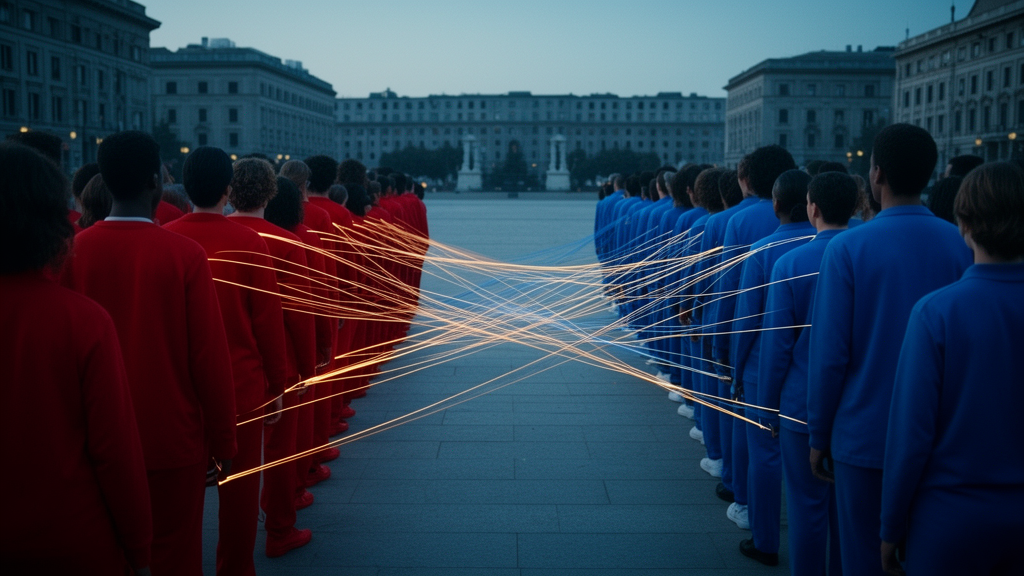
Americans increasingly encounter the same national political battles no matter where they live, and a new study in PLOS Complex Systems suggests that this nationalization of politics interacts with the architecture of social networks in ways that determine not only how deeply partisan polarization takes hold but also how long it persists. The research, authored by Jing Li, is the first to systematically model how different social network structures combine with increasingly nationalized partisan interactions to produce sustained polarization, moving beyond earlier work that linked nationalization to polarization without specifying the network mechanisms involved.
The core finding is that polarization is governed by two interchangeable channels of partisan exposure. The first is the volume of local connectivity, captured by a network’s average degree, meaning the average number of connections each person has. The second is the strength of the national signal, captured by the level of nationalization, meaning the extent to which political information and partisan cues come from shared national sources rather than local ones. Crucially, these two channels can substitute for one another: a society can reach the same level and speed of polarization through many local connections with weak national signals, or through fewer local connections with strong national signals.
This interchangeability has an important implication for how scholars and commentators should interpret the polarization of recent decades. As national media, national campaigns, and national party organizations have come to dominate political communication, the national signal has grown stronger, and this alone can drive polarization even if the underlying network of personal contacts remains unchanged. Conversely, in a world of dense local social ties, even a modest national signal can spread partisan attitudes rapidly because each individual transmits political content to many neighbors. The model shows that the level and speed of polarization depend on the combined exposure these two channels provide, rather than on either factor in isolation.
To establish these results, Li ran analyses across a wide range of network specifications, varying network sizes, average degrees, and nationalization levels. This systematic sweep is what distinguishes the study from prior research, which had explored the link between nationalization and polarization but had not examined how different network structures interact with nationalized partisan interactions. By holding the nationalization level fixed while varying network properties, and vice versa, the analysis isolates the distinct contribution of each channel and demonstrates that they operate as substitutes in producing polarization.
The second major contribution of the study concerns durability, not just speed. When Li compared a real-world Facebook network with four theoretical networks, two structural properties emerged as the key determinants of how long polarization lasts once it arises. The first is mixing speed, measured formally as algebraic connectivity, which describes how quickly information, influence, or attitudes can diffuse across the entire network. The second is community structure, measured as modularity, which describes how sharply the network divides into densely connected clusters with sparse connections between them.
These two properties shape polarization’s persistence in intuitive ways. A network with high algebraic connectivity mixes rapidly, so partisan attitudes spread quickly, but rapid mixing also means that opposing views encounter one another frequently, which in the model’s dynamics affects whether polarization settles into a stable state. A network with high modularity, by contrast, traps people within like-minded communities where they mostly encounter reinforcing views, allowing polarized clusters to endure even when the national signal is weak. The comparison between the Facebook network and the theoretical alternatives shows that real social media networks occupy a distinctive position in this structural space, with consequences for the durability of the divisions they host.
Perhaps the most striking conclusion is that network structure is a genuine but second-order contributor to polarization. Its influence is greatest when nationalization is low. In that regime, the details of who is connected to whom, how densely people are tied, and how clustered the network is, matter substantially for whether partisan attitudes diverge. But as nationalization strengthens, the powerful national signal increasingly overwhelms these structural differences, and networks of very different architectures converge toward similar polarization outcomes. Polarization, in other words, is best understood as the emergent product of nationalization and connectivity, with structure playing a supporting role whose importance fades as national signals intensify.
This hierarchy of effects helps reconcile competing explanations for American polarization. Some accounts emphasize media environments and nationalized elite messaging, while others stress social sorting, echo chambers, and the clustering of like-minded people into separate communities. The model suggests both are partly right, but they operate at different levels of priority. Nationalization and average connectivity form the first-order engine that drives the level and speed of polarization, while modularity and algebraic connectivity determine the texture and persistence of the divisions that result. A highly modular network can lock in polarization that a national signal started, and a fast-mixing network can accelerate its spread, but neither structural feature substitutes for the raw exposure provided by strong national signals and dense local ties.
The technical approach also illustrates why network science is essential for studying political attitudes. Individual-level surveys can document that partisans hold increasingly divergent views, but they cannot reveal how the pattern of social connections transforms exposure into durable division. By simulating partisan interactions on networks of different sizes, densities, and community structures, and under different nationalization levels, the study treats polarization as an emergent property of a coupled system: individuals responding to partisan signals embedded in a specific social topology. The finding that average degree and nationalization are interchangeable channels is precisely the kind of result that only becomes visible when network structure is modeled explicitly rather than assumed away.
For anyone worried about the health of democratic politics, the study offers a sobering but clarifying message. Reducing polarization is not simply a matter of fixing one lever. Weakening the national signal would help, but so would altering the density of local social connectivity, and the two channels reinforce each other in producing exposure to partisan content. Meanwhile, the structural features that make polarization durable, such as strong community boundaries and particular mixing speeds, may persist long after the national signal that triggered the division has faded. Understanding polarization as the emergent product of nationalization and connectivity, with network structure as a second-order but real contributor, provides a more complete map of the problem than either a purely media-centered or a purely social-structural account can offer.
Subject of Research: How nationalization of politics and social network structure interact to produce sustained partisan polarization
Article Title: Nationalization, network structure and partisan polarization
Article References: Li, J. (2026). Nationalization, network structure and partisan polarization. PLOS Complex Systems, 3(8), e0000121. https://doi.org/10.1371/journal.pcsy.0000121
Image Credits: AI Generated
DOI: 10.1371/journal.pcsy.0000121
Keywords: partisan polarization, nationalization, social networks, network structure, algebraic connectivity, modularity, average degree, political communication, echo chambers, complex systems, agent-based modeling, Facebook network
Cite Scienmag News
Reid Dalton. (October 9, 2026). How Nationalized Politics and Network Structure Lock In Partisan Polarization. Scienmag. https://scienmag.com/how-nationalized-politics-and-network-structure-lock-in-partisan-polarization/
Reid Dalton. "How Nationalized Politics and Network Structure Lock In Partisan Polarization." Scienmag, 9 October 2026, https://scienmag.com/how-nationalized-politics-and-network-structure-lock-in-partisan-polarization/. Accessed 9 October 2026.
Reid Dalton. "How Nationalized Politics and Network Structure Lock In Partisan Polarization." Scienmag. October 9, 2026. https://scienmag.com/how-nationalized-politics-and-network-structure-lock-in-partisan-polarization/


