


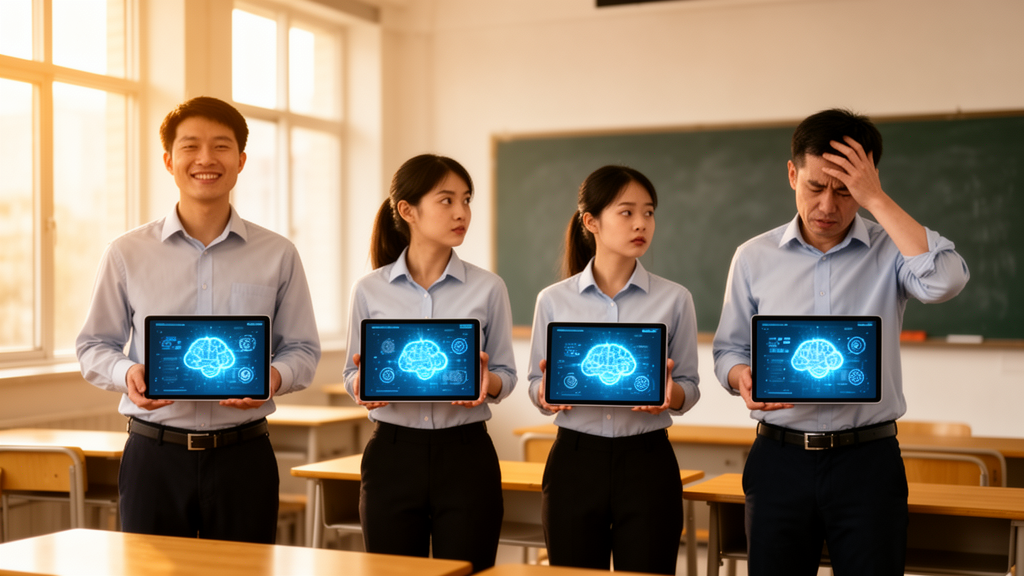
Artificial intelligence has swept into classrooms around the world, but few groups have felt the pressure of that transition more acutely than vocational education teachers in China. Unlike their counterparts in general academic schools, vocational instructors must simultaneously master AI tools for classroom teaching, adapt hands-on practical training to automated and intelligent technologies, and manage the emotional strain of preparing students for a labor market being reshaped in real time. A new study published in BMC Psychology by Jiamiao Hu and Sheng Zhou of Jinhua University of Vocational Technology offers one of the most detailed portraits yet of how these teachers are coping, and its central finding is striking: teachers do not experience AI competence as a single sliding scale of confidence, but as four sharply distinct psychological profiles, each with its own consequences for how happy and healthy they feel at work.
The research team surveyed 768 in-service teachers drawn through a regionally stratified online sampling design, with 378 working in secondary vocational schools and 390 in higher vocational colleges across eastern, central, and western mainland China. Rather than treating AI self-efficacy as a single score, the researchers used the six-dimensional Teacher Artificial Intelligence Competence Self-Efficacy Scale, known as TAICS, which measures a teacher’s confidence in six separate domains: AI knowledge, AI pedagogy, AI assessment, AI ethics, professional engagement, and human-centered education. Occupational well-being was captured with the Teacher Subjective Well-Being Questionnaire, and AI anxiety was assessed with a version of the AI Anxiety Scale adapted specifically to the teaching context. The study was approved by the Institutional Review Board of Jinhua University of Vocational Technology and conducted in accordance with the Declaration of Helsinki, with all participants providing electronic informed consent.
The methodological heart of the study is latent profile analysis, a statistical technique that sorts individuals into unobserved subgroups based on their response patterns across multiple dimensions. Instead of asking whether a single variable predicts another, latent profile analysis asks whether the population contains meaningful types. Before running those models, the team used multi-group confirmatory factor analysis to verify that the TAICS scale measured the same construct the same way in secondary and higher vocational settings, and the scale achieved full scalar measurement invariance across school levels. That technical result matters: it means any differences found between school types reflect genuine differences in teachers’ confidence rather than artifacts of how the questionnaire functions in different institutions.
When the models were fitted in Mplus, four distinct profiles emerged, and the researchers gave them vivid names. The first, Foundational Stage, accounted for 21.4 percent of teachers and showed uniformly low confidence across all six dimensions. The second, Technically Skilled but Ethically Cautious, also 21.4 percent, paired solid technical confidence with marked hesitation in the ethical and human-centered domains. The third, Pedagogically Engaged but Technically Constrained, was the mirror image, comprising 25.7 percent of teachers who felt capable of guiding learning with AI but doubted their technical mastery. The largest group, Holistic Competence, at 31.6 percent, showed broadly balanced and high confidence across all six dimensions. The fact that nearly half of the teachers fell into the two lopsided middle profiles is arguably the study’s most consequential discovery, because it suggests that competence in AI is not developing evenly even within the same workforce.
The link to well-being was unambiguous. Scores on the Teacher Subjective Well-Being Questionnaire rose monotonically across the four profiles, from a mean of 2.74 in the Foundational Stage group to 3.04 in the Technically Skilled group, 3.17 in the Pedagogically Engaged group, and 3.43 in the Holistic Competence group. Pairwise effect sizes, computed as Cohen’s d using pooled within-class standard deviations, ranged from 0.39 to 2.06, meaning the gap between the lowest and highest profiles was not merely statistically detectable but enormous by conventional standards. Teachers who feel capable across the full spectrum of AI-related demands, from technical operation to ethical judgment to human-centered care, report markedly better occupational well-being than those struggling at the foundation level.
But the study’s most intriguing twist involves anxiety. The researchers hypothesized that AI anxiety might moderate, or alter, the relationship between competence profiles and well-being, and they tested this using covariate and distal-outcome approaches, specifically the R3STEP method for incorporating covariates and the BCH posterior-probability-weighted method for linking profiles to continuous outcomes. The moderation was significant only for the Holistic Competence profile, with an unstandardized coefficient of minus 0.13 that was significant at p below .001. For the Technically Skilled group the interaction fell just short of significance at B of minus 0.07, p equal to .062, and for the Pedagogically Engaged group it did not reach significance either. Overall, the interaction accounted for a small share of variance, a delta R-squared of 0.012.
What does that moderation mean in practical terms? The well-being advantage enjoyed by the Holistic Competence group over the Foundational Stage group shrank by roughly one third across the observed range of AI anxiety. In other words, even the most confident and best-rounded teachers are not immune to the corrosive effect of anxiety about AI. The researchers interpret this cautiously, noting that the cross-sectional design prevents any claim about causation. Anxiety may erode the benefits of competence, or low well-being may feed anxiety, or both may stem from unmeasured factors such as institutional support, workload, or access to training. Still, the pattern fits the Job Demands-Resources framework that the authors apply to AI-in-education research: AI competence functions as a personal resource that buffers job demands, while anxiety acts as a demand-like strain that can undercut even abundant resources.
The findings arrive at a moment when China’s vocational education system is under intense pressure to digitalize. Vocational teachers are expected to integrate intelligent manufacturing tools, AI-assisted assessment, and adaptive learning platforms into curricula designed to produce job-ready graduates, all while the skills those graduates need are shifting beneath their feet. The study’s profile structure suggests that one-size-fits-all training programs are likely to miss the mark. A teacher in the Technically Skilled but Ethically Cautious profile does not need another workshop on operating AI software; that teacher needs support in navigating questions of fairness, privacy, and the human purpose of education. Conversely, a Pedagogically Engaged but Technically Constrained teacher needs hands-on technical scaffolding, not more philosophy. Matching interventions to profiles, the authors argue, is more efficient and more humane than blanket upskilling.
The anxiety findings carry their own policy implication. Because the well-being premium of holistic competence is attenuated at high levels of AI anxiety, competence-building alone may be insufficient. The authors suggest pairing development programs with anxiety-mitigation strategies, which could include transparent communication about how AI will and will not be used in evaluation, peer support networks, and gradual, supported exposure to AI tools rather than abrupt mandates. The small overall variance explained by the interaction, however, is a reminder that anxiety is one factor among many, and the authors are careful not to overstate its role.
Like all cross-sectional research, the study captures a single moment in a fast-moving transition, and the authors explicitly frame their moderation result as an association to be interpreted cautiously rather than a causal claim. Future longitudinal work could track whether teachers move between profiles as they gain experience, whether anxiety precedes or follows competence gaps, and whether the four-profile structure replicates in other countries and educational sectors. What the study establishes firmly is that the human side of the AI transition in education is not uniform. Behind the aggregate statistics on teacher AI readiness lie four distinct populations with different needs, and the teachers who have achieved the most complete command of AI are, paradoxically, the ones whose hard-won well-being advantage is most vulnerable to being eaten away by fear of the very technology they have mastered. Understanding that paradox, the authors suggest, may be the key to helping educators not just survive the AI era but thrive in it.
Subject of Research: AI teaching self-efficacy profiles and occupational well-being among Chinese vocational education teachers
Article Title: Latent profiles of AI teaching self-efficacy and their associations with occupational well-being among vocational education teachers in China: the moderating role of AI anxiety
Article References: Hu, J., & Zhou, S. (2026). Latent profiles of AI teaching self-efficacy and their associations with occupational well-being among vocational education teachers in China: the moderating role of AI anxiety. BMC Psychology. https://doi.org/10.1186/s40359-026-05721-w
Image Credits: AI Generated
DOI: 10.1186/s40359-026-05721-w
Keywords: AI teaching self-efficacy, vocational education, teacher well-being, AI anxiety, latent profile analysis, China, Job Demands-Resources theory, teacher psychology, AI in education, BMC Psychology, survey research, professional development
Cite Scienmag News
Glenn Wilkins. (October 9, 2026). AI Confidence Divides Chinese Vocational Teachers Into Four Distinct Profiles, With Anxiety Eroding the Biggest Well-Being Gains. Scienmag. https://scienmag.com/ai-confidence-divides-chinese-vocational-teachers-into-four-distinct-profiles-with-anxiety-eroding-the-biggest-well-being-gains/
Glenn Wilkins. "AI Confidence Divides Chinese Vocational Teachers Into Four Distinct Profiles, With Anxiety Eroding the Biggest Well-Being Gains." Scienmag, 9 October 2026, https://scienmag.com/ai-confidence-divides-chinese-vocational-teachers-into-four-distinct-profiles-with-anxiety-eroding-the-biggest-well-being-gains/. Accessed 9 October 2026.
Glenn Wilkins. "AI Confidence Divides Chinese Vocational Teachers Into Four Distinct Profiles, With Anxiety Eroding the Biggest Well-Being Gains." Scienmag. October 9, 2026. https://scienmag.com/ai-confidence-divides-chinese-vocational-teachers-into-four-distinct-profiles-with-anxiety-eroding-the-biggest-well-being-gains/


