


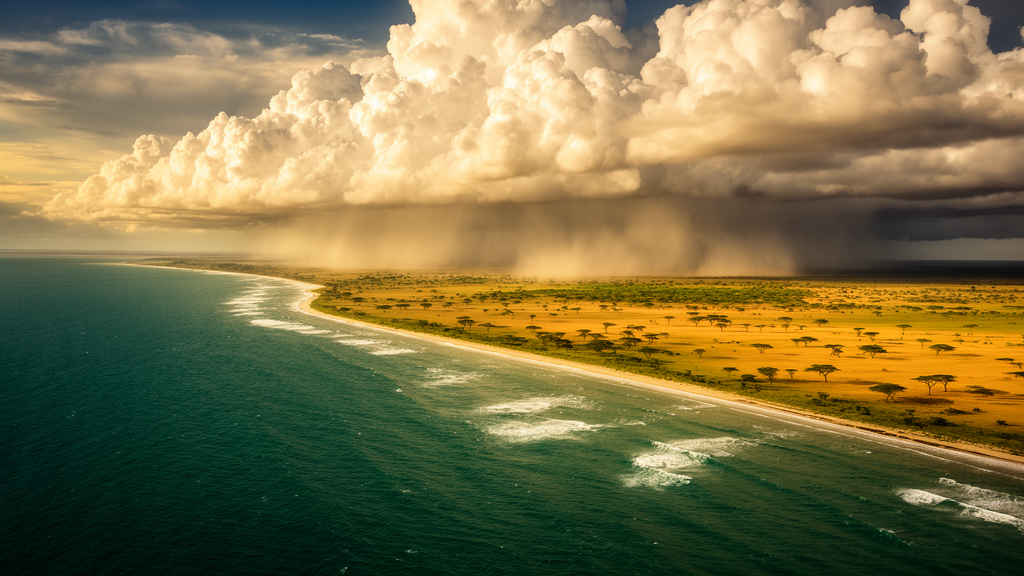
Few climate stories are as dramatic as the swings of rainfall across the Sahel, the semi-arid belt that stretches across Africa just south of the Sahara. In the 1950s and 1960s, the region enjoyed abundant rains; by the 1970s and 1980s, devastating droughts had displaced communities and starved crops. Since then, rainfall has partially recovered, and extreme downpours have become more frequent. A new study published in Weather and Climate Dynamics by Elsa Mohino of the Universidad Complutense de Madrid and her colleagues now offers one of the clearest physical explanations yet for why the North Atlantic Ocean holds such power over this fragile rain regime, and it does so by tracking something deceptively simple: energy.
The team focused on the Atlantic Multidecadal Variability, or AMV, a natural fluctuation in which North Atlantic sea surface temperatures swing warm and cool over periods of several decades. Scientists have long known that the AMV explains between roughly 40 and 65 percent of Sahel rainfall variability at decadal timescales, and that its positive phase, marked by warmer-than-normal North Atlantic waters, brings wetter conditions to the Sahel. What has remained contentious is the precise chain of physical mechanisms connecting ocean warmth to African rain, particularly the roles of the Saharan Heat Low and a shallow circulation that sits above the Sahara.
To isolate the AMV signal, the researchers turned to an unusually comprehensive modelling experiment. They analysed simulations from thirteen coupled atmosphere-ocean models in which North Atlantic sea surface temperatures, between 10 and 65 degrees north, were artificially restored to an idealised AMV pattern. Half the runs imposed the warm positive phase and half the cool negative phase, allowing the team to compute the difference and extract a clean response. Because the observational record is short, reanalyses misrepresent Sahel multidecadal variability, and other ocean basins muddy the picture, this idealised framework is one of the few reliable ways to pin down cause and effect. Two models that behaved unrealistically were excluded, leaving eleven for the main analysis.
The headline result is unambiguous: every model simulated increased Sahel rainfall in response to the warm North Atlantic, with a multimodel mean increase of about 0.10 millimetres per day during the July-to-September peak season, roughly five percent of the climatological average. More importantly, the team showed that this wetting is best described not as a simple intensification of rain but as a northward shift of the entire tropical rain belt, the Intertropical Convergence Zone, over West Africa. When the researchers decomposed the rainfall changes into components representing shifts versus amplitude changes, about seventy percent of the Sahel response came from the shift itself.
Why should a northward-shifted rain band follow from warmer northern waters? The answer lies in the atmospheric energy budget. Warmer sea surfaces evaporate more water, and evaporation carries latent heat into the air. In the simulations, the net energy input into the atmosphere over the North Atlantic rose by about 1.5 watts per square metre, and a remarkable 85 percent of that increase came from enhanced surface latent heat flux. The atmosphere cannot store this surplus locally, so the circulation must export it. The models show the excess energy flowing southward across the equator over Atlantic and African longitudes, a cross-equatorial energy transport that, by well-established theory, pulls the ascending branch of the Hadley circulation, and with it the rain band, toward the north.
The numbers align strikingly with global observations. Scaling the simulated energy transport against the simulated rain-band displacement yields roughly 1.6 degrees of ITCZ shift per petawatt of cross-equatorial transport, closely matching estimates derived from observed interannual variability of the zonally averaged ITCZ. Across models, those that produced the strongest southward energy export also produced the largest Sahel rainfall increases, and models with the greatest North Atlantic energy input generated the strongest transport. The energetic framework thus not only explains the mean response but also accounts for why different climate models disagree, a valuable diagnostic for narrowing future projections.
The study also resolved a long-standing debate about the shallow meridional circulation, a shallow overturning cell over the Sahara that some earlier work suggested intensifies during wet Sahel years. Mohino and colleagues found the opposite: in their simulations the shallow circulation consistently weakens during the positive AMV phase. This matters because the upper branch of that circulation sweeps dry Saharan air southward into the mid-troposphere over the Sahel, exporting moist static energy from the convective region and suppressing deep convection. When the circulation weakens, the dry-air intrusion diminishes, moisture accumulates in the column, and convection deepens into a more vigorous, top-heavy structure capable of producing heavier rain.
The energy budget makes this connection quantitative. Climatologically, horizontal advection of dry air at mid-levels is a major term balancing the energy input over the Sahel. Under a positive AMV, this export weakens, and the compensation must come from enhanced vertical export by the divergent circulation, which is the signature of deeper convection. Intriguingly, the dominant driver of the reduced dry-air advection is not a change in the winds but a change in the moisture field itself: as the rain band shifts north, the whole troposphere moistens, flattening the meridional humidity gradient that the northerly winds previously exploited. Models with the greatest reduction in mid-level dry-air intrusion show the largest rainfall gains, tying the thermodynamic and dynamic responses into a single coherent picture.
The findings carry real weight for a region where millions of lives depend on the timing and intensity of the summer rains. By identifying latent heat flux over the North Atlantic as the energy source that ultimately repositions the West African rain belt, the study suggests that monitoring North Atlantic sea surface temperatures and surface energy exchanges could sharpen decadal forecasts of Sahel rainfall. The energetic framework also offers a template for assessing other drivers, from Arctic sea-ice loss to Southern Ocean warming, whose influences on the Sahel may likewise be expressed through shifts in atmospheric energy transport. And because the same mechanism, a weakened shallow circulation with reduced dry-air intrusion, has been implicated in Sahel rainfall responses to climate change, the work hints that the multidecadal ocean rhythm and the long-term warming trend may push the monsoon through related physical doorways. For a region still recovering from the trauma of twentieth-century drought, understanding where the energy flows may be the key to anticipating where the rain will fall.
Subject of Research: Energetic mechanisms linking Atlantic Multidecadal Variability to Sahel rainfall and the West African Monsoon
Article Title: An energetic perspective on the impact of the Atlantic Multidecadal Variability on the West African Monsoon
Article References: Mohino, E., Monerie, P.-A., Mignot, J., & Bordoni, S. (2026). An energetic perspective on the impact of the Atlantic Multidecadal Variability on the West African Monsoon. Weather and Climate Dynamics, 7(3), 1619-1639. https://doi.org/10.5194/wcd-7-1619-2026
Image Credits: AI Generated
Keywords: Atlantic Multidecadal Variability, West African Monsoon, Sahel rainfall, ITCZ, latent heat flux, cross-equatorial energy transport, moist static energy, shallow meridional circulation, Saharan Heat Low, climate models, Hadley circulation, decadal variability
Cite Scienmag News
Russell Cooper. (October 9, 2026). How a Warmer North Atlantic Supercharges Sahel Rainfall Through an Atmospheric Energy Shift. Scienmag. https://scienmag.com/how-a-warmer-north-atlantic-supercharges-sahel-rainfall-through-an-atmospheric-energy-shift/
Russell Cooper. "How a Warmer North Atlantic Supercharges Sahel Rainfall Through an Atmospheric Energy Shift." Scienmag, 9 October 2026, https://scienmag.com/how-a-warmer-north-atlantic-supercharges-sahel-rainfall-through-an-atmospheric-energy-shift/. Accessed 9 October 2026.
Russell Cooper. "How a Warmer North Atlantic Supercharges Sahel Rainfall Through an Atmospheric Energy Shift." Scienmag. October 9, 2026. https://scienmag.com/how-a-warmer-north-atlantic-supercharges-sahel-rainfall-through-an-atmospheric-energy-shift/


