


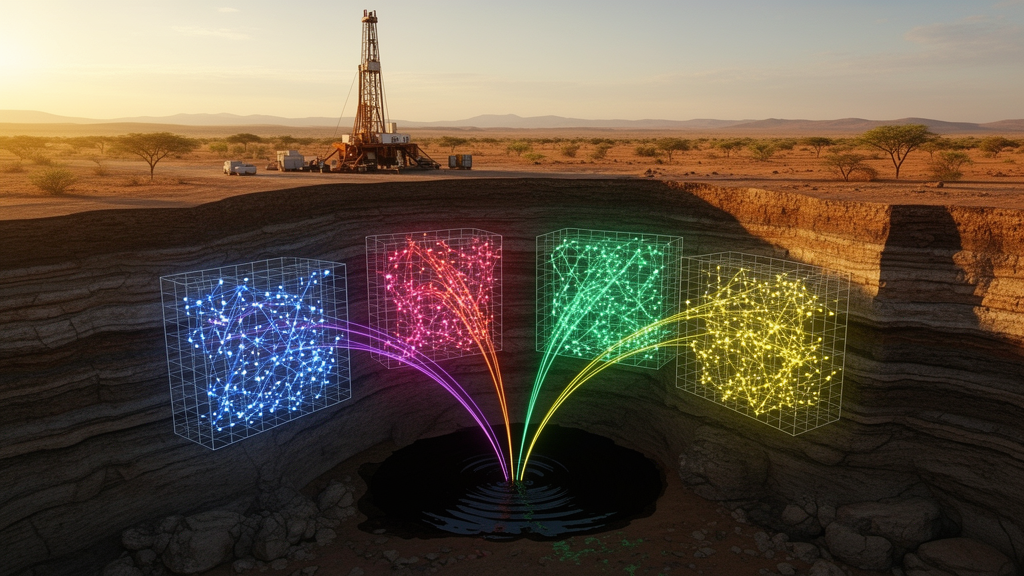
Beneath the plains of eastern Venezuela lies a reservoir of clastic rock, its sand and shale layers saturated with brine and oil, its properties known only indirectly through the faint echoes of seismic waves that bounce off its boundaries. Turning those echoes into reliable numbers — how fast compressional and shear waves travel through each layer, and how dense the rock is — is the central task of prestack seismic inversion. It is a notoriously ill-posed problem: many different underground models can produce nearly identical seismic traces, and small amounts of noise in the data can push the answer in wildly different directions. A new study published in Nonlinear Processes in Geophysics by Richard Perez-Roa, Saba Infante, Gabriel Barragan, and Raul Manzanilla of Yachay Tech University in Ecuador tackles this ambiguity head-on by asking a deceptively simple question: of the four most widely used Markov Chain Monte Carlo sampling algorithms, which one should a geophysicist actually choose?
The team’s answer matters because the stakes of seismic inversion extend far beyond academic curiosity. The three elastic parameters at issue — P-wave velocity, S-wave velocity, and density — are the raw ingredients from which geophysicists derive indicators of fluid content, porosity, and hydrocarbon saturation. Traditional deterministic inversion methods, such as least-squares approaches, deliver a single best-fitting model but say little about how confident one should be in it. Bayesian inference offers a different philosophy: instead of one answer, it produces an entire probability distribution over plausible underground models, blending prior geological knowledge with the information contained in the seismic data itself. The catch is that this posterior distribution cannot be written down analytically for realistic problems, so researchers must sample from it using Markov Chain Monte Carlo methods — and the choice of sampler shapes both the quality of the answer and the size of the computing bill.
The four contenders in this statistical showdown represent distinct generations of sampling technology. The oldest and simplest is the Metropolis-Hastings algorithm, developed in the 1950s and 1970s, which explores the model space by random walks: it proposes a random perturbation of the current model and accepts or rejects it according to a probability ratio. It requires no gradient calculations, making it cheap per step, but in high-dimensional spaces its drunken-wander behavior means samples are highly correlated and convergence is slow. At the other extreme sits Hamiltonian Monte Carlo, borrowed from molecular dynamics, which endows each model with an auxiliary momentum variable and simulates frictionless motion across an energy landscape defined by the negative logarithm of the posterior. By following the gradient of that landscape, HMC proposes bold, physically informed moves that traverse the parameter space far more efficiently — provided the gradients are computed correctly and the step sizes are tuned with care.
Between these poles lie two Langevin-based methods rooted in the mathematics of Brownian motion, the theory Paul Langevin formulated in 1908 as a simplification of Einstein’s treatment of jittering particles. The Metropolis-Adjusted Langevin Algorithm, or MALA, discretizes a stochastic differential equation whose drift term pulls each proposal toward regions of higher posterior probability, then applies a Metropolis acceptance step to remove discretization bias. Its newer variant, Lip-MALA, goes further: it adapts the step length at every iteration according to a Lipschitz condition, automatically shrinking steps where the posterior landscape changes abruptly and enlarging them where it is smooth. This dynamic tuning, the authors note, improves stability and mixing in the high-dimensional posteriors that seismic inversion generates, where the number of unknowns scales with the number of layers in the model.
The forward physics connecting models to data is the Aki-Richards approximation, the workhorse equation of amplitude-versus-offset analysis that emerged in the early 1980s. It expresses the reflection coefficient at each rock interface as a linearized function of the contrasts in P-wave velocity, S-wave velocity, and density, weighted by angle-dependent coefficients. The researchers worked in a logarithmic parameterization — inverting for the logarithms of the three elastic parameters — which guarantees physically sensible positive values and dovetails naturally with the structure of the Aki-Richards equations. Working at three incidence angles, they assembled a matrix operator that converts any candidate model into synthetic seismic traces, then measured how well those traces match the observed data through a Gaussian likelihood combined with a Gaussian prior built from well logs and low-frequency velocity models.
The first arena was a synthetic test: noise-free seismic traces generated from real well-log values at angles of 9, 18.5, and 27.5 degrees, with the true answer known in advance. Each algorithm ran a Markov chain of 10,000 accepted realizations after a burn-in period, and the team judged performance through posterior means, standard deviations, correlation coefficients, root-mean-square errors, acceptance rates, execution times, and a multivariate effective sample size diagnostic to confirm convergence. The results drew a clear dividing line. For velocity estimation, the three gradient-based methods all outperformed Metropolis-Hastings, with HMC achieving the highest correlation and the lowest error. For density, the picture inverted in an unexpected way: MH and HMC both struggled, with correlations below 0.29, while MALA and Lip-MALA delivered correlations above 0.60 and errors roughly a third smaller.
The computational ledger told an equally important story. Metropolis-Hastings was the fastest of the four, despite its statistical clumsiness, because each of its steps is so cheap. HMC was the slowest, its long Hamiltonian trajectories and repeated gradient evaluations exacting a heavy price in wall-clock time — and it also recorded the lowest acceptance rate. Lip-MALA, by contrast, posted the highest acceptance rate of all four algorithms, a sign that its adaptive step control consistently proposes moves the posterior is willing to accept. MALA ran quickly as well. The trade-off, in short, was stark: gradient information buys accuracy, but the bill arrives in computing hours.
Synthetic benchmarks, however, can flatter an algorithm. The decisive test came from real data: an oil field in eastern Venezuela’s Eastern Basin, where alternating sandstones and shales host brine and oil, and where partial-stack seismic traces at angles of 19, 24, and 29 degrees had to be tied to upscaled well logs — a correlation of 0.55 that reflects the messiness of field data. Here the same hierarchy largely held. Metropolis-Hastings again showed the weakest velocity correlations, while Lip-MALA achieved the highest and the lowest errors, and the Langevin pair again dominated density estimation, with correlations above 0.48 where MH and HMC fell below 0.28. The team then scaled the problem to two dimensions, inverting a grid of 351 time samples by 136 horizontal cells over a 340-meter span, using a prior model built from interpreted horizons and faults. In this more realistic setting, HMC redeemed itself: its long trajectories navigated the rougher, more heterogeneous posterior landscape better than local Langevin steps, producing the lowest posterior standard deviations for all three parameters — though at the highest computational cost, with Lip-MALA offering the best compromise between precision and efficiency.
The practical guidance that emerges is refreshingly concrete. When speed matters most — rapid screening of frontier areas with poor well control, or near-real-time decisions during drilling — Metropolis-Hastings or MALA remain defensible choices despite their statistical limitations. When fidelity is paramount, as in mature fields where drilling and production decisions hinge on accurate elastic properties, HMC earns its runtime, particularly in two-dimensional and higher-dimensional problems where its ability to traverse multi-basin posterior landscapes reduces global uncertainty. Lip-MALA stands out as the algorithm for practitioners who want gradient-informed accuracy without HMC’s price tag, and as the most reliable option for the stubborn problem of density estimation. The authors also offer a methodological caution: researchers should report both pointwise fit and uncertainty measures, because an algorithm that wins on one metric can lose on another, and choosing the wrong yardstick can make the best tool look like the worst.
Beyond the rankings, the study demonstrates something conceptually larger: that the full Bayesian machinery — priors, likelihoods, posterior sampling, and rigorous convergence diagnostics — can be carried from idealized synthetic exercises all the way to geologically complex field data, delivering not just pictures of the subsurface but honest probability distributions over what lies there. The framework is not locked to its simplifying assumptions of one-dimensional layered models and linearized reflectivity; the authors point out that more sophisticated forward modeling and petrophysical relationships can be slotted into the same statistical skeleton. As exploration moves into ever more challenging terrain, and as computing resources grow, the quiet contest between random walks, Hamiltonian trajectories, and Langevin diffusion may well determine how clearly the industry can see what it is drilling toward.
Subject of Research: Comparison of Markov Chain Monte Carlo algorithms for Bayesian prestack seismic inversion of elastic properties
Article Title: Bayesian inference based on algorithms: MH, HMC, MALA and Lip-MALA for prestack seismic inversion
Article References: Bayesian inference based on algorithms: MH, HMC, MALA and Lip-MALA for prestack seismic inversion. (n.d.). https://doi.org/10.5194/npg-33-173-2026
Image Credits: AI Generated
Keywords: seismic inversion, Bayesian inference, Markov Chain Monte Carlo, Metropolis-Hastings, Hamiltonian Monte Carlo, MALA, Lip-MALA, AVO, elastic properties, reservoir characterization, Venezuela, geophysics
Cite Scienmag News
Violet Maxwell. (October 9, 2026). Four Monte Carlo Algorithms Face Off in the Hunt for Oil Beneath Venezuela. Scienmag. https://scienmag.com/four-monte-carlo-algorithms-face-off-in-the-hunt-for-oil-beneath-venezuela/
Violet Maxwell. "Four Monte Carlo Algorithms Face Off in the Hunt for Oil Beneath Venezuela." Scienmag, 9 October 2026, https://scienmag.com/four-monte-carlo-algorithms-face-off-in-the-hunt-for-oil-beneath-venezuela/. Accessed 9 October 2026.
Violet Maxwell. "Four Monte Carlo Algorithms Face Off in the Hunt for Oil Beneath Venezuela." Scienmag. October 9, 2026. https://scienmag.com/four-monte-carlo-algorithms-face-off-in-the-hunt-for-oil-beneath-venezuela/


