


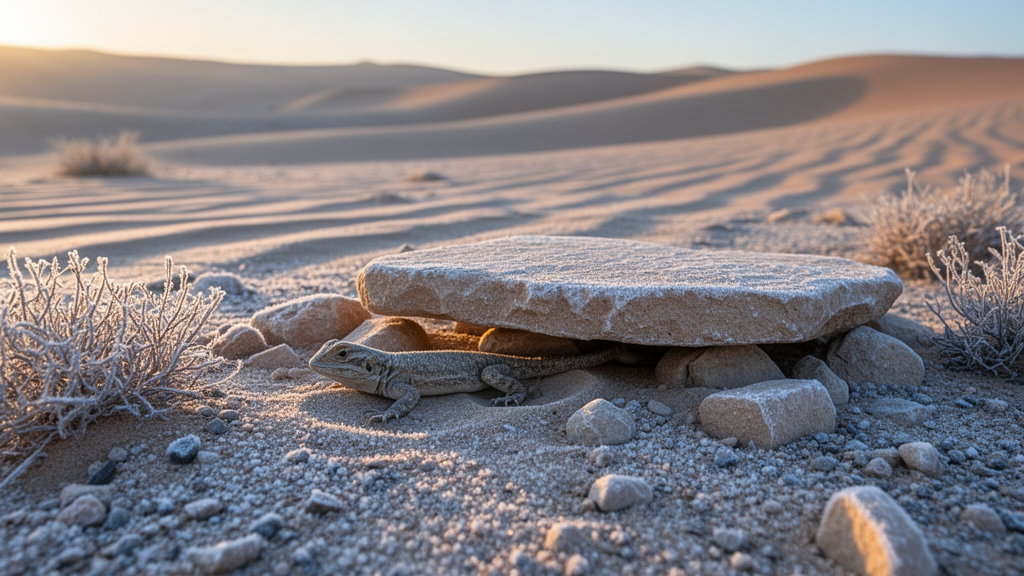
When winter descends on Egypt’s deserts, the lizards that thrive there do not simply slow down. They enter brumation, a reptilian form of hibernation in which metabolism, activity, and feeding are suppressed for months to survive cold temperatures and the near-total absence of food. A new study published in Environmental Science and Pollution Research has taken one of the closest looks yet at what this seasonal shutdown does to the kidneys of four Egyptian desert species, and the results reveal a strikingly species-specific picture of damage, remodeling, and biochemical defense. The work, led by Amira R. Hammad of Kafrelsheikh University together with colleagues at Kafrelsheikh and Tanta Universities, combined classical histology, quantitative morphometry, oxidative stress biochemistry, and gene expression analysis to build a layered portrait of renal life during dormancy.
The team examined four desert-dwelling reptiles that occupy different ecological niches and differ in how deeply and reliably they brumate: the Egyptian spiny-tailed lizard Uromastyx aegyptia, the desert monitor Varanus griseus, Savigny’s agama Trapelus savignii, and the ringed wall gecko Tarentola annularis. For each species, kidney tissue was collected during the active season and again during brumation, allowing direct within-species comparison. This design matters because brumation is not a uniform state across reptiles. Some species are obligate brumators that reliably spend the entire cold season dormant, while others are more facultative, emerging during warm spells and adjusting their dormancy to prevailing conditions. The researchers hypothesized that this behavioral difference might be mirrored in the intensity of the physiological responses they measured.
Under the microscope, the brumating kidneys showed clear signs of degeneration. The authors report glomerulosclerosis, a scarring and hardening of the glomeruli, the tufts of capillaries where blood filtration begins, along with necrotic renal tubules and cytoplasmic vacuolization, in which the cells lining the tubules accumulate fluid-filled spaces. These changes echo earlier observations in hibernating mammals, where renal tissue undergoes structural remodeling during cold ischemia and then recovers on arousal. In mammals such as ground squirrels and bears, the kidney has become a natural model of organ preservation, because it tolerates months of reduced blood flow and low temperature without permanent injury. The Egyptian lizards appear to be running a comparable program, with structural changes that look damaging in a snapshot but are presumably reversible when the animals rewarm in spring.
Morphometric analysis, in which structures are measured and compared statistically, revealed that the direction of renal change was not uniform across species. Glomerular diameter decreased significantly during brumation in Uromastyx aegyptia and Tarentola annularis, but increased in Varanus griseus and Trapelus savignii. The proximal tubules, which reabsorb the bulk of the filtrate, widened in T. savignii but narrowed in U. aegyptia. The distal tubules, important for fine-tuning ion and water balance, followed the same split pattern, expanding significantly in T. savignii while contracting in U. aegyptia. In other words, two species shrank their filtration and transport machinery while the other two enlarged theirs, a divergence the authors interpret as species-specific renal adaptation rather than a single universal hibernation phenotype.
Why would closely related desert reptiles remodel the same organ in opposite directions? The answer likely lies in their different water economies and dormancy strategies. Uromastyx aegyptia, a large herbivorous agamid that spends long periods underground, may prioritize water conservation by reducing glomerular filtration, a strategy consistent with seasonal kidney studies in the related Saharan species Uromastyx acanthinura, where winter morphology shifts with body water economy. The desert monitor, an active predator with a wide thermal niche, and the smaller agama may maintain or even expand renal structures to handle intermittent arousal and feeding. Seasonal remodeling of visceral organs is well documented in squamates, including previous work on the same gecko species showing dramatic reshaping of internal organs between seasons, so the kidney appears to be one component of a whole-body seasonal reorganization.
The biochemical side of the story centers on reactive oxygen species. Even when metabolism is depressed, cells continue to leak electrons from mitochondria, and the reoxygenation events that accompany periodic arousal can generate bursts of superoxide and other radicals that damage lipids, proteins, and DNA. The study measured malondialdehyde, or MDA, a standard end product of lipid peroxidation, as an index of oxidative damage. In all four species, MDA rose significantly during brumation, confirming that winter dormancy imposes genuine oxidative stress on reptilian kidneys. This finding aligns with a growing body of literature on hibernating frogs, turtles, toads, and mammals, and with the preparation for oxidative stress hypothesis, which proposes that animals anticipating a stressor preemptively bolster their antioxidant arsenal.
The enzymatic defenses responded, but each species in its own way. Superoxide dismutase, or SOD, which converts superoxide radicals into hydrogen peroxide, and catalase, or CAT, which then splits hydrogen peroxide into water and oxygen, both showed increased activity during brumation, with distinct patterns in each species. At the level of gene expression, SOD transcript abundance increased by 0.77-fold in U. aegyptia, 1.79-fold in V. griseus, 0.12-fold in T. savignii, and 0.51-fold in T. annularis. Catalase expression told an even more divergent tale, rising 5.24-fold in U. aegyptia, 0.86-fold in V. griseus, and 0.35-fold in T. annularis, while actually falling by 0.90-fold in T. savignii. The five-fold catalase upregulation in the spiny-tailed lizard stands out as the strongest single transcriptional response in the dataset.
When the authors sorted the species by dormancy strategy, a pattern emerged. The two obligate brumators, Uromastyx aegyptia and Varanus griseus, showed more consistent upregulation of their antioxidant genes than the facultative species Trapelus savignii and Tarentola annularis. The researchers suggest that the intensity of antioxidant defense correlates with the depth and duration of winter dormancy. An animal that commits to months of uninterrupted cold torpor faces a prolonged oxidative challenge and must invest heavily in enzymatic protection, whereas a species that brumates intermittently may rely more on behavioral buffering, such as basking during warm spells, and less on constitutive molecular defenses. This framing connects the histology and biochemistry to ecology, turning a kidney study into a window on how life histories shape stress physiology.
The broader significance of the work reaches beyond herpetology. Hibernation and brumation are among the most extreme physiological states in the animal kingdom, and understanding how dormant animals protect organs like the kidney has long interested biomedical researchers, because mammalian kidneys suffer severe injury during cold ischemia in transplantation and surgery. Studies of hibernating ground squirrels, bears, and dormice have shown that dormant kidneys are natural models of organ preservation, and the lizard data extend that comparative framework to ectotherms, which experience body temperatures that track their surroundings rather than staying warm. Reptiles may therefore harbor additional, evolutionarily independent solutions to the problem of protecting filtration tissue through cold and hypoperfusion.
There are also conservation and climate dimensions. Desert reptiles already live at the edge of their thermal tolerances, and warming winters could shorten or destabilize brumation, forcing animals to balance energy budgets in new ways, as recent work on hibernating lizards exposed to insecticides and rising temperatures has suggested. If antioxidant capacity is tuned to a particular depth and duration of dormancy, then climate-driven changes in dormancy behavior could leave kidneys mismatched to their oxidative environment. The authors collected and handled all animals under the approval of the Institutional Animal Care and Use Committee of Kafrelsheikh University, and they note that the datasets are available from the corresponding author on reasonable request. For now, the study stands as a detailed demonstration that four lizards sleeping through the same Egyptian winter are, at the level of their kidneys, solving the problem in four different ways.
Subject of Research: Renal histological changes and antioxidant enzyme responses during brumation in four Egyptian desert lizard species
Article Title: Renal histological and antioxidant response in Egyptian desert lizards during brumation
Article References: Hammad, A. R., Mahfouz, M. E., Bakr, S. M., & Alm-Eldeen, A. A. (2026). Renal histological and antioxidant response in Egyptian desert lizards during brumation. Environmental Science and Pollution Research, 33(30), 15298-15309. https://doi.org/10.1007/s11356-026-38195-9
Image Credits: AI Generated
DOI: 10.1007/s11356-026-38195-9
Keywords: brumation, desert lizards, kidney histology, oxidative stress, antioxidant enzymes, superoxide dismutase, catalase, malondialdehyde, gene expression, Uromastyx aegyptia, Varanus griseus, hibernation
Cite Scienmag News
Juliet Wilcox. (October 9, 2026). Egyptian Desert Lizards Rewire Their Kidneys and Antioxidant Defenses to Survive Winter Dormancy. Scienmag. https://scienmag.com/egyptian-desert-lizards-rewire-their-kidneys-and-antioxidant-defenses-to-survive-winter-dormancy/
Juliet Wilcox. "Egyptian Desert Lizards Rewire Their Kidneys and Antioxidant Defenses to Survive Winter Dormancy." Scienmag, 9 October 2026, https://scienmag.com/egyptian-desert-lizards-rewire-their-kidneys-and-antioxidant-defenses-to-survive-winter-dormancy/. Accessed 9 October 2026.
Juliet Wilcox. "Egyptian Desert Lizards Rewire Their Kidneys and Antioxidant Defenses to Survive Winter Dormancy." Scienmag. October 9, 2026. https://scienmag.com/egyptian-desert-lizards-rewire-their-kidneys-and-antioxidant-defenses-to-survive-winter-dormancy/


