


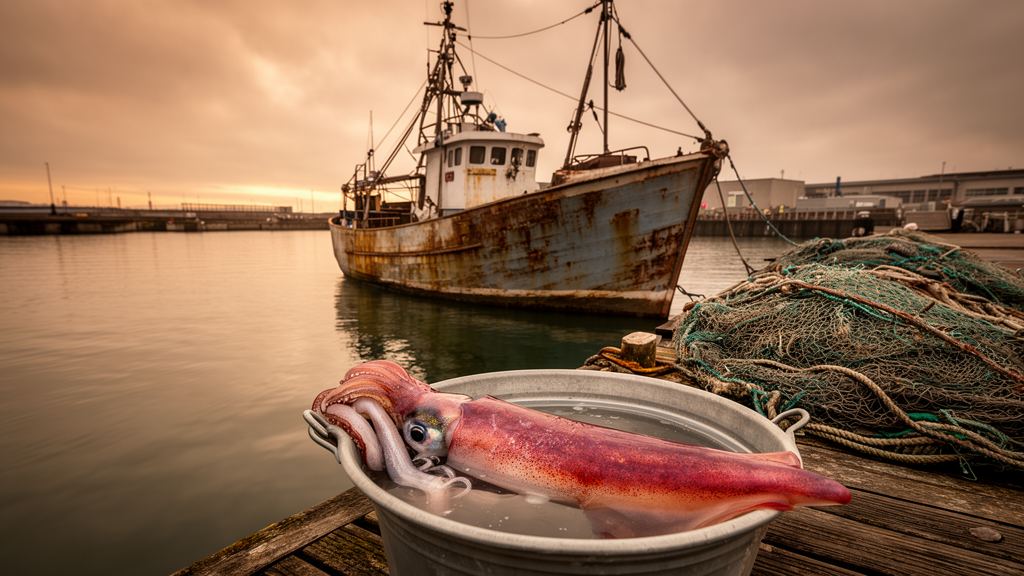
One of the most valuable fisheries in the Northwest Pacific is sending an unmistakable warning signal about what happens to marine ecosystems when ocean temperatures climb beyond the tolerance of the species that sustain them. The Japanese flying squid, Todarodes pacificus, has long anchored commercial fishing across the East Sea, also known as the Sea of Japan, supporting fleets and coastal economies for generations. Now, a new analysis of more than three decades of oceanographic and fisheries data reveals that this iconic fishery has been pushed toward collapse by a cascade of climate-driven forces acting simultaneously: gradual thermal habitat degradation, increasingly severe marine heatwaves, and a rapid influx of a warm-adapted predator into the squid’s traditional grounds.
The study, published in Communications Earth & Environment, draws on multi-decadal observations spanning 1993 to 2025, giving researchers an unusually long window through which to watch a fishery unravel. Rather than attributing the decline to a single cause, the team, led by Seongsik Park of Pukyong National University’s Research Center for Ocean Industrial Development together with colleagues at the National Institute of Fisheries Science and Pukyong National University, traced the collapse through a formal statistical framework known as sequential mediation analysis. This approach allowed them to quantify how rising ocean temperatures transmit their effects through distinct ecological channels before ultimately suppressing squid catches.
The first of those channels is the slow, cumulative erosion of suitable thermal habitat. Japanese flying squid are a short-lived, fast-growing cephalopod species whose population dynamics are acutely sensitive to water temperature, which governs spawning success, egg development, and the growth of paralarvae. As long-term warming has progressively shifted the temperature envelope of the East Sea, the fraction of the region that remains thermally hospitable to the squid has contracted. This kind of habitat degradation does not produce dramatic headlines in any single year, but its steady accumulation steadily narrows the reproductive base of the population, leaving it with less capacity to absorb shocks.
The second pathway is far more abrupt. The researchers identified a striking teleconnection, a long-distance climate link, in which an intensified early-summer La Niña phase of the El Niño-Southern Oscillation amplifies marine heatwaves over the major squid fishing grounds during the following autumn and winter. Marine heatwaves, defined as prolonged periods when sea surface temperatures exceed seasonal thresholds, have become more frequent and intense worldwide as the ocean absorbs the bulk of the excess heat trapped by greenhouse gases. In the East Sea, these events arrive precisely when squid populations are concentrated in the fishing grounds, subjecting them to acute thermal stress that can impair physiology, disrupt migration, and elevate mortality across entire cohorts.
The third pathway is perhaps the most ecologically revealing, because it exposes a trade-off that warming oceans impose on vulnerable species. As waters warmed, Seriola quinqueradiata, the Japanese amberjack, a powerful predatory fish adapted to warmer conditions, rapidly expanded into the squid’s habitat. The study frames this predator influx as an ecological trade-off linked to the same thermal changes that stress the squid: conditions that become more favorable for warm-adapted fish become simultaneously less survivable for the squid, which now faces both direct physiological strain and intensified predation pressure. The combination means the squid is squeezed from two directions at once, its habitat shrinking and its enemies multiplying.
What makes the analysis particularly compelling is the way these three mechanisms interlock. The mediation analysis demonstrated that rising ocean temperatures drive the squid collapse not through a single direct effect but through these interconnected pathways operating in sequence and in parallel. Gradual warming erodes the population’s baseline resilience, heatwaves deliver acute shocks that can decimate a year class, and the predator influx converts thermal stress into additional mortality. A population weakened by one mechanism has little margin left to withstand the others, which is precisely the signature of a cascading collapse rather than a simple decline.
The implications extend well beyond the East Sea. The authors describe the squid fishery’s trajectory as an early warning for climate-driven species replacements in warming oceans, a phenomenon likely to recur wherever commercially important species sit near the warm edge of their thermal tolerance. Short-lived pelagic species such as squids are especially instructive in this regard, because their populations turn over within a single year, meaning that environmental signals are translated into catch statistics almost immediately. Long-lived fish can buffer bad years with surviving adults; squid cannot, so their fisheries function as sensitive barometers of ocean change.
Perhaps the most sobering finding comes from the study’s forward-looking component. Climate model projections indicate that under unabated warming, the risk of the regional squid fishery reaching a zero-catch state increases substantially by the 2040s, and critically, this elevated risk emerges across multiple emissions scenarios. That robustness across scenarios matters: it suggests that even substantial near-term reductions in greenhouse gas emissions may not fully avert the threat to this fishery within the next two decades, although the pace and severity of decline would still depend on the emissions pathway humanity follows. The window for adaptation, however, is closing.
The researchers argue that these findings underscore the urgent need for transboundary, climate-adaptive management of the fishery. Japanese flying squid migrate across national jurisdictions in the Northwest Pacific, meaning that no single country can protect the population alone. Climate-adaptive management would require fishing quotas and seasonal closures that respond dynamically to ocean conditions rather than fixed historical baselines, coordinated monitoring of marine heatwave forecasts, and international agreements that anticipate shifting stock distributions instead of reacting to them after catches have already crashed. The study was supported by the Korea Institute of Marine Science & Technology Promotion, funded by the Ministry of Oceans and Fisheries of Korea, reflecting the growing institutional recognition that fisheries science must now be climate science.
For the fishing communities that depend on the East Sea’s squid grounds, the message of this research is difficult to ignore. The collapse they have witnessed is not the result of overfishing alone or of natural variability alone, but of a climate system reshaping the thermal architecture of the ocean faster than the species within it can adapt. The Japanese flying squid, a species that has sustained one of the region’s defining fisheries, is being displaced by warming waters, battered by heatwaves, and hunted by newcomers from the south. Whether its fishery survives the 2040s will depend not only on the trajectory of global emissions but on whether the nations bordering these waters can act, together and quickly, on the warning that the ocean has already delivered.
Subject of Research: Climate-driven collapse of the Japanese flying squid fishery in the East Sea through thermal habitat loss, marine heatwaves, and predator influx
Article Title: Cascading fishery collapse associated with thermal habitat degradation, marine heatwaves, and predator influx
Article References: Park, S., Yoon, S., Lee, I.-C., & Kim, K. (2026). Cascading fishery collapse associated with thermal habitat degradation, marine heatwaves, and predator influx. Communications Earth & Environment. https://doi.org/10.1038/s43247-026-04110-w
Image Credits: AI Generated
DOI: 10.1038/s43247-026-04110-w
Keywords: Japanese flying squid, fishery collapse, marine heatwaves, La Niña, ocean warming, thermal habitat degradation, Japanese amberjack, East Sea, climate change, mediation analysis, fisheries management, species replacement
Cite Scienmag News
Violet Maxwell. (October 9, 2026). Warming Seas, Heatwaves and a Hungry Predator Drove a Squid Fishery to the Brink. Scienmag. https://scienmag.com/warming-seas-heatwaves-and-a-hungry-predator-drove-a-squid-fishery-to-the-brink/
Violet Maxwell. "Warming Seas, Heatwaves and a Hungry Predator Drove a Squid Fishery to the Brink." Scienmag, 9 October 2026, https://scienmag.com/warming-seas-heatwaves-and-a-hungry-predator-drove-a-squid-fishery-to-the-brink/. Accessed 9 October 2026.
Violet Maxwell. "Warming Seas, Heatwaves and a Hungry Predator Drove a Squid Fishery to the Brink." Scienmag. October 9, 2026. https://scienmag.com/warming-seas-heatwaves-and-a-hungry-predator-drove-a-squid-fishery-to-the-brink/


