


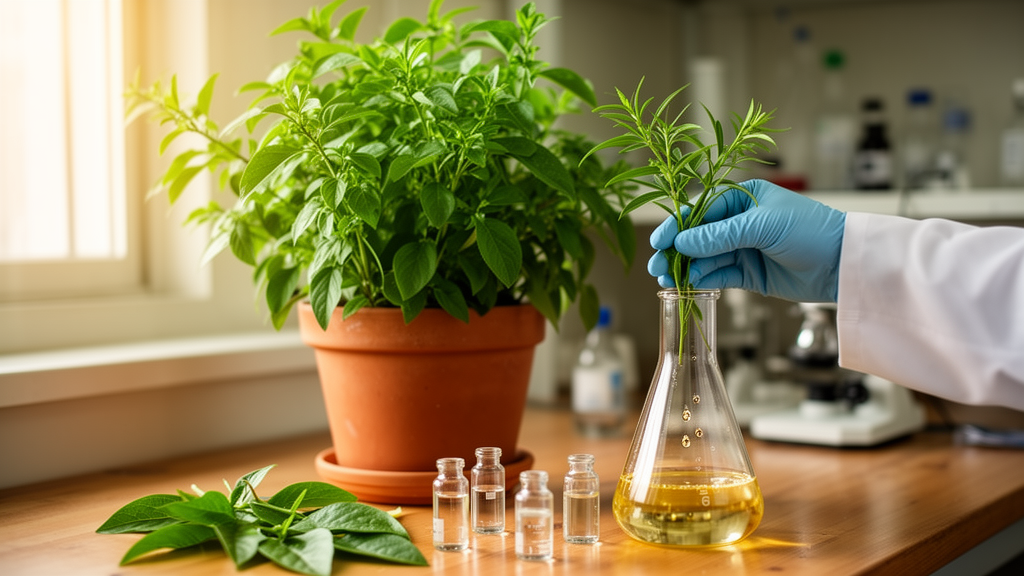
A humble South African medicinal herb known in local languages as the fire extinguisher has just given up one of its best-kept chemical secrets. In a new open-access study published in Discover Chemistry, researchers from Lagos State University in Nigeria, together with collaborators at the Aromatic Plant Research Center in Utah and the University of Alabama in Huntsville, report the first-ever gas chromatography-mass spectrometry characterization of the essential oil distilled from the leaves of Pentanisia prunelloides, a perennial herb in the gardenia family long prized in traditional medicine. The team found that the volatile oil is dominated by sesquiterpenes, most notably trans-alpha-bergamotene, and that it shows measurable, if moderate, antioxidant and blood-sugar-lowering activity in laboratory assays. The findings offer a molecular rationale for a plant whose vernacular names, including setima-mollo in Sotho, icimamlilo in Zulu, and sooibrandbossie in Afrikaans, all refer to its traditional use in putting out internal fires such as fever, inflammation, and heartburn.
The significance of the work lies partly in what had never been done before. Although the roots and leaves of Pentanisia prunelloides have been extensively studied as solvent extracts, with documented antibacterial, antifungal, antiviral, anti-inflammatory, analgesic, antidiabetic, and even cytotoxic properties, no previous research had profiled the essential oil of the leaves or tested that oil for antioxidant and antidiabetic activity. Essential oils are chemically distinct from solvent extracts because they concentrate volatile terpenes and other small lipophilic molecules rather than the tannins, alkaloids, and glycosides found in conventional extracts. Because essential oils are made up of small molecules that readily penetrate cell membranes and skin tissue, they have attracted growing interest as natural antioxidants and as sources of drug leads. The new study fills a genuine gap in the ethnopharmacological record for this species.
To obtain the oil, the researchers collected fresh leaves in August 2025 from Amuloko Village near Ibadan in Oyo State, Nigeria, where the plant was authenticated by a botanist at the Forestry Research Institute of Nigeria and assigned voucher specimen FHI 113211. After air-drying for five days and grinding, 500 grams of powdered leaves were subjected to hydrodistillation for three hours in an all-glass Clevenger apparatus built to British Pharmacopoeia specifications. The pale yellow oil was collected over hexane, dried with anhydrous sodium sulphate, and refrigerated until analysis. The yield was modest at 0.42 percent by volume relative to the dry plant mass, which is typical for leaf essential oils and underscores why large quantities of plant material are usually needed for volatile oil research.
The chemical fingerprinting revealed a remarkably complex mixture. The chromatogram resolved 56 compounds, together accounting for the entire composition of the oil. Sesquiterpene hydrocarbons dominated at 54.71 percent, followed by long-chain hydrocarbons at 13.1 percent, fatty acids at 6.94 percent, oxygenated monoterpenes at 2.92 percent, triterpenes at 1.64 percent, diterpenoids at 0.95 percent, and trace monoterpene hydrocarbons at 0.15 percent. The single most abundant constituent was trans-alpha-bergamotene at 20.43 percent, a cyclic sesquiterpene whose derivatives have been reported to display antidiabetic, anti-inflammatory, antioxidant, antimicrobial, immunosuppressive, cytotoxic, and insecticidal activities. Other major components included 11-methyltricosane at 6.76 percent, alpha-selinene at 6.09 percent, alpha-humulene at 5.91 percent, cis-9-octadecenamide at 5.88 percent, 2-methylhexacosane at 5.46 percent, beta-selinene at 5.44 percent, and beta-caryophyllene at 4.53 percent, several of which carry documented pharmacological credentials of their own.
With the composition mapped, the team turned to biological testing. Antioxidant capacity was evaluated using five complementary in vitro assays: DPPH radical scavenging, nitric oxide radical scavenging, ferric ion-reducing antioxidant power, hydrogen peroxide scavenging, and inhibition of lipid peroxidation measured by the thiobarbituric acid reactive substances method with egg yolk homogenate as a lipid-rich substrate. Across all assays the oil showed dose-dependent activity but was consistently outperformed by ascorbic acid, the vitamin C standard, which achieved significantly lower IC50 values at every concentration tested. The oil performed best against the DPPH radical, with an IC50 of 122.69 micrograms per millilitre. Using the widely applied classification scheme in which IC50 values below 50 micrograms per millilitre indicate very strong activity, 50 to 100 strong, 101 to 150 moderate, and above 150 weak, the oil falls squarely into the moderate category for its most potent assay.
Quantitative phytochemical screening added context to those results. The oil registered a total antioxidant capacity of 0.90 plus or minus 0.05 milligrams of ascorbic acid equivalents per 100 grams, along with moderate phenolic content of 0.18 plus or minus 0.15 milligrams of gallic acid equivalents per 100 grams and flavonoid content of 0.41 plus or minus 0.08 milligrams of quercetin equivalents per 100 grams. Phenolics and flavonoids are widely regarded as the primary drivers of antioxidant capacity in plant materials because their redox chemistry allows them to act as reducing agents, hydrogen donors, and singlet oxygen quenchers, with hydroxyl groups playing a particularly important role in radical scavenging. The authors suggest that the observed antioxidant effects likely arise from the synergistic action of multiple volatile constituents rather than from any single compound, a view consistent with the broader literature on essential oil bioactivity.
The antidiabetic side of the study focused on two carbohydrate-hydrolyzing enzymes, alpha-amylase and alpha-glucosidase, which are the molecular targets of widely prescribed drugs such as acarbose, voglibose, and miglitol. Blocking these enzymes slows the digestion of starch and other carbohydrates, delaying glucose absorption and blunting the post-meal spike in blood sugar. The essential oil inhibited both enzymes in a dose-dependent manner, with an IC50 of 114.75 micrograms per millilitre against alpha-amylase and 133.99 micrograms per millilitre against alpha-glucosidase. Acarbose remained roughly twice as potent, with IC50 values of 57.03 and 57.61 micrograms per millilitre respectively, and the differences were statistically significant at p less than 0.05. Even so, the moderate inhibition demonstrated by a crude volatile mixture is noteworthy, because it suggests that the oil contains bioactive constituents capable of interacting with clinically relevant drug targets.
The stakes of this kind of research are considerable. Diabetes ranks among the top ten causes of death worldwide, and the International Diabetes Federation projects a 46 percent increase in global prevalence by 2050, when an estimated 853 million people are expected to be living with the disease. Hyperglycemia drives the excessive production of reactive oxygen species, and the resulting oxidative stress contributes to diabetic nephropathy, neuropathy, and cardiovascular disease. Antioxidants help protect insulin-producing beta cells by inhibiting lipid peroxidation and reducing diabetes-induced radical formation. Meanwhile, the standard synthetic hypoglycemic agents come with undesirable side effects including constipation, weight gain, and diarrhea, which is precisely why researchers continue to search medicinal plants for gentler alternatives. A plant whose very name in three languages celebrates extinguishing internal fire turning out to carry both radical-scavenging and enzyme-inhibiting chemistry makes for an unusually satisfying convergence of folklore and pharmacology.
The chemical profile also fits broader patterns. Reports on essential oils from other members of the Rubiaceae family, including Gardenia, Morinda, and Coffea species, consistently show a dominance of sesquiterpene hydrocarbons alongside oxygenated terpenes and fatty acid derivatives, with compounds such as alpha-humulene, beta-caryophyllene, and caryophyllene oxide frequently among the leading constituents. The predominance of sesquiterpenes and fatty acid derivatives in Pentanisia prunelloides therefore aligns with the chemotaxonomic signature of its plant family. The authors also note that factors such as drying temperature and duration can substantially influence the yield, composition, and biological efficacy of essential oils, and that in silico studies have linked the biological performance of volatile oils to the synergistic interplay of their constituents. Minor components present in minute quantities may still contribute meaningfully when acting in concert with the major terpenes.
The researchers are careful about what their results do and do not prove. All of the activity data come from in vitro assays, and the oil’s potency, while real, is moderate rather than exceptional when compared with reference standards. The authors state that further in vivo, toxicological, and clinical studies are required to validate efficacy and safety before the essential oil could be considered for therapeutic application in managing diabetes or oxidative stress-related disorders. Nevertheless, the study delivers a genuine first: the complete GC-MS characterization of a previously unexamined essential oil, backed by quantitative phytochemistry and a battery of enzyme and radical assays, all of which lend scientific weight to a traditional remedy that Southern African healers have prescribed for fevers, chest pain, colds, stomach aches, sore joints, tuberculosis, rheumatoid arthritis, ulcers, and inflammation. For a plant nicknamed the fire extinguisher, the latest evidence suggests the nickname may be more chemically apt than anyone realized.
Subject of Research: Chemical composition, antioxidant activity, and antidiabetic enzyme inhibition of the leaf essential oil of Pentanisia prunelloides
Article Title: Chemical profiling, antioxidant and antidiabetics activities of the essential oil from Pentanisia prunelloides Klotzsch ex Eckl & Zeyh
Article References: Balogun, S. R., Azeez, R. A., Elesho, A. O., Ogundajo, A. L., Owolabi, M. S., Osinaike, T., Prabodh, S., Ambika, P., & William, S. (2026). Chemical profiling, antioxidant and antidiabetics activities of the essential oil from Pentanisia prunelloides Klotzsch ex Eckl & Zeyh. Discover Chemistry, 3(1), Article 484. https://doi.org/10.1007/s44371-026-00940-x
Image Credits: AI Generated
DOI: 10.1007/s44371-026-00940-x
Keywords: Pentanisia prunelloides, essential oil, GC-MS, sesquiterpenes, trans-alpha-bergamotene, antioxidant, alpha-amylase, alpha-glucosidase, antidiabetic, oxidative stress, Rubiaceae, ethnomedicine
Cite Scienmag News
Bethany Barker. (October 9, 2026). Fire Extinguisher Plant Yields Essential Oil With Antioxidant and Antidiabetic Potential. Scienmag. https://scienmag.com/fire-extinguisher-plant-yields-essential-oil-with-antioxidant-and-antidiabetic-potential/
Bethany Barker. "Fire Extinguisher Plant Yields Essential Oil With Antioxidant and Antidiabetic Potential." Scienmag, 9 October 2026, https://scienmag.com/fire-extinguisher-plant-yields-essential-oil-with-antioxidant-and-antidiabetic-potential/. Accessed 9 October 2026.
Bethany Barker. "Fire Extinguisher Plant Yields Essential Oil With Antioxidant and Antidiabetic Potential." Scienmag. October 9, 2026. https://scienmag.com/fire-extinguisher-plant-yields-essential-oil-with-antioxidant-and-antidiabetic-potential/


