


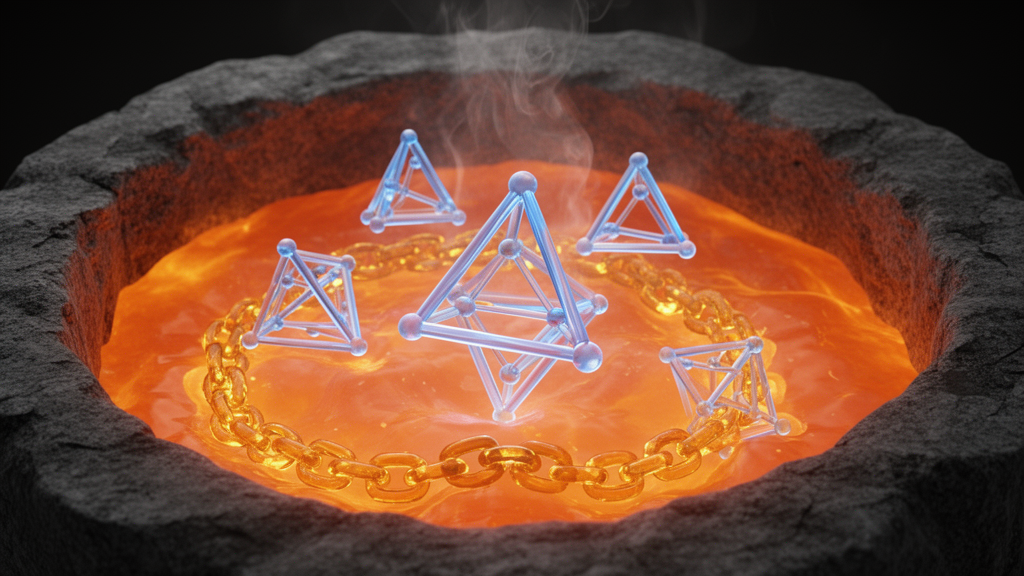
Boron is one of the most useful chemical tracers in geology. Its two stable isotopes, boron-11 and boron-10, behave slightly differently in different chemical environments, and the resulting isotopic fingerprints can be read from minerals such as tourmaline to reconstruct how magmas released fluids, how ores formed, and how water moved through the crust. But the whole approach rests on a deceptively simple question: in what geometric arrangement does boron actually sit inside a silicate melt? A new experimental study published in the European Journal of Mineralogy by Jakob Rauscher of the GFZ Helmholtz Centre for Geosciences and colleagues provides the most systematic answer yet for granitic melts, and the answer turns out to depend almost entirely on one compositional parameter.
The team synthesized a suite of haplogranite glasses, simplified chemical analogues of natural granitic melts, spanning water contents from completely dry to 7.2 weight percent, boron concentrations between 1.5 and 5.2 weight percent B2O3, and a range of aluminum saturation index, or ASI, from 0.8 to 1.7. The ASI is the molar ratio of alumina to the sum of calcium, sodium, and potassium oxides, and it classifies granites as peraluminous when above one, metaluminous near one, and peralkaline below one. This ratio matters because in a melt, aluminum and boron compete for the same alkali elements that stabilize different structural units. The researchers then probed the local environment of boron in each quenched glass using boron-11 magic angle spinning nuclear magnetic resonance spectroscopy at Ruhr-Universität Bochum, a technique that distinguishes trigonal, threefold-coordinated BO3 groups from tetrahedral, fourfold-coordinated BO4 groups by their characteristic resonance signals.
The result was strikingly one-dimensional. Within the studied range, the first-order control on boron coordination was the ASI value, with water content and boron concentration playing only secondary roles. Every glass with an ASI above 1.1, regardless of how wet or boron-rich it was, contained almost exclusively trigonal boron, with tetrahedral boron never exceeding 7 percent. In contrast, glasses with lower ASI values showed a steady and dramatic rise in tetrahedral boron, reaching a maximum of 90 percent in a sample with an ASI of about 0.8. The explanation lies in the melt’s network chemistry: converting trigonal boron to tetrahedral boron requires non-bridging oxygens and charge-balancing cations, and in strongly peraluminous melts all available alkalis are consumed stabilizing AlO4 units, leaving nothing to support BO4 formation.
The study also revealed a pattern familiar from decades of research on industrial borate glasses. Plotting the amount of tetrahedral boron against total alkali concentration showed negligible BO4 below about 7.5 weight percent alkalis, a rise to a maximum of roughly 2.5 weight percent tetrahedral boron at 9 to 9.5 weight percent alkalis, and then a decline at higher alkali contents. This echoes the classic boron anomaly described by Bray and O’Keefe in the 1960s, in which adding alkalis to borate glass first increases and then suppresses tetrahedral boron. Its appearance in hydrous aluminosilicate compositions suggests that the same structural competition operates in natural magmas, not just in laboratory glass formulations.
Water, long suspected of promoting tetrahedral boron through its hydroxyl groups acting as network modifiers, produced only ambiguous effects. There was a tendency toward higher tetrahedral boron in hydrous compared with anhydrous glasses at low ASI, consistent with earlier work on albite melts by Schmidt and colleagues. But the authors flag a serious confounding factor: quench rate. Water dramatically lowers melt viscosity and the glass transition temperature, and slower cooling is known to favor BO4 preservation in glass. Because the hydrous samples were synthesized in internally heated pressure vessels with slower quenching than the anhydrous melts fused in open crucibles, the apparent water effect may partly or wholly reflect cooling history rather than melt structure at magmatic temperatures. For low-ASI compositions, the anhydrous glasses may better approximate the true melt structure.
Boron concentration itself showed a limited capacity to drive tetrahedral coordination. The maximum tetrahedral proportion of 90 percent occurred in a relatively boron-poor sample with about 1.7 weight percent B2O3, while a compositionally similar sample containing 5.1 weight percent B2O3 reached only 49 percent. Likewise, among near-metaluminous samples, the boron-poorer glass reached 54 percent tetrahedral boron while its boron-richer counterpart managed only 20 percent. The interpretation is that melts with ASI below one have a finite supply of non-bridging oxygens to support BO4 groups; once that capacity is saturated, additional boron simply joins the network as trigonal units.
The findings align well with the sparse existing data on natural volcanic glasses. Two earlier NMR studies of peraluminous Italian rhyolites by Tonarini and colleagues and by Slejko and colleagues found 75 to 92 percent trigonal boron, matching the new experimental results for ASI values above 1.1. This convergence matters enormously for isotope geochemistry, because boron isotope fractionation between phases is governed by their coordination environments. In neutral to acidic aqueous fluids, boron occurs dominantly as trigonal B(OH)3 across the pressure, temperature, and pH conditions typical of crustal rocks, as established by Raman spectroscopy experiments from Schmidt’s group. If both the melt and the fluid host boron in trigonal coordination, there should be little if any isotopic fractionation between them.
That conclusion carries direct implications for interpreting ore deposits. Peraluminous granites, formed by partial melting of aluminous sedimentary rocks in orogenic belts, are closely associated worldwide with pegmatites and with tin, tungsten, lithium, uranium, niobium, and tantalum mineralization, and they are commonly rich in tourmaline. Geologists have used tourmaline’s boron isotope composition to test whether fluid exsolution from granite occurred, but existing experimental constraints on melt-fluid fractionation conflict badly, with some studies predicting around minus 7 per mil at 700 degrees Celsius and others predicting less than 1 per mil at similar temperatures. The new NMR data suggest that for peraluminous systems, the small fractionation values are more plausible, since both phases would hold boron in trigonal coordination, a view supported by direct tourmaline-melt partitioning experiments of Cheng and colleagues that found differences below 1 per mil even at 660 degrees Celsius.
For metaluminous and peralkaline melts, the picture changes fundamentally. Combining the experimentally derived relationship between ASI and tetrahedral boron with published ab initio calculations of isotope fractionation factors for trigonal and tetrahedral boron species, the team built a predictive model linking the melt-fluid boron isotope fractionation to melt ASI and temperature. The model predicts fractionations of minus 4 to minus 7 per mil at 730 and 530 degrees Celsius respectively for a granite with an ASI of 0.8, and shows that assuming 30 percent versus zero percent tetrahedral boron in the fluid shifts the predicted fractionation by 1 to 3 per mil depending on temperature. The authors note that the strongly peraluminous Macusani rhyolite of Peru, with an ASI of 1.3, should show near-zero fractionation by this model, in tension with a reported experimental value of minus 7.5 per mil, and they point out that spectroscopic confirmation of boron coordination in that glass remains an outstanding test.
What emerges is a practical tool: measure or estimate a granite melt’s aluminum saturation index, and its boron coordination, and hence its likely isotope behavior during fluid exsolution, can be predicted. For the peraluminous magmas that generate many of the world’s strategic metal deposits, boron isotopes in tourmaline and fluids will record little fractionation from their parent melts. For the rarer metaluminous and peralkaline systems, the isotopic contrast between melt and fluid should be substantial and temperature-dependent, opening a sharper window on degassing and ore-forming processes. A single structural ratio, hidden in the atomic geometry of the melt, now stands as the key to reading boron’s isotopic messages from the deep crust.
Subject of Research: Boron coordination and isotope fractionation in granitic melts
Article Title: Boron coordination in haplogranite glasses
Article References: Rauscher, J., Fechtelkord, M., Jahn, S., Michaud, J. A.-S., Mothan, D., Sieber, M. J., Trumbull, R. B., Wilke, F. D. H., Wilke, M., & Wunder, B. (2026). Boron coordination in haplogranite glasses. European Journal of Mineralogy, 38(4), 383-396. https://doi.org/10.5194/ejm-38-383-2026
Image Credits: AI Generated
Keywords: boron, haplogranite, NMR spectroscopy, granitic melts, aluminum saturation index, boron isotopes, isotope fractionation, tourmaline, pegmatites, ore deposits, silicate glasses, magmatic fluids
Cite Scienmag News
Bethany Barker. (October 9, 2026). Boron’s Hidden Geometry in Granite Melts Rewrites Isotope Rules for Ore Formation. Scienmag. https://scienmag.com/borons-hidden-geometry-in-granite-melts-rewrites-isotope-rules-for-ore-formation/
Bethany Barker. "Boron’s Hidden Geometry in Granite Melts Rewrites Isotope Rules for Ore Formation." Scienmag, 9 October 2026, https://scienmag.com/borons-hidden-geometry-in-granite-melts-rewrites-isotope-rules-for-ore-formation/. Accessed 9 October 2026.
Bethany Barker. "Boron’s Hidden Geometry in Granite Melts Rewrites Isotope Rules for Ore Formation." Scienmag. October 9, 2026. https://scienmag.com/borons-hidden-geometry-in-granite-melts-rewrites-isotope-rules-for-ore-formation/


