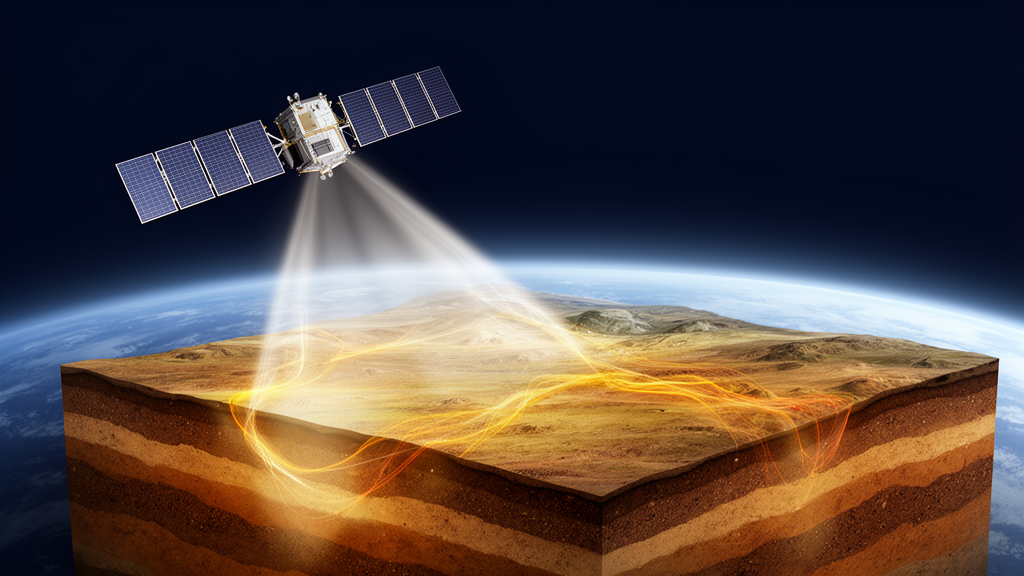
Every three hours, a satellite sweeping over Earth records the temperature of the planet’s skin, a quantity climatologists treat as an Essential Climate Variable because it governs how water and energy move between the ground and the air. Yet for all the torrents of satellite-derived land surface temperature data pouring from instruments such as MODIS on NASA’s Terra spacecraft, land data assimilation specialists have largely left this treasure trove on the shelf. Soil moisture retrievals are assimilated routinely in operational centers around the world, while land surface temperature observations sit mostly unused. The reason is deceptively simple: land surface temperature changes extraordinarily fast, resetting itself with every shift in sunlight, cloud cover, and incoming longwave radiation, so any correction made to it tends to vanish almost immediately.
A new study published in Geoscientific Model Development by Yunhao Fu, Yongjun Zheng, and Jingjia Luo of Nanjing University of Information Science and Technology now offers a way to make those fleeting observations stick. The team’s insight is that land surface temperature should not be used to update temperature alone. Instead, when the observation is ingested into an offline land surface model, the analysis should simultaneously adjust both soil temperature and soil moisture in the uppermost soil layers. By coupling the two quantities, the short-lived thermal signal from the satellite can be banked in soil moisture, which possesses far longer memory, and then slowly released back into the soil thermal state through the model’s own physics.
The technical machinery behind the scheme is the Local Ensemble Transform Kalman Filter, or LETKF, a deterministic ensemble Kalman filter variant prized for its computational efficiency and natural parallelism. Applied here to the Common Land Model, CoLM, for the first time, the filter works by carrying an ensemble of fifty model states forward in time, each member perturbed in fourteen tunable parameters to represent model uncertainty. The difference between ensemble members and the observations provides a statistical estimate of the background error covariance, and crucially, that covariance contains cross-correlations between soil temperature and soil water content even though the observation operator itself only involves temperature-like quantities.
That observation operator is itself a notable piece of engineering. Rather than equating satellite skin temperature with a single model temperature, the researchers built a physically realistic forward operator within CoLM’s two-big-leaf canopy framework. It combines the thermal emissions of sunlit leaves, shaded leaves, and the bare ground, weighted by vegetation cover fraction, canopy gap fraction, ground emissivity, and downward longwave radiation, then takes the fourth root of the total emitted energy to arrive at a radiometric temperature. This makes the simulated quantity directly comparable to what MODIS actually measures, especially over partially vegetated terrain where mixing of canopy and soil signals is strongest.
The experiments were global, run at half-degree resolution with hourly WFDE5 atmospheric forcing derived from ERA5. MODIS land surface temperature retrievals were aggregated from their native 0.01-degree pixels into model grid cells using latitude-weighted averaging, with strict quality control that discarded contaminated retrievals and any aggregated value built from fewer than 1,500 raw pixels. Assimilation cycles ran every three hours throughout 2001, followed by a two-month free forecast to test whether the corrections persisted. The localization scale shrank from 730 kilometers at the equator to 146 kilometers near the poles, following the latitude-dependent grid geometry, and a conservative increment clipping procedure prevented any single analysis from pushing the model more than three background standard deviations away from its forecast.
The headline result is a paradox that actually validates the whole approach: the land surface temperature itself barely improved. Because an offline model is slaved to its atmospheric forcing, whatever nudge the assimilation gave the surface thermal state was quickly damped back toward the trajectory dictated by radiation and weather, with root-mean-square differences typically shifting by only about 0.1 kelvin. But the corrections did not disappear; they migrated. Soil temperature bias over Northeast Asia dropped sharply, by roughly 1.0, 1.5, and 2.0 kelvins in soil layers at 0 to 10, 40 to 100, and 100 to 200 centimeters respectively, revealing that the signal injected at the surface was being carried downward by vertical diffusion and preserved in deeper layers where atmospheric forcing cannot erase it.
Snow responded with particular enthusiasm. Over Northeast Asia, the root-mean-square difference in snow temperature fell by about 4 kelvins and snow depth errors shrank by roughly 150 millimeters, with the biggest gains arriving in late winter and early spring when freezing and melting dominate. The joint update matters here in a way that pure temperature updating cannot match: when temperature and water content are adjusted together, water stored in soil and snow is free to change phase between liquid and solid, which is exactly what happens in the real world when skin temperature crosses the freezing point near mid- and high latitudes. Independent satellite records from ATSR-2, AVHRR, and MODIS confirmed widespread snow cover improvements across the Northern Hemisphere, with root-mean-square difference reductions near 10 percent over much of Eurasia and North America.
The humid tropics delivered the most dramatic hydrological gains. In the Amazon Rainforest, the unbiased root-mean-square difference in soil water content fell by approximately 0.06, 0.12, 0.15, and 6.00 kilograms per square meter in the successive soil layers from the surface down to 200 centimeters, with the largest absolute improvements concentrated in the deepest layer. The authors attribute this depth amplification to the high hydraulic conductivity of humid soils, which allows the assimilation-modified water in the upper layers to drain efficiently downward, where it lingers far longer than any surface signal could. By contrast, arid regions with low conductivity, such as central North America and northern Australia, showed localized degradations, and freeze-thaw transitions introduced difficulties where the exact timing of phase change proved hard to capture.
Surface fluxes provided a final, independent test. Evaluated against ERA5-Land, GLDAS, MERRA2, and eddy-covariance towers from the FLUXNET2015 and AmeriFlux networks, the assimilation run showed clear improvements in bare-soil evaporation and latent heat flux over western North America, the Tibetan Plateau, Northeast Asia, the Amazon, and central Africa, mirroring the soil moisture gains in nearly the same locations. Sensible heat flux responded more unevenly, improving in humid regions while degrading in drier ones, a consequence of how soil moisture controls the partitioning of available energy between the two fluxes. Most tower sites saw better performance in at least one flux variable, with latent heat showing the most consistent error reductions.
The broader lesson reaches beyond one model or one filter. The researchers acknowledge that maintaining a realistic ensemble spread remains the stubborn weakness of ensemble assimilation in offline land models, since atmospheric forcing pins the forecasts so tightly that members struggle to diverge. Their parameter perturbation scheme, resampled each cycle and capped at 15 percent of parameter magnitude, kept the ensemble alive without collapsing, with soil layer temperature spreads of 0.3 to 1.4 kelvins and soil moisture spreads growing from about 0.5 to 10 kilograms per square meter with depth. The natural next step, they suggest, is two-way coupling between land and atmosphere, where assimilating satellite radiances into a coupled system would let the land surface temperature observations influence weather directly rather than being perpetually overwritten by it. For now, the study demonstrates that even in a one-way world, satellite skin temperature observations, handled with the right joint-update strategy, can quietly reshape the entire thermal and hydrological profile of the land beneath.
Subject of Research: Assimilation of satellite land surface temperature into offline land surface models using ensemble-based data assimilation
Article Title: Effectively assimilate satellite land surface temperature into offline land surface models within ensemble-based assimilation frameworks
Article References: Fu, Y., Zheng, Y., & Luo, J. (2026). Effectively assimilate satellite land surface temperature into offline land surface models within ensemble-based assimilation frameworks. Geoscientific Model Development, 19(18), 9177-9201. https://doi.org/10.5194/gmd-19-9177-2026
Image Credits: AI Generated
Keywords: land surface temperature, data assimilation, LETKF, soil moisture, soil temperature, MODIS, snow, land surface model, CoLM, satellite remote sensing, ensemble Kalman filter, hydrology
Cite Scienmag News
Violet Maxwell. (October 9, 2026). Satellite Skin Temperature Gets a Memory Boost in Land Models Through Joint Soil Updates. Scienmag. https://scienmag.com/satellite-skin-temperature-gets-a-memory-boost-in-land-models-through-joint-soil-updates/
Violet Maxwell. "Satellite Skin Temperature Gets a Memory Boost in Land Models Through Joint Soil Updates." Scienmag, 9 October 2026, https://scienmag.com/satellite-skin-temperature-gets-a-memory-boost-in-land-models-through-joint-soil-updates/. Accessed 9 October 2026.
Violet Maxwell. "Satellite Skin Temperature Gets a Memory Boost in Land Models Through Joint Soil Updates." Scienmag. October 9, 2026. https://scienmag.com/satellite-skin-temperature-gets-a-memory-boost-in-land-models-through-joint-soil-updates/