


Supercapacitors have long promised a middle path between the lightning-fast discharge of ordinary capacitors and the steady endurance of lithium-ion batteries, but the materials at their heart keep imposing compromises. A team at Thiagarajar College of Engineering in Madurai, India, now reports that a seemingly small chemical substitution—slipping the rare-earth element lanthanum into a nickel-cobalt layered double hydroxide—can push one of the most promising electrode families well past its usual limits. In a study published in the journal Ionics, the researchers show that their hydrothermally grown NiCoLa layered double hydroxide delivers a specific capacity of 390.3 mAh per gram, retains about 85.5 percent of its initial capacitance after repeated cycling, and converts charge with a coulombic efficiency of 98.56 percent.
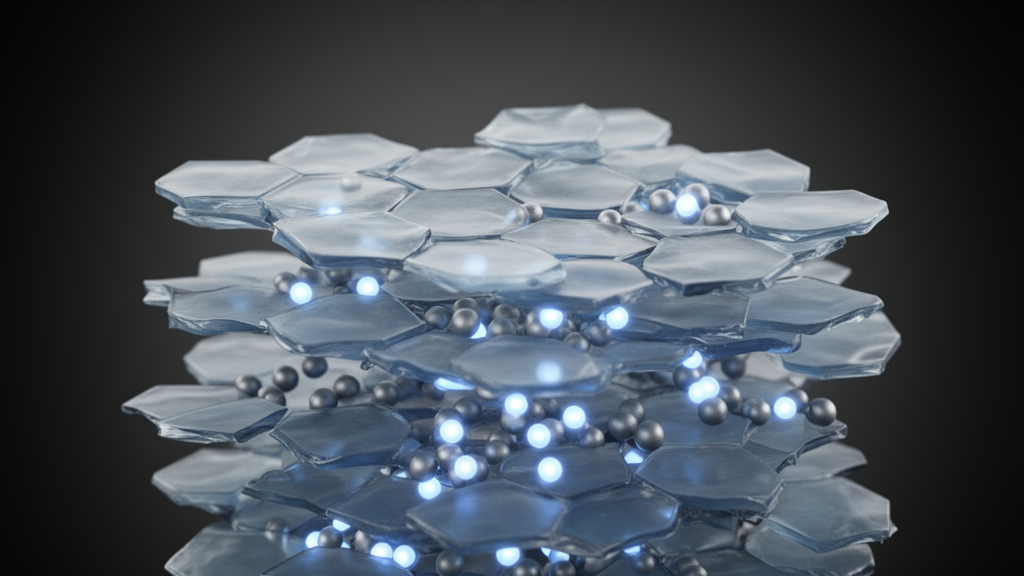
The material belongs to a class called layered double hydroxides, or LDHs, structures best imagined as positively charged metal hydroxide sheets stacked like a deck of cards, with water and mobile anions filling the spaces between them. That architecture gives LDHs an unusually high density of electroactive sites exposed to the electrolyte, which is exactly what a pseudocapacitive electrode needs, because charge storage in these materials relies on fast, reversible redox reactions occurring at or near the surface. Nickel and cobalt have dominated the field precisely because both metals shuttle readily between oxidation states, but LDHs made from them suffer from well-known weaknesses: sheets that tend to restack and block access to active sites, moderate electrical conductivity, and structural degradation under the mechanical stress of long-term cycling.
The Indian team’s strategy was to attack those weaknesses from two directions at once. First, they chose a hydrothermal synthesis route, sealing metal precursors in an aqueous reaction medium and letting them crystallize under elevated temperature and pressure. Hydrothermal growth is prized in electrode research because it encourages the formation of well-ordered nanosheet architectures rather than tangled or amorphous precipitates. In the resulting material, scanning electron microscopy and transmission electron microscopy revealed a hierarchical nanostructure—a network of sheets arranged across multiple length scales—which the authors attribute to the controlled crystallization that the hydrothermal environment makes possible. Such hierarchical textures matter enormously in practice, since they create channels for ions to penetrate deep into the electrode rather than stalling at its outermost surface.
The second lever was the lanthanum itself. Lanthanum ions, with their large ionic radius and stable trivalent state, act as a structural and electronic modifier when incorporated into the nickel-cobalt hydroxide layers. According to the study, the presence of La3+ produced a slight increase in the interlayer spacing—the gap between the stacked hydroxide sheets—effectively propping the deck of cards open. Wider galleries mean easier access for hydroxide ions from the electrolyte, more intercalation sites during charging and discharging, and reduced sheet-to-sheet restacking that would otherwise render much of the material electrochemically dead. Rare-earth elements have been steadily gaining attention in the electrode literature for exactly this kind of role, with earlier work reporting improved capacity and lifespan when lanthanum or other rare earths were coupled with nickel-cobalt systems, including recent studies on synergistic lanthanum and scandium doping in nickel-cobalt LDHs and on lanthanum-oxide and nickel-cobalt LDH nanocomposites.
Structural confirmation came from X-ray diffraction, which verified the formation of the LDH crystalline phase through its characteristic (003) and (006) reflections—the fingerprint of a well-ordered layered lattice. The doping-related expansion of the interlayer spacing showed up as a small shift in these peaks, tying the atomic-level chemistry directly to the nanostructure. That connection between synthesis, structure, and performance is the intellectual core of the work: the authors argue that the synergistic effects of multi-metal redox properties and the structural adjustments induced by lanthanum incorporation are jointly responsible for the electrode’s behavior, rather than any single ingredient acting alone.
The electrochemical evidence followed a standard but rigorous testing regime. Cyclic voltammetry traced the redox reactions as the applied potential was swept back and forth, mapping how much charge the material could store and how quickly. Galvanostatic charge-discharge cycling measured the practical capacity under constant current, while electrochemical impedance spectroscopy probed the internal resistance and the speed of ion and electron transport within the electrode. Together, the three techniques returned the headline numbers: 390.3 mAh per gram of specific capacity, roughly 85.5 percent capacity retention over extended cycling, and 98.56 percent coulombic efficiency, meaning that almost every electron injected into the electrode during charging is recovered during discharge—a critical figure for real devices, where side reactions silently bleed away stored energy.
Crucially, the researchers did not stop at the half-cell level, which can flatter a material before it meets the demands of a complete device. They assembled an asymmetric supercapacitor, pairing the NiCoLa LDH as the battery-like faradaic electrode with a capacitive counter-electrode, allowing the device to span a wider operating voltage window than either electrode could tolerate alone. The full cell delivered a specific capacity of 34.17 mAh per gram, a specific energy of 17.08 Wh per kilogram, and a specific power of 500 W per kilogram. Those figures sit in a genuinely interesting part of the energy landscape: conventional carbon-based supercapacitors typically offer high power but only a few watt-hours per kilogram, while batteries deliver far more energy but slower charging and shorter cycle lives. An asymmetric device in the double-digit energy range with strong power delivery and rapid charging ability is precisely the hybrid profile that applications from regenerative braking to grid frequency regulation demand.
The broader context makes the result more than a one-off material triumph. The field of nickel-cobalt LDH electrodes has produced a rich catalogue of enhancement strategies in recent years: doping with sulfur, pairing LDHs with MXenes or graphene, growing heterostructures with oxides and sulfides, anchoring nanosheets onto carbon cloth or nickel foam, and assembling trimetallic layered hydroxides with hierarchical micro-flower morphologies. Each approach targets the same set of bottlenecks—conductivity, surface area, structural stability, and rate capability. The new study’s contribution is to show that lanthanum incorporation, delivered through a relatively simple and scalable hydrothermal route, can address several of those bottlenecks simultaneously without the complexity of multi-step heterostructure engineering. The hydrothermal method also avoids the need for binders in some configurations and produces crystalline material in a single vessel, factors that matter when research results must eventually translate into manufacturable electrodes.
There are, of course, the familiar caveats that attend any laboratory-scale energy-storage advance. The reported capacity retention, while respectable at about 85.5 percent, still implies measurable fading over the tested cycling window, and the path from a coin-cell or beaker-scale device to the robust, kilowatt-scale modules that real infrastructure requires involves challenges of electrode loading, electrolyte management, and thermal behavior that laboratory papers rarely address in full. The authors themselves frame the work as establishing the material as an advanced candidate for next-generation supercapacitors—a claim about promise and mechanism rather than a finished commercial technology. Still, the specific numbers reported are competitive within the current literature on LDH-based asymmetric devices, and the mechanistic story—lanthanum widening the interlayer galleries while nickel and cobalt carry the redox load—offers a clear design rule for other researchers to test and refine.
What gives the work its wider significance is the growing recognition that rare-earth chemistry may be one of the more underexploited levers in pseudocapacitor design. Lanthanum’s large size, its reluctance to participate directly in the redox chemistry, and its oxophilic character make it less a charge-storage agent than an architect: it holds the layered house open, stabilizes the lattice against the swelling and shrinking of repeated cycling, and subtly redistributes electronic density across the nickel and cobalt centers that do the electrochemical work. The Madurai team’s demonstration that this architectural role can be delivered through straightforward hydrothermal synthesis—using equipment and processes already common in materials laboratories—suggests that NiCoLa LDH and its cousins could move quickly from journal pages to prototype devices. For a world urgently needing storage that bridges the gap between instantaneous power and long-duration energy, electrodes built from carefully tailored decks of metal hydroxide cards may prove to be one of the quiet, materials-level breakthroughs on which faster progress is built.
Subject of Research: Lanthanum-doped nickel-cobalt layered double hydroxide electrodes synthesized hydrothermally for high-performance supercapacitor energy storage
Article Title: Tailoring NiCoLa layered double hydroxide via hydrothermal synthesis for superior supercapacitor performance
Article References: Prabhu, B., Karthickprabhu, S., Mahendran, M., & Deepikaa, M. (2026). Tailoring NiCoLa layered double hydroxide via hydrothermal synthesis for superior supercapacitor performance. Ionics. https://doi.org/10.1007/s11581-026-07477-0
Image Credits: AI Generated
DOI: 10.1007/s11581-026-07477-0
Keywords: layered double hydroxide, supercapacitor, hydrothermal synthesis, lanthanum doping, nickel-cobalt electrode, pseudocapacitance, energy storage, asymmetric supercapacitor, electrochemistry, rare earth elements, specific capacity, nanosheets
Cite Scienmag News
Denise Maddox. (October 9, 2026). Rare-Earth Twist Turns Nickel Cobalt Nanosheets Into Supercapacitor Powerhouses. Scienmag. https://scienmag.com/rare-earth-twist-turns-nickel-cobalt-nanosheets-into-supercapacitor-powerhouses/
Denise Maddox. "Rare-Earth Twist Turns Nickel Cobalt Nanosheets Into Supercapacitor Powerhouses." Scienmag, 9 October 2026, https://scienmag.com/rare-earth-twist-turns-nickel-cobalt-nanosheets-into-supercapacitor-powerhouses/. Accessed 9 October 2026.
Denise Maddox. "Rare-Earth Twist Turns Nickel Cobalt Nanosheets Into Supercapacitor Powerhouses." Scienmag. October 9, 2026. https://scienmag.com/rare-earth-twist-turns-nickel-cobalt-nanosheets-into-supercapacitor-powerhouses/


