


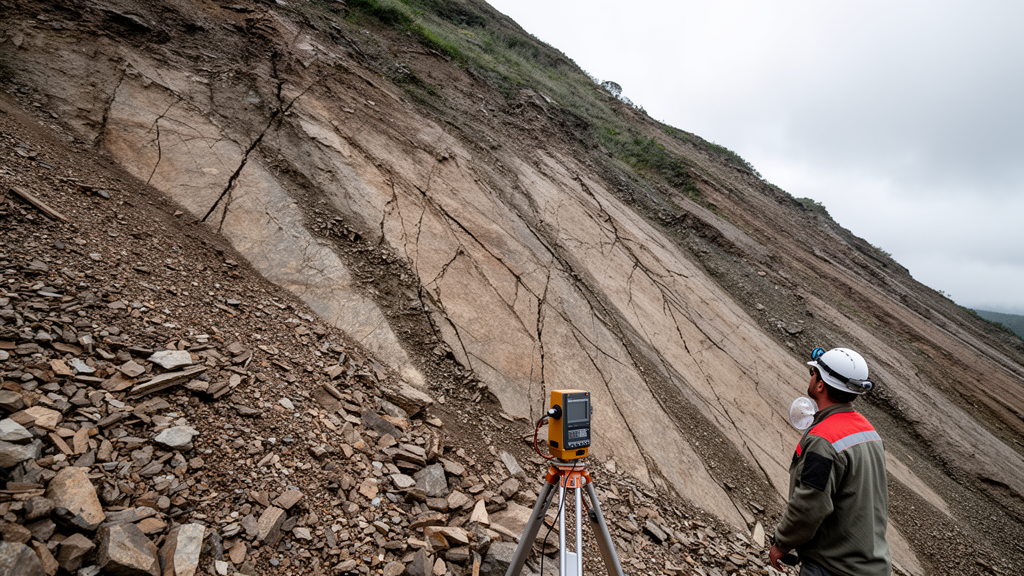
When a large earthquake strikes, the shaking rarely ends with the mainshock. In the hours, days, and months that follow, aftershocks continue to rattle the landscape, and field surveys after major events have repeatedly shown that these secondary shocks are often the final straw that pushes an already weakened hillside into outright failure. Yet most engineering analyses of seismically triggered landslides still evaluate slopes as if a single mainshock were the whole story. A new study published in Natural Hazards and Earth System Sciences by Tianyi Wang of Hebei GEO University, Chengda Zhang of the Tianjin North China Geological Exploration Bureau, Jiangwei Zhang of Tsinghua University, Su Chen of Beijing University of Technology, and Zhijun Dai of the Institute of Geophysics, China Earthquake Administration, tackles that blind spot head-on with a probabilistic framework designed specifically for mainshock–aftershock sequences.
The core of the work is a reliability analysis method for the permanent displacement of soil slopes subjected to sequential ground motions. Permanent displacement, the irreversible sliding deformation that accumulates when seismic forces momentarily exceed the resisting strength of the slope material, is a standard yardstick for judging whether a slope remains serviceable after an earthquake. The authors argue that judging this quantity from mainshock shaking alone systematically misrepresents the hazard, because aftershocks add cumulative damage to soil that has already been degraded by the first event. Their solution couples a carefully constructed stochastic description of sequence-type ground motions with the probability density evolution method, a computational framework for nonlinear stochastic dynamics originally developed by Li and co-workers and previously extended to complex slope reliability problems.
Building the seismic input was the first technical hurdle. The team assembled 96 recorded mainshock–aftershock pairs drawn from 15 seismic events in the NGA-West2 strong-motion database maintained by the Pacific Earthquake Engineering Research Center. Selection criteria were strict: the aftershock had to be the largest-magnitude event within twelve months of the mainshock, both events needed magnitudes of at least 5.0 and peak ground accelerations of at least 0.05 g, both records had to come from the same component of the same station, the site shear-wave velocity in the upper 30 meters had to fall between 100 and 700 meters per second, and rupture distances could not exceed 80 kilometers. Each sequence was configured as a mainshock followed by a twenty-second quiet interval and then the aftershock, preserving the fully non-stationary character of real sequences.
Rather than treating these recordings as isolated deterministic inputs, the researchers modeled them as zero-mean, fully non-stationary stochastic processes using an evolutionary power spectral density framework. Frequency-domain energy distribution curves were fitted for each ground motion using an optimal square approximation criterion and least-squares regression, yielding a parameter vector that defines each evolving spectrum. This random-function dimension-reduction approach generates representative ground-motion time histories together with their associated probabilities, forming a complete probabilistic set that can feed directly into the probability density evolution method. That is a crucial advantage over Monte Carlo simulation, which demands enormous sample counts and often leaves the probability structure of the sample set incomplete.
A second, equally consequential decision concerned how to measure the intensity of a ground-motion sequence. Conventional practice leans on peak ground acceleration, but a single peak value says little about the sustained, damage-accumulating character of repeated shaking. The team therefore screened 21 candidate intensity measures spanning three families: peak-based parameters such as peak ground velocity and displacement, spectral measures such as response spectral acceleration and acceleration spectral intensity, and cumulative measures including Arias intensity, significant duration, and several root-mean-square and cumulative-absolute quantities. Correlation analysis against the simulated slope responses produced a clear winner: cumulative absolute velocity, or CAV, showed the strongest correlation with permanent displacement, with a correlation coefficient of 0.872, and captured the cumulative aftershock contribution better than any peak-based alternative.
With the seismic input and intensity measure defined, the mechanical side of the analysis proceeded on a two-layer soil slope model 150 meters long and 30 meters high, built in the finite-difference platform FLAC3D with a mesh refined to roughly half a meter in the potential sliding zone. The soil, a clay from southwestern China, was represented by a Mohr–Coulomb constitutive model with a tensile cutoff, and local damping with a 5 percent critical damping fraction, corresponding to a damping coefficient of 0.157, reproduced energy dissipation during wave transmission. Because FLAC3D avoids assembling a global stiffness matrix, it is computationally efficient for the many nonlinear dynamic simulations that a probabilistic treatment requires. Ninety-six scaled sequences were run at three CAV levels of 12, 28, and 40 meters per second, generating the response ensemble needed for density evolution.
The results reveal how strongly and how variably sequences load a slope. Average permanent displacements rose from 0.067 meters at a CAV of 12 meters per second to 0.328 meters at 28 and 0.633 meters at 40 meters per second, values comparable to those produced by mainshock-only shaking at peak ground accelerations of 0.4, 0.5, and 0.6 g in earlier work. Even with CAV as the intensity measure, the displacement results remained scattered, a reminder that frequency content and duration also matter and that no single parameter fully predicts slope response. That residual variability is precisely why the authors insist on a probabilistic treatment: the probability density evolution method propagates the uncertainty through the dynamics rather than averaging it away.
The probability distributions that emerged are strikingly non-standard. The probability density curves of permanent displacement showed bimodal or multimodal shapes that cannot be described by normal or lognormal distributions, underscoring how sequence effects reshape the statistics of slope response. Reliability estimates depended heavily on the chosen failure threshold. At a CAV of 12 meters per second, displacements ranged from 0 to 0.25 meters and reliability was 48.5 percent against a low-level threshold of 0.05 meters. At 28 meters per second the range widened to 0 to 1.00 meters and reliability fell to 45.5 percent at the medium threshold of 0.25 meters, while at 40 meters per second the range stretched to 0 to 2.00 meters and reliability dropped to 31.7 percent at the high threshold of 0.50 meters.
Comparisons against a conventional PGA-based analysis highlight the practical payoff of the new approach. At the 50 percent cumulative probability level, CAV-based displacements were approximately 0.07, 0.32, and 0.55 meters for the three intensity levels, against roughly 0.20, 0.50, and 0.70 meters for the corresponding PGA cases, and the PGA-based curves showed heavier large-displacement tails. Overall, switching from PGA to CAV reduced the dispersion of predicted displacements by about 40 percent on average, producing tighter, more informative reliability estimates. The authors caution that their results apply to clayey soil slopes of the kind found in southwestern China and to shallow crustal earthquake sequences, and that soil-parameter and geometric variability were not yet included, an extension they expect will further improve engineering applicability.
For disaster prevention, the message is clear: the aftershock is not a footnote but a first-order player in landslide hazard. By embedding sequence effects into a rigorous probabilistic framework and identifying cumulative absolute velocity as the intensity measure that best tracks cumulative damage, the study gives engineers a defensible way to quantify how likely a slope is to exceed critical displacement limits when the ground refuses to stay still. As seismic safety requirements tighten worldwide, methods that treat mainshock–aftershock sequences as the coupled, cumulative phenomena they truly are may well become the standard against which slope stability is judged.
Subject of Research: Probabilistic reliability analysis of soil slope permanent displacement under mainshock–aftershock earthquake sequences
Article Title: Reliability analysis method for soil slopes permanent displacement under mainshock–aftershock sequences
Article References: Wang, T., Zhang, C., Zhang, J., Chen, S., & Dai, Z. (2026). Reliability analysis method for soil slopes permanent displacement under mainshock–aftershock sequences. Natural Hazards and Earth System Sciences, 26(9), 4611-4619. https://doi.org/10.5194/nhess-26-4611-2026
Image Credits: AI Generated
DOI: 10.5194/nhess-26-4611-2026
Keywords: aftershocks, mainshock–aftershock sequences, slope stability, permanent displacement, cumulative absolute velocity, probability density evolution method, reliability analysis, landslides, ground motion intensity measures, FLAC3D, seismic hazard, soil slopes
Cite Scienmag News
Violet Maxwell. (October 9, 2026). Aftershocks Take Center Stage in New Slope Reliability Method. Scienmag. https://scienmag.com/aftershocks-take-center-stage-in-new-slope-reliability-method/
Violet Maxwell. "Aftershocks Take Center Stage in New Slope Reliability Method." Scienmag, 9 October 2026, https://scienmag.com/aftershocks-take-center-stage-in-new-slope-reliability-method/. Accessed 9 October 2026.
Violet Maxwell. "Aftershocks Take Center Stage in New Slope Reliability Method." Scienmag. October 9, 2026. https://scienmag.com/aftershocks-take-center-stage-in-new-slope-reliability-method/


