


In 2024, more than 300,000 migrants crossed the Darién Gap into Panama and continued their journey north through Central America, and among them were more than 64,000 children. The numbers alone are staggering, but they conceal the human reality of the route: pregnant women walking for days through hazardous terrain, newborns carried across rivers, and adolescents arriving at transit points exhausted, dehydrated, and frightened. For the frontline health care workers who meet these families at clinics and shelters along the way, the clinical challenges are unlike those encountered in routine practice. Yet a new study published in the International Journal for Equity in Health reveals that, until recently, almost no structured training existed to prepare these workers for the specific health and nutrition needs of migrants in short-term transit.
The study, led by Finn Holler of the UNICEF Latin America and Caribbean Regional Office together with colleagues from UNICEF offices in Panama City, New York, San José, and Nairobi, set out to close that gap. Conducted between August and October 2024 at four migrant transit points in Costa Rica, Guatemala, and Panama, the project had three goals: to identify existing training materials and clinical guidance relevant to migrant maternal, newborn, child, and adolescent health; to measure the knowledge of frontline health care workers before and after a pilot training program; and to document the priorities and practical lessons that emerged during implementation. The work was carried out as a UNICEF capacity-building initiative in collaboration with national health authorities, funded by the United States Agency for International Development, which had no role in the study design, analysis, or publication.
The first finding was sobering. A desk review of available migrant health training materials, combined with key informant consultations, identified no programs addressing maternal, newborn, child, and adolescent health and nutrition for migrants in short-term transit anywhere in Central America. Existing packages, such as those developed for European reception settings or for longer-term refugee camps, did not fit the realities of transit migration, where families may pass through a facility in hours or days and where clinical guidance tailored to that context simply did not exist. In response, the team developed checklists to support a standardized approach to care at transit points, filling a void that had left individual clinicians to improvise.
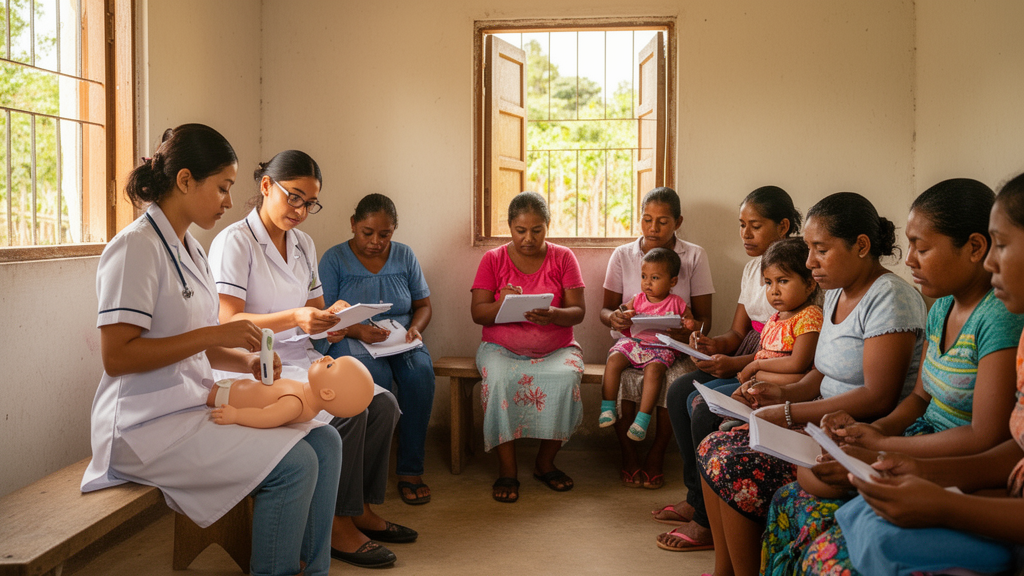
The training itself was built as a modular, context-adapted curriculum covering maternal, newborn, child, and adolescent health, nutrition, and intercultural competence. The modular design was a deliberate technical choice: it allows the content to be recombined and scaled according to local needs, staff availability, and the shifting profile of the migrant population at each site. Rather than importing a generic curriculum, the developers drew on the gaps and priorities identified during the needs assessment, ensuring that each session addressed situations the workers were actually encountering, from managing malnutrition in children who have walked for weeks to communicating across language and cultural barriers in the middle of a clinical encounter.
To evaluate whether the training worked, the researchers administered questionnaires before and after each session and collected participant feedback through evaluation surveys. The results were consistent across all three countries. In Costa Rica, average knowledge scores rose from 60 percent to 85 percent, a gain of 25 percentage points. In Guatemala, scores improved from 69 percent to 89 percent, a 20-point increase. In Panama, the improvement was from 57 percent to 81 percent, a gain of 24 points. Participant satisfaction was correspondingly high, at 94 percent in Costa Rica, 100 percent in Guatemala, and 93 percent in Panama. For a program delivered under the logistical constraints of active transit points, where staff time is scarce and patient flows are unpredictable, these figures represent a strong signal that short, targeted training can meaningfully raise the knowledge base of frontline teams.
Equally valuable is what the participants told the researchers about what was missing. Health care workers requested more training time and identified clear priorities for future rounds: psychological first aid, gender-based violence, and reproductive health. These requests reflect the epidemiology of the route itself. Women and girls in transit face elevated risks of sexual violence, and mental health burdens accumulate across an arduous journey. The study’s authors note that mental health and psychosocial support, gender-based violence, and reproductive health emerged as the leading priorities for future training, pointing toward the next iteration of the curriculum.
The technical significance of the study lies partly in its honest framing of what the data can and cannot show. The pre- and post-test design demonstrates a short-term gain in knowledge, but the authors are explicit that effects on clinical practice, service quality, and health outcomes remain to be evaluated. Knowledge scores are a proxy, not a guarantee: whether a worker who can answer a questionnaire correctly will manage a dehydrated infant or counsel a traumatized pregnant woman differently in a crowded shelter clinic is a question that requires follow-up research. The study also did not require ethics committee approval under international guidelines, because it was a descriptive report of programmatic capacity-building activities that collected no identifiable personal data, and the questionnaires were anonymous evaluations conducted for internal program purposes.
The context in which this work unfolded deserves attention. The Darién Gap, the roadless stretch of jungle connecting Colombia to Panama, has become one of the world’s most dangerous migration corridors, and the flow through it surged dramatically in recent years. Children, adolescents, and pregnant women are particularly vulnerable to the hazardous conditions and to the limited access to care along the route. Transit countries such as Panama, Costa Rica, and Guatemala have had to build health responses for a population that is constantly moving, often without documentation, and frequently speaking indigenous languages or languages other than Spanish. Health systems designed for resident populations are poorly equipped for this task, and the intercultural competence component of the training addressed precisely this mismatch.
The study also situates itself within a broader landscape of migration health training initiatives, referencing packages and frameworks developed by the World Health Organization, the Pan American Health Organization, the International Organization for Migration, and other agencies, including efforts in Europe such as EUR-HUMAN, ORAMMA, and the MEM-TP package. What distinguishes the Central American program is its focus on short-term transit, a phase of migration that most existing materials overlook. Migrants in transit are neither settled refugees nor returning travelers; their contact with health services is brief, their needs are acute, and the window for intervention is narrow. Training that assumes a stable clinical relationship does not transfer well to this setting, which is why the development of transit-specific checklists and modules matters.
Looking ahead, the researchers suggest that the modular training could be adapted and scaled to other transit corridors, and the identified priorities, psychological first aid, gender-based violence, and reproductive health, offer a roadmap for the next version. The program’s funders and implementers, including UNICEF and USAID, now face the harder evaluation question: does better-trained staff translate into better outcomes for mothers and children on the move? For now, the study stands as a documented proof of concept that a gap in global health training, one affecting hundreds of thousands of the world’s most vulnerable travelers, can be identified, measured, and partially closed with a modest, well-targeted intervention. In a year when more than 64,000 children crossed one of the planet’s most perilous jungle routes, that is a finding with consequences far beyond the three countries where it was tested.
Subject of Research: Maternal and child health and nutrition training for frontline health workers serving migrants in transit in Central America
Article Title: Enhancing healthcare capacity at migrant transit points: development and implementation of a maternal and child health and nutrition training program in Costa Rica, Guatemala, and Panama
Article References: Holler, F., Baffoe, P., Fautsch-Macías, Y., Manchikanti, S., López Borbón, D., Arts, M., & McQuen Patterson, J. (2026). Enhancing healthcare capacity at migrant transit points: development and implementation of a maternal and child health and nutrition training program in Costa Rica, Guatemala, and Panama. International Journal for Equity in Health. https://doi.org/10.1186/s12939-026-03025-4
Image Credits: AI Generated
DOI: 10.1186/s12939-026-03025-4
Keywords: migration health, transit migration, maternal and child health, nutrition, frontline health workers, capacity building, Central America, Darién Gap, UNICEF, psychological first aid, gender-based violence, intercultural competence
Cite Scienmag News
Courtney Benton. (October 9, 2026). Training Frontline Health Workers for Migrant Mothers and Children in Central America. Scienmag. https://scienmag.com/training-frontline-health-workers-for-migrant-mothers-and-children-in-central-america/
Courtney Benton. "Training Frontline Health Workers for Migrant Mothers and Children in Central America." Scienmag, 9 October 2026, https://scienmag.com/training-frontline-health-workers-for-migrant-mothers-and-children-in-central-america/. Accessed 9 October 2026.
Courtney Benton. "Training Frontline Health Workers for Migrant Mothers and Children in Central America." Scienmag. October 9, 2026. https://scienmag.com/training-frontline-health-workers-for-migrant-mothers-and-children-in-central-america/


