


On a windswept peninsula in north-west Scotland, where ice-moulded bedrock meets the grey waters of Loch Gairloch, a team of geoscientists has quietly resolved one of the most stubborn technical problems in modern geochronology. Cosmogenic surface-exposure dating, the technique that allows researchers to read the age of a rock surface directly from atoms forged by cosmic rays, has transformed the study of glaciers, landslides and climate change over the past three decades. Yet the method depends entirely on knowing how fast those atoms are produced, and different calibration studies have produced production-rate estimates that disagree by enough to shift calculated ages by more than ten percent. For events that unfolded over mere centuries, such as the abrupt climate swings at the end of the last ice age, that uncertainty has been a serious handicap. A new study published in the journal Geochronology by Gordon Bromley of the University of Galway and colleagues at the University of Maine and the University of Cincinnati now provides a rigorous field test of eight competing calibration datasets, and the verdict is clear: a production rate calibrated on Rannoch Moor, in the heart of the Scottish Highlands, outperforms them all.
The physics behind surface-exposure dating is elegant. High-energy cosmic rays striking the upper atmosphere shower the Earth’s surface with secondary particles that split atomic nuclei within minerals such as quartz. One product of this spallation is beryllium-10, a rare isotope that accumulates in the top few centimetres of an exposed rock at a known rate. Measure the concentration of beryllium-10 in a glacially polished boulder, divide by the production rate, and you obtain the time since the ice retreated. The catch is that the production rate is not constant across the planet. It varies with altitude, latitude, atmospheric pressure and the strength of Earth’s geomagnetic field, which shields the surface from cosmic radiation. Calibration experiments therefore measure beryllium-10 in surfaces whose true exposure age is known independently, typically from radiocarbon dating, and then use numerical scaling models to extrapolate the site-specific rate to anywhere else on Earth. Most modern calibrations converge on sea-level, high-latitude values of roughly 3.8 to 4.1 atoms per gram of quartz per year, but the residual spread among them is large enough to matter for short-lived events.
Bromley and his colleagues chose the Redpoint Peninsula as their natural laboratory, a low-relief coastal landscape between Loch Torridon and Loch Gairloch underlain by Neoproterozoic Torridonian sandstones. The peninsula carries a conspicuous suite of moraine ridges, first described in 1979, that record a stabilisation or readvance of the decaying last British ice sheet during Termination 1, the final deglaciation that ended the last glacial period. This episode, known as the Wester Ross Readvance, has been dated repeatedly over the years with conflicting results, with published beryllium-10 ages ranging from about 13.5 to 16.3 thousand years depending on which production rate was applied. The key to resolving the ambiguity lay in a small lake called Loch Bad na h-Achlaise, sitting just inside the mapped readvance limits. Sediment cores from the lake basin record the transition from marine to freshwater conditions as the ice retreated and the land rebounded, and the basal organic sediments yielded radiocarbon ages showing the peninsula was ice free by at least 15.9 thousand years ago.
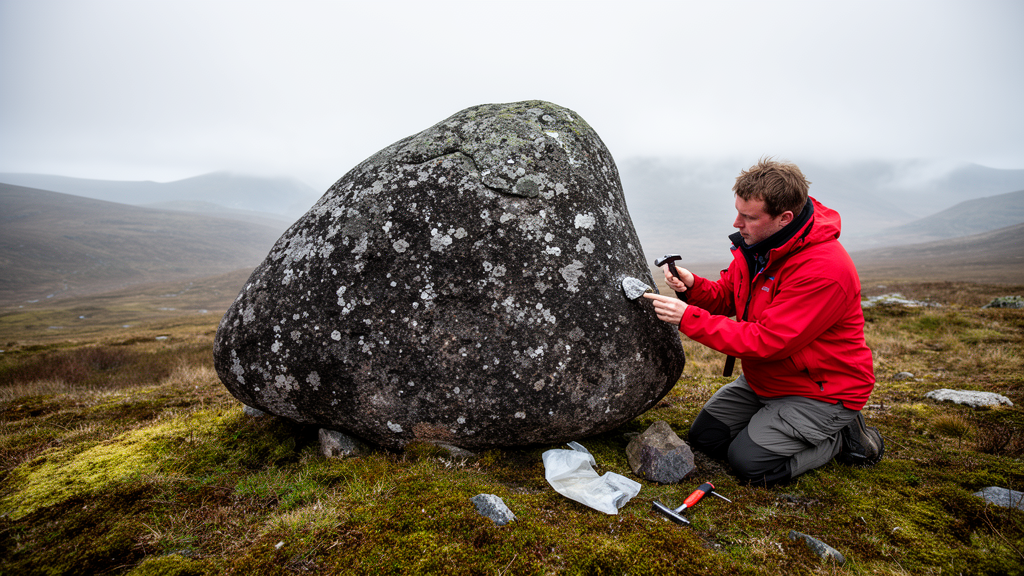
That radiocarbon benchmark is what gives the new study its power. Because the boulders sampled for beryllium-10 analysis all lie above the local marine limit and close to the lake, the onset of organic sedimentation provides a minimum-limiting age for their exposure: the rocks must be at least as old as the lake sediments, and probably somewhat older, since vegetation needed time to colonise the freshly deglaciated basin. The team collected samples from the top few centimetres of eleven glacial boulders at three sites, including perched boulders on ice-moulded bedrock highs and boulders embedded in the crest of the outermost Redpoint moraine. Back in the laboratory, quartz was painstakingly isolated through acid leaching and froth flotation, beryllium was extracted by ion chromatography, and isotope ratios were measured by accelerator mass spectrometry at Lawrence Livermore National Laboratory. Procedural blanks contributed only about one percent of typical sample signals, and two statistical outliers were identified and set aside, leaving nine tightly clustered measurements.
The internal consistency of the nine remaining ages is striking. Treated as a single population, they form a normal distribution whose scatter can be explained by analytical uncertainty alone, with a low reduced chi-squared value. That statistical coherence means the landforms sampled, from terrain outboard of the moraines to the moraine crest itself, were all exposed within a very narrow window of time. It also means the dataset is an ideal yardstick for testing production rates: whatever rate is applied, the relative pattern stays the same, so any systematic offset from the radiocarbon benchmark points directly at the calibration rather than at the geology. Using version 3 of the University of Washington online calculator and three standard scaling schemes, the team calculated apparent exposure ages with eight production-rate datasets drawn from Scotland, Switzerland, Sweden, Norway, north-eastern North America and a global compilation.
The results were decisive. Only two of the eight calibrations, Rannoch Moor and the Swiss Chironico landslide, produced mean ages overlapping the radiocarbon control within one standard deviation, and only Rannoch Moor yielded a mean age, 16.1 thousand years, that actually predates the onset of lacustrine sedimentation. The remaining six rates produced ages younger than the radiocarbon benchmark, under-predicting the true deglaciation age by up to seven to eight percent. The worst performers shared a common weakness: their calibration surfaces lack direct, independent age control. The Isle of Skye and Highlands dataset, for example, relies on presumed ages for the deglaciation of cirques correlated with distant climate records, while the Glen Roy calibration ties a wave-cut shoreline to a varve sequence twenty-five kilometres away without unequivocal dating. The Mount Billingen calibration assumes bedrock erosion features correspond to the indirectly dated drainage of the Baltic Ice Lake. Even the widely used Borchers global compilation, the default in popular online calculators, technically passed a statistical test only because of its large internal scatter, and the authors warn it too would yield ages that are stratigraphically too young.
The study also delivers a hard number. Using the radiocarbon control as an independent minimum-limiting age, the team derived a maximum-limiting sea-level, high-latitude beryllium-10 production rate of 3.925 plus or minus 0.070 atoms per gram per year under time-independent scaling. Any production rate higher than this ceiling will produce exposure ages that are unrealistically young relative to the radiocarbon chronology. The finding carries weight beyond Scotland because it independently vindicates the Rannoch Moor calibration, which had come under challenge. A 2019 critique questioned the radiocarbon ages of moss fragments underpinning the calibration, suggesting inbuilt age errors from aquatic carbon or carbonate contamination. Bromley and colleagues systematically dismantle that critique, noting that the re-sampling campaign examined only one of seven original sites, that the new basal ages from that site are virtually indistinguishable from the originals, and that the carbon-isotope values of the dated mosses fall squarely within the range seen in other well-validated British radiocarbon datasets. No carbonate sources exist up-ice of the original coring locations.
Beyond the metrology, the new chronology rewrites the story of the Wester Ross Readvance itself. Because the nine exposure ages from terrain on both sides of the Redpoint moraines are statistically indistinguishable, the ice-margin stabilisation they record must have been brief, lasting no longer than roughly two hundred years. The readvance, previously envisaged by some workers as a spatially extensive resurgence of ice, now appears as a short-lived hiccup in the wholesale collapse of the British ice sheet during Heinrich Stadial 1, a cold interval between about 17.8 and 14.6 thousand years ago. The timing also places the event at least five hundred years earlier than previous estimates. Brief but prominent moraine-building episodes at around this time appear in records from elsewhere in Britain and Ireland and as far afield as New Zealand and South America, hinting at a widespread, if subtle, glacial response to North Atlantic climate variability during the deglaciation.
The broader lesson is one that resonates across the geosciences: a dating method is only as good as its calibration. Surface-exposure dating underpins reconstructions of glacier and ice-sheet behaviour that in turn inform projections of future sea-level rise, so minimising production-rate uncertainty is not an academic nicety but a practical necessity. By anchoring beryllium-10 chronology to an independent radiocarbon benchmark in the same landscape, the Redpoint study shows that calibrations built on directly dated surfaces consistently outperform those resting on inferred ages, and it hands researchers working at mid-latitude Northern Hemisphere sites a validated tool. The boulders of Redpoint, battered by Atlantic gales for sixteen millennia, have finally told the time with precision, and in doing so they have sharpened the clock that scientists around the world use to read the history of a melting planet.
Subject of Research: Calibration and testing of cosmogenic beryllium-10 production rates for surface-exposure dating of the last British ice sheet deglaciation
Article Title: Testing current estimates of the in situ cosmogenic 10Be production rate in the north-western British Isles, with implications for ice sheet behaviour during Termination 1
Article References: Bromley, G. R. M., Hall, B. L., Putnam, A. E., & Lowell, T. V. (2026). Testing current estimates of the in situ cosmogenic 10 Be production rate in the north-western British Isles, with implications for ice sheet behaviour during Termination 1. Geochronology, 8(2), 329-349. https://doi.org/10.5194/gchron-8-329-2026
Image Credits: AI Generated
DOI: 10.5194/gchron-8-329-2026
Keywords: cosmogenic nuclide dating, beryllium-10, surface-exposure dating, production rate calibration, British ice sheet, Wester Ross Readvance, Termination 1, Heinrich Stadial 1, radiocarbon dating, Scotland, deglaciation, geochronology
Cite Scienmag News
Violet Maxwell. (October 9, 2026). Scotland’s Ancient Boulders Put a Famous Dating Clock to the Test. Scienmag. https://scienmag.com/scotlands-ancient-boulders-put-a-famous-dating-clock-to-the-test/
Violet Maxwell. "Scotland’s Ancient Boulders Put a Famous Dating Clock to the Test." Scienmag, 9 October 2026, https://scienmag.com/scotlands-ancient-boulders-put-a-famous-dating-clock-to-the-test/. Accessed 9 October 2026.
Violet Maxwell. "Scotland’s Ancient Boulders Put a Famous Dating Clock to the Test." Scienmag. October 9, 2026. https://scienmag.com/scotlands-ancient-boulders-put-a-famous-dating-clock-to-the-test/


