


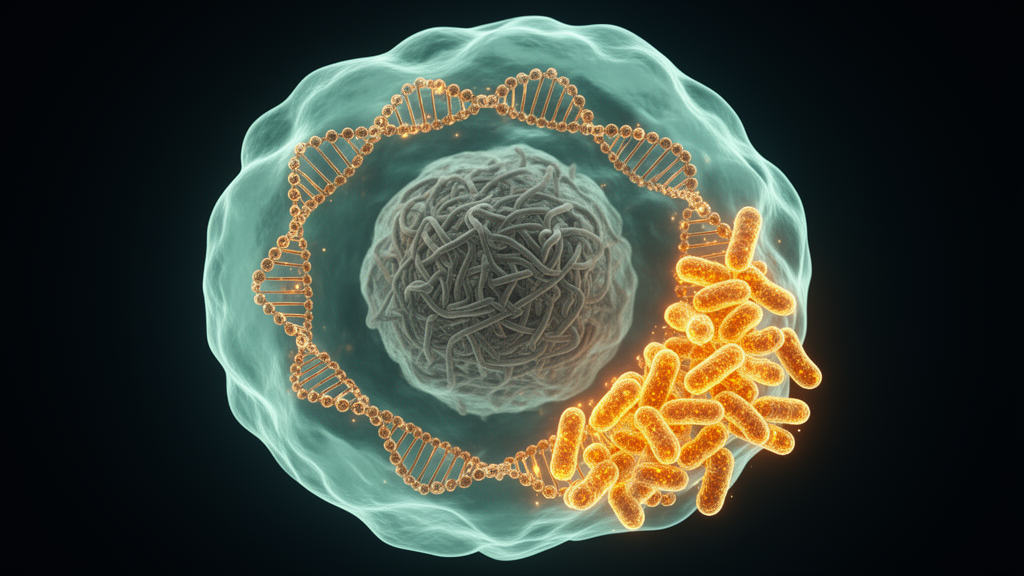
When Salmonella slips into a macrophage, the two combatants open fire within minutes. The bacterium deploys a molecular syringe to suppress the host’s inflammatory alarm, while the macrophage races to manufacture defensive proteins before it dies. A new study has now mapped this opening skirmish with high resolution, and its central finding is striking: Salmonella’s SPI-1 secretion machinery can throttle the inflammatory transcriptional response driven by the innate immune receptor TLR4, yet it leaves the receptor’s translational program untouched. The macrophage, it turns out, keeps a second, faster weapon loaded.
The research focused on the first hour of infection, a window that matters enormously because most infected macrophages do not survive long. More than half die within sixty minutes, and over eighty percent are gone by four hours, killed by inflammasome-driven pyroptosis triggered by effectors delivered through Salmonella’s SPI-1 injectisome, a process the study found to be independent of TLR4 activation. That leaves infected cells only a brief interval in which they can produce the proteins needed to coordinate the immune response. The team hypothesized that in such a compressed timeframe, targeted translational upregulation, which can act on pre-existing mRNAs and boost synthesis from newly transcribed, low-abundance transcripts, would be critical, enabling a faster response than transcriptional regulation alone.
To dissect the host response, the researchers exploited two genetic tools: macrophages lacking TLR4, the receptor that recognizes the bacterial outer-membrane molecule lipopolysaccharide, and a Salmonella strain, ΔprgJ, that cannot assemble a functional SPI-1 injectisome. They infected wild-type and TLR4-deficient bone marrow-derived macrophages with either wild-type or injectisome-mutant bacteria, flash-freezing samples every fifteen minutes for the first hour. Each time point was analyzed with parallel RNA sequencing, which measures mRNA abundance, and ribosome profiling, or Ribo-seq, a highly sensitive technique that reveals the global translatome at the moment of harvest by sequencing the roughly thirty-nucleotide mRNA fragments protected from nuclease digestion by translating ribosomes. Because the data were highly phased, the team could restrict their analysis to in-frame reads that map to coding sequences, reflecting ribosomes moving in three-nucleotide increments during decoding.
The morphological data alone revealed that two independent mechanisms drive the early macrophage response. Both wild-type and injectisome-mutant Salmonella induce ruffling of the cell membrane, driven by host actin polymerization, within fifteen minutes of infection. But TLR4-deficient macrophages ruffle only when infected with wild-type bacteria, not with the SPI-1 mutant, and they actually show a higher proportion of ruffled cells than wild-type macrophages after wild-type infection, likely because they lack the TLR4-dependent resolution mechanisms that normally rein in membrane ruffling. Consistent with this, purified LPS induced ruffling in a strictly TLR4-dependent manner, whereas the TLR2/1 agonist Pam3CSK4, the TLR5 ligand flagellin, and inert fluorescent beads did not induce ruffling in either cell type.
At the transcriptional level, the first hour was, as anticipated, remarkably quiet. Only eleven genes showed TLR4-dependent and Salmonella infection-dependent upregulation of mRNA abundance during wild-type infection, including Acod1, Olr1, Il1a, and Cxcl1, whose transcripts rose gradually over the hour. When the bacteria lacked the injectisome, however, twenty-nine genes were TLR4-dependently upregulated, with thirteen, among them Maff, Nfkbiz, Socs3, Tnfaip3, Tnf, Il10, Cxcl2, and Ptgs2, reaching their greatest expression in injectisome-mutant infection. Gene Ontology enrichment confirmed these transcripts encode immune and defense-response proteins. Notably, anti-apoptotic BCL2A1 family genes were upregulated only in injectisome-mutant infection, precisely the condition in which host cell death was minimal during this timeframe.
The translational picture was far richer. Forty-four and forty-six genes showed TLR4-dependent increases in protein synthesis during wild-type and injectisome-mutant infection respectively, with twenty-seven percent shared between the two conditions, a greater overlap than in the RNA data. Crucially, significantly more genes were upregulated at the level of protein synthesis than of RNA abundance, meaning the increases in synthesis cannot be explained by rising transcript numbers alone. By comparing parallel Ribo-seq and RNA-seq data, the team calculated translational efficiency, the relative number of ribosomes per transcript, for every gene. This analysis demonstrated that variation in gene expression during the first sixty minutes was predominantly driven by changes in translation, with more genes upregulated translationally than transcriptionally in every condition, and that the combined absence of host TLR4 and the bacterial SPI-1 injectisome substantially diminished this translational response.
Eleven genes showed clear TLR4-dependent translational upregulation: Ccl3, Cxcl2, Dusp1, Fos, Ier3, Il10, Osm, Ptgs2, Tnf, Zfp36, and Zfp36l2. Six of these encode direct cell-to-cell signaling molecules, including the pro-inflammatory cytokines TNF, CXCL2, and CCL3, and the enzyme PTGS2, also called COX2, which generates pro-inflammatory prostaglandins. The response is supported by rapid synthesis of the c-FOS transcription factor, the stress-survival factor IER3, and the pleiotropic cytokine OSM. Yet alongside this inflammatory axis, the macrophage simultaneously translates apparent resolution factors: the MAPK/JNK phosphatase DUSP1, the AU-rich RNA-destabilizing proteins ZFP36 and ZFP36L2, and the anti-inflammatory cytokine IL-10. The concurrent translation of these negative feedback mediators suggests the TLR4-driven burst of inflammatory protein synthesis is designed to be self-limiting. The eleven genes also fell into three clusters by translational behavior, ranging from concurrent transcriptional and translational induction to translation-only responses with little transcriptional change.
Here the study delivers its headline result. The translational efficiency of these eleven genes during wild-type Salmonella infection exceeded that during injectisome-mutant infection, despite lower transcript abundance in the wild-type condition. In other words, the SPI-1 injectisome attenuates the TLR4-dependent transcriptional response, likely through effectors modulating signaling downstream of the receptor, but this inhibition occurs downstream of the branch governing translational regulation. The translational response is not repressed; rather, it is maximal when the injectisome is intact, suggesting the secretion system somehow augments TLR4-dependent increases in translation, perhaps through effectors delivered into the host cell or as a response to injectisome-mediated membrane injury. K-mer enrichment analysis reinforced the mechanism: the 3′ untranslated regions of all eleven transcripts carry multiple copies of a six-nucleotide AU-rich motif, UAUUUA, aligning with previous reports that LPS-driven translational reprogramming operates through RNA-binding proteins that recognize AU-rich elements.
Validation experiments confirmed the sequencing data. Quantitative RT-PCR closely matched the RNA-seq measurements for Tnf and Fos, and western blotting showed that TNF-α protein was detected only in injectisome-mutant infection of wild-type macrophages, mirroring the condition with maximal expression in the Ribo-seq data. c-FOS protein was significantly more abundant in wild-type than TLR4-deficient macrophages for both bacterial strains, although the protein appeared downregulated in wild-type-infected TLR4-deficient cells despite similar inferred translation, hinting at additional post-translational regulation of c-FOS abundance.
The authors acknowledge limitations: the analysis is confined to the first sixty minutes, before broader transcriptional responses emerge and Salmonella transitions toward SPI-2-associated intracellular remodeling; bulk profiling may obscure differences between infected and bystander cells; and the specific SPI-1 effectors responsible for transcriptional inhibition remain unidentified. The work used the non-typhoidal Salmonella Typhimurium strain SL1344, and validation in other serovars would be needed given their pathogenic and metabolic diversity. Still, the implications are broad. Many bacterial pathogens employ effectors to target host transcriptional responses, and understanding how translational control persists or adapts in the face of this common bacterial strategy could reveal the regulatory networks that ultimately decide the outcome of infection. In the opening minutes of the macrophage-Salmonella battle, the host’s translational program is the weapon the bacterium cannot yet silence.
Subject of Research: TLR4-dependent transcriptional and translational responses in macrophages during the first hour of Salmonella infection
Article Title: Toll-like receptor 4-driven translational reprogramming in macrophages is unaffected by Salmonella SPI-1 activity
Article References: Wood, G., Johnson, R., Brember, M. P., Lastovka, F., Tourlomousis, P., Bryant, C. E., & Chung, B. Y. W. (2026). Toll-like receptor 4-driven translational reprogramming in macrophages is unaffected by Salmonella SPI-1 activity. iScience, 29(11), Article 117901. https://doi.org/10.1016/j.isci.2026.117901
Image Credits: AI Generated
DOI: 10.1016/j.isci.2026.117901
Keywords: Salmonella, TLR4, macrophages, translation, Ribo-seq, SPI-1 injectisome, innate immunity, cytokines, translational efficiency, LPS, inflammation, gene expression
Cite Scienmag News
Juliet Wilcox. (October 26, 2026). Salmonella silences inflammatory genes transcriptionally, but macrophage translation escapes. Scienmag. https://scienmag.com/salmonella-silences-inflammatory-genes-transcriptionally-but-macrophage-translation-escapes/
Juliet Wilcox. "Salmonella silences inflammatory genes transcriptionally, but macrophage translation escapes." Scienmag, 26 October 2026, https://scienmag.com/salmonella-silences-inflammatory-genes-transcriptionally-but-macrophage-translation-escapes/. Accessed 26 October 2026.
Juliet Wilcox. "Salmonella silences inflammatory genes transcriptionally, but macrophage translation escapes." Scienmag. October 26, 2026. https://scienmag.com/salmonella-silences-inflammatory-genes-transcriptionally-but-macrophage-translation-escapes/


