


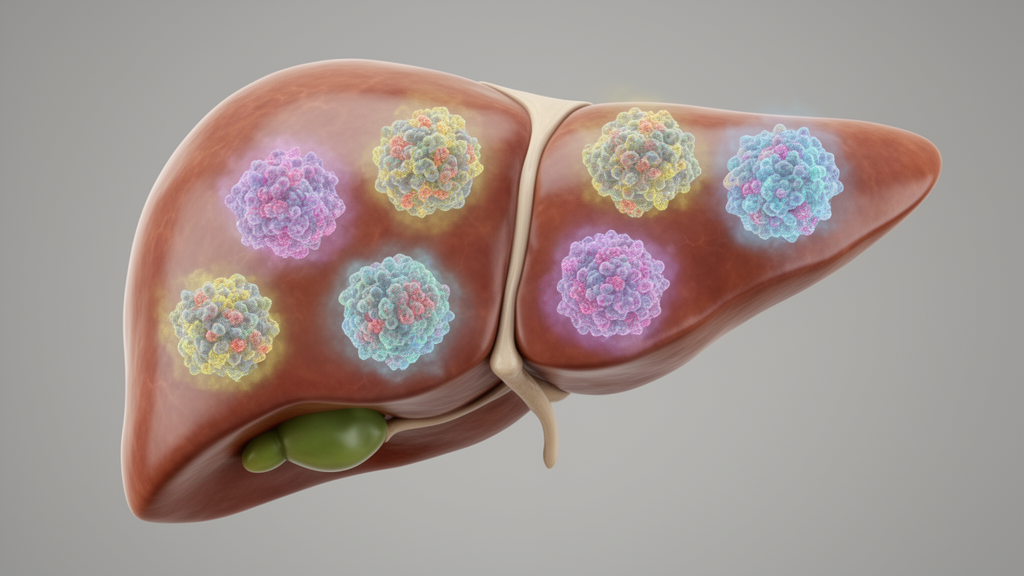
A Mini Review concludes that artificial intelligence could help distinguish the genetic, cellular and treatment-associated features of ovarian cancer liver metastases, but warns that direct molecular evidence from hepatic lesions remains sparse and no AI-integrated system is ready to select liver-directed treatment. The proposed approach combines matched tissue sampling, spatial profiling, conventional genomic analysis and carefully validated computational models. Its immediate value lies in generating and testing reproducible biological hypotheses across defined types of liver involvement rather than in replacing clinical judgment or standard testing.
The anatomical distinction is fundamental. The International Federation of Gynecology and Obstetrics staging system separates implants on the liver surface from metastases within the liver parenchyma, yet both may be grouped under the broad clinical label of liver metastasis. That label does not reveal whether lesions arose from the same clone, retain comparable DNA-repair status or have been altered by chemotherapy. A primary ovarian tumor can also fail to represent the full diversity of disease elsewhere, because metastatic sites may acquire new mutations, copy-number changes, transcriptional states and microenvironmental organization. Primary-tumor profiling is therefore a starting point rather than a complete substitute for sampling liver lesions.
Matched multiregion sequencing has already demonstrated why that distinction matters. In a small study of high-grade serous ovarian cancer, investigators examined 33 tumor regions from six patients, including two with liver metastases. Some lesions retained much of the primary tumor’s mutational history, whereas others appeared to have disseminated earlier and evolved in parallel. Because most distant metastases were sampled after chemotherapy, anatomical and temporal differences could not be cleanly separated. Even so, the findings provide direct, limited evidence that metastatic sites can diverge during evolution. They do not establish a recurrent molecular program unique to ovarian cancer liver metastases, and a variant found in one lesion must remain a candidate site-associated change until its distribution and function are tested.
Different layers of molecular information answer different questions. Germline variants establish constitutional susceptibility, whereas somatic mutations and copy-number changes describe the architecture of an established tumor. Methylation and transcriptional programs capture additional aspects of tumor evolution and cellular state. In a whole-genome analysis of 640 ovarian tumors from 243 patients, researchers identified five high-grade serous ovarian cancer subtypes, including homologous-recombination-deficient and proficient groups with distinct transcriptional programs and treatment responses. But inherited risk, tumor homologous-recombination deficiency and a lesion’s response to systemic therapy cannot be treated as interchangeable labels. A liver-focused analysis would ideally compare matched normal DNA, primary tumor, hepatic lesion and, where possible, a nonhepatic metastasis, while recording whether each specimen is a surface implant, direct extension or separate parenchymal deposit.
Treatment adds another layer of complexity. In the ARIEL2 trial, loss of BRCA1 promoter methylation was associated with resistance, even though genomic scars associated with homologous-recombination deficiency could remain detectable after platinum resistance emerged. BriTROC-1 found broad concordance in mutations and copy-number profiles between diagnosis and relapse without identifying a common acquired copy-number explanation for chemotherapy resistance. Longitudinal single-cell RNA sequencing, however, found enrichment of a stress-associated cellular state during treatment alongside changes in stromal populations. A lesion can therefore remain genetically similar to the primary tumor yet behave differently under therapy. Platinum exposure, PARP inhibitor use and the interval between treatment and sampling should be retained as essential annotations rather than treated as nuisance variables.
Spatial analysis could reveal information that bulk sequencing misses, but it must preserve the anatomy of the specimen. Ovarian cancer subclones with different copy-number patterns have been associated with distinct local environments, and single-cell studies have distinguished immune-infiltrated, immune-excluded and immune-desert phenotypes involving macrophages, fibroblasts and candidate chemokine pathways. A spatial atlas has also linked tumor-cell MHC class II expression with immune organization and outcome. These observations come largely from ovarian tumors outside the liver, however, and their hepatic relevance remains to be demonstrated directly. Similarly, mechanisms reported in colorectal cancer, melanoma or hepatocellular carcinoma can motivate experiments but cannot be transferred uncritically to ovarian cancer. Liver-derived evidence is particularly important because liver metastases from different primary cancers do not necessarily share the same biology.
For artificial intelligence to add value, it must connect these measurements without erasing their origins. Factor-based models such as MOFA+ can organize variation across molecular modalities, while GLUE relates chromatin accessibility to gene expression through a guidance graph, and MultiVI models paired or unpaired data when an assay is missing from some cells. Spatial approaches such as SpatialGlue and SMART use graph-based integration to connect molecular and spatial relationships. Foundation models including scGPT and Nicheformer may be useful in small disease-specific cohorts, but transfer to treated ovarian cancer liver metastases is an empirical question. A well-annotated modest cohort may be more informative than a larger dataset in which lesion class, sampling time or patient identity is uncertain.
These tools are hypothesis generators, not proof of mechanism. RNA-inferred copy-number change must be distinguished from DNA-confirmed alteration, particularly when constitutional predisposition or treatment selection is discussed. Likewise, a predicted ligand-receptor interaction, graph edge or cell-cell communication score is not evidence that the proposed pathway is active. Candidate programs should be localized in the tissue, supported by RNA or protein measurements and tested for recurrence across independent patients. Model performance should also be compared with simpler single-modality approaches and prespecified expression scores. For validation, all samples, sections, cells and time points from one patient must remain within the same data partition; cells or technical replicates cannot substitute for independent patients.
Clinical translation requires endpoints that match the proposed use. Prognosis, prediction of systemic-treatment response, characterization of disease distribution and estimation of benefit from a local procedure are distinct outcomes. Liver surgery is already part of contemporary ovarian cancer care, but administrative data cannot show that a molecular subgroup benefits more from resection. Trials of secondary cytoreduction have produced differing results under different selection criteria, and none isolated hepatic resection or evaluated genomic criteria for selecting patients. Trials of BRCA-mutated or homologous-recombination-deficient disease support the use of genomic information for systemic therapy, not a genomic rule for hepatectomy. Likewise, a 2026 case of prolonged hepatic control after yttrium-90 radioembolization cannot separate the intervention’s contribution from systemic treatment and other care.
The review therefore proposes a staged development pathway. The first studies should test whether reproducible tumor states occupy defined hepatic cellular neighborhoods, using consistent lesion classification, treatment annotation, pathology and assays selected for a specific question. Candidate regulatory relationships could be assessed with computational approaches such as hypergraph prediction of circRNA-miRNA interactions, but predictions would need confirmation through localization, binding assays and perturbation-rescue experiments in ovarian hepatic samples. Clinical evaluation should then examine whether AI-supported molecular information changes multidisciplinary decisions, introduces errors or delays care. Whether such information improves patient outcomes would require comparative evaluation. For now, AI-assisted genomic profiling is best regarded as a disciplined way to integrate lesion-specific biology with spatial context—not as a validated tool for choosing liver-directed therapy.
Subject of Research: AI-assisted genomic and spatial profiling of ovarian cancer liver metastases
Article Title: Artificial intelligence assisted genomic profiling of ovarian cancer liver metastases
Article References: Sun, L., Li, Z., & Chen, S. (2026). Artificial intelligence assisted genomic profiling of ovarian cancer liver metastases. Frontiers in Genetics, 17, Article 2004540. https://doi.org/10.3389/fgene.2026.2004540
Image Credits: AI Generated
DOI: 10.3389/fgene.2026.2004540
Keywords: artificial intelligence, ovarian cancer, liver metastases, spatial transcriptomics, genomic profiling, tumor evolution, high-grade serous ovarian cancer, cancer microenvironment, machine learning, precision medicine, Artificial, intelligence
Cite Scienmag News
Nathaniel Bowman. (October 20, 2026). AI could clarify molecular diversity in ovarian cancer liver metastases. Scienmag. https://scienmag.com/ai-could-clarify-molecular-diversity-in-ovarian-cancer-liver-metastases/
Nathaniel Bowman. "AI could clarify molecular diversity in ovarian cancer liver metastases." Scienmag, 20 October 2026, https://scienmag.com/ai-could-clarify-molecular-diversity-in-ovarian-cancer-liver-metastases/. Accessed 20 October 2026.
Nathaniel Bowman. "AI could clarify molecular diversity in ovarian cancer liver metastases." Scienmag. October 20, 2026. https://scienmag.com/ai-could-clarify-molecular-diversity-in-ovarian-cancer-liver-metastases/


