


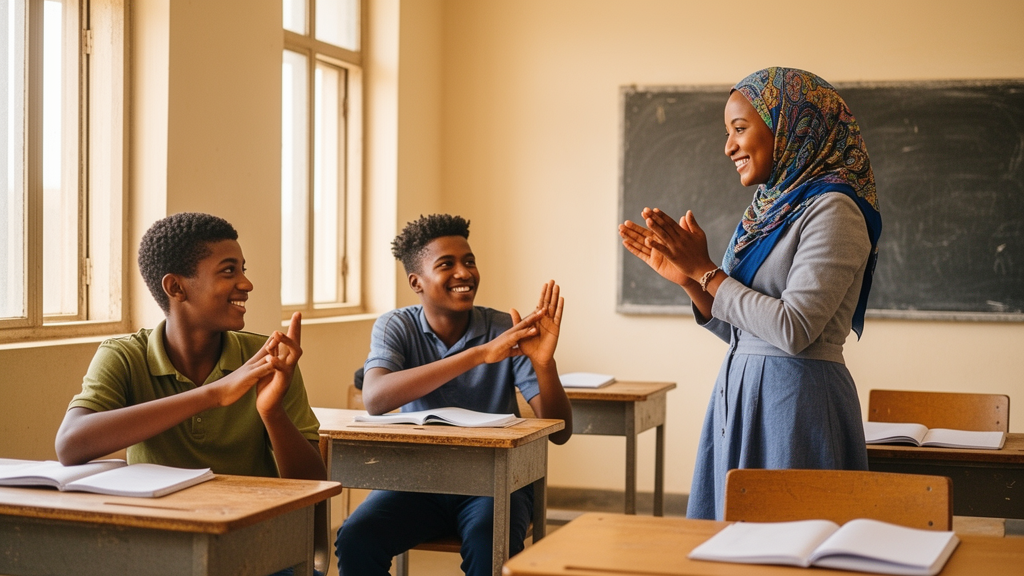
In the middle schools of Dessie City, Ethiopia, a quiet revolution in understanding academic success is taking shape. A new study published in Discover Education suggests that for students with hearing impairment, the grades written on report cards may depend as much on what happens inside the mind as on what happens in the classroom. Researchers Mengistu Awlachew Zemedkun of Dessie College of Teachers Education and Seifemichael Tsegaye of Wollo University found that two psychological factors—emotional well-being and social self-concept—together explain more than a third of the variation in academic achievement among deaf and hard-of-hearing learners. The finding, drawn from one of the first investigations of its kind in the Ethiopian context, challenges the assumption that instructional quality and resources alone determine how students with disabilities perform at school.
The research team surveyed 140 students with hearing impairment enrolled in Grades 7 and 8 across 27 middle schools that operate integrated education programs. Rather than sampling a subset, the investigators used a comprehensive technique, including every eligible student within the selected schools, which minimized sampling bias and strengthened the internal validity of the results. Academic performance was measured objectively from official school records, using each student’s cumulative first-semester average across nine core subjects, including Amharic, mathematics, English, and general science. Psychological variables were captured through standardized self-report questionnaires, carefully translated from English into Amharic and then into Ethiopian Sign Language so that every participant could respond accurately and comfortably.
The instruments themselves underwent rigorous validation. The 42-item emotional well-being scale, adapted from Patel and Dhar, asks students to rate statements about their feelings, stress, and emotional balance on a five-point scale. The 14-item social self-concept questionnaire, adapted from Laryea, probes how students perceive their own social competence on a four-point scale. Both were pilot-tested with deaf students at a nearby school and showed strong internal consistency, with Cronbach’s alpha values of 0.933 and 0.810 respectively. Forward-backward translation and review by language specialists ensured the Amharic versions preserved the meaning of the original items, a technical detail that matters enormously when measuring subtle psychological constructs across languages and communication modes.
The headline result is striking. Students with hearing impairment in the sample achieved a mean academic score of 62.56 percent, with a standard deviation of 9.94—firmly within the national “satisfactory” band of 60 to 79 percent and significantly above the 50 percent pass mark. A one-sample t-test confirmed the difference was statistically robust, t(139) = 14.95, p < 0.001. This alone is a noteworthy finding, countering deficit narratives that portray deaf learners as inevitably lagging behind. On average, these students were not merely passing; they were performing at a level Ethiopian education policy formally classifies as satisfactory.
But the study’s central contribution lies in its analysis of prediction. Emotional well-being correlated positively with academic performance at r = 0.559, and social self-concept at r = 0.487, both highly significant. When the researchers entered both variables into a multiple regression model, the combined predictors explained 35.9 percent of the variance in academic achievement—a substantial share for two psychological variables. Emotional well-being emerged as the stronger predictor, with a standardized beta of 0.417, while social self-concept contributed a beta of 0.258. In practical terms, the regression equation implies that a ten-point gain in emotional well-being corresponds to roughly a 1.6-point rise in cumulative academic scores, while a ten-point gain in social self-concept corresponds to approximately a 5.2-point rise.
The asymmetry between the two predictors is where the study becomes genuinely revealing. Emotional well-being alone accounted for 31.2 percent of the variance, whereas social self-concept independently explained only 4.7 percent. The authors attribute this gap to the specific conditions of Ethiopian integrated schools. Classroom communication for deaf students frequently generates acute emotional responses—frustration, anxiety, and stress—that can derail attention and persistence in the moment. Emotional regulation, in this view, acts as a proximal mechanism directly governing engagement with learning tasks. Social self-concept, by contrast, operates through broader processes of peer integration and social adjustment, exerting a more indirect influence on day-to-day academic behavior.
Context amplifies this pattern. Many Ethiopian schools lack dedicated psychological counseling services, meaning deaf students must rely heavily on their own internal coping resources when communication barriers arise. Where formal support structures are thin, the capacity to manage one’s own emotional state becomes correspondingly more consequential. This interpretation aligns with the theoretical framework the researchers built from three established models: the Self-Worth Theory of Motivation, which holds that students who feel valued engage more persistently with academic tasks; Expectancy-Value Theory, in which confidence and perceived task value drive effort; and Ecological Systems Theory, which situates individual development within nested layers of family, school, and peer environment.
The study is careful about its limits, and readers should be too. Its cross-sectional design captures associations at a single point in time, so causal direction cannot be established—it remains possible that students who perform well academically subsequently feel better about themselves, rather than the reverse. Self-report measures are vulnerable to social desirability bias, and the sample was confined to urban middle schools in a single city administration, restricting generalizability to rural Ethiopia or to specialized schools for the deaf. The remaining 64.1 percent of unexplained variance is itself informative: instructional quality, teacher attitudes, parental involvement, degree of hearing loss, socioeconomic status, and cognitive factors all likely shape outcomes in ways this model did not test.
Even with those caveats, the implications are hard to ignore. If more than a third of academic achievement among deaf learners traces back to emotional and social psychological factors, then schools that focus exclusively on curriculum and accommodations are addressing only part of the problem. The researchers recommend structured counseling services and peer-support programs tailored to deaf students, teacher training in sign language and cooperative learning strategies, sustained parental emotional support, and inclusive education policies that mandate psychosocial services alongside academic accommodations. For a country expanding its integrated education programs, the message is that emotional well-being is not a luxury or an afterthought—it is, on the evidence, one of the strongest levers available for lifting the school outcomes of students who cannot hear the lesson but are determined to learn it anyway.
Subject of Research: Psychological predictors of academic achievement among students with hearing impairment in Ethiopian inclusive middle schools
Article Title: Emotional well-being and social self-concept as predictors of academic achievement among students with hearing impairment in middle schools of Dessie City Ethiopia
Article References: Zemedkun, M. A., & Tsegaye, S. (2026). Emotional well-being and social self-concept as predictors of academic achievement among students with hearing impairment in middle schools of Dessie City Ethiopia. Discover Education, 5(1), Article 962. https://doi.org/10.1007/s44217-026-02187-1
Image Credits: AI Generated
DOI: 10.1007/s44217-026-02187-1
Keywords: hearing impairment, emotional well-being, social self-concept, academic achievement, inclusive education, Ethiopia, educational psychology, deaf students, middle school, multiple regression, psychosocial support, special needs education
Cite Scienmag News
Courtney Benton. (October 19, 2026). Emotions and Self-Image Drive School Success for Deaf Students in Ethiopia. Scienmag. https://scienmag.com/emotions-and-self-image-drive-school-success-for-deaf-students-in-ethiopia/
Courtney Benton. "Emotions and Self-Image Drive School Success for Deaf Students in Ethiopia." Scienmag, 19 October 2026, https://scienmag.com/emotions-and-self-image-drive-school-success-for-deaf-students-in-ethiopia/. Accessed 19 October 2026.
Courtney Benton. "Emotions and Self-Image Drive School Success for Deaf Students in Ethiopia." Scienmag. October 19, 2026. https://scienmag.com/emotions-and-self-image-drive-school-success-for-deaf-students-in-ethiopia/


