


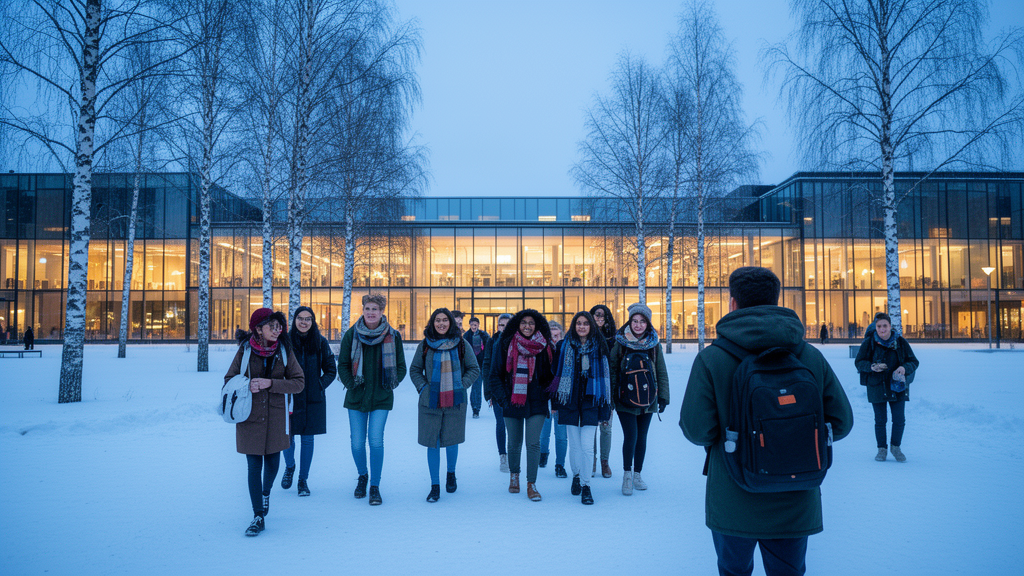
International students who pay tuition fees to study at Finnish universities arrive with a powerful expectation: that a degree will serve as a bridge to meaningful work, a better standard of living and a better life. Yet a new study from the University of Eastern Finland reveals that this expectation is caught in a painful contradiction. The same political and labor market forces that welcome these students as skilled future workers also make it harder for them to stay, find jobs matching their education and build the lives they imagined. The result, researchers say, is a form of what scholars call cruel optimism, in which the pursuit of a better life becomes an obstacle to success and well-being.
The study, published in the Nordic Journal of Transitions, Careers and Guidance, examined the career expectations and identity construction of tuition fee-paying students in Finnish universities. Doctoral Researcher Jarkko Immonen, the lead author, interviewed fifteen tuition fee-paying master’s students at the universities of Helsinki and Eastern Finland. The interviewees varied greatly in age, family and life situation, work experience and field of study, giving the researchers a broad view of how non-EU students interpret the ideals attached to university education and what they expect from their studies and careers.
The theoretical lens of cruel optimism, drawn from affect theory, proved central to the analysis. The concept describes a state in which an object of desire, such as the promise of a good life through education and work, simultaneously sustains and obstructs the person pursuing it. In the Finnish context, the researchers found that the promise is intertwined with neo-liberal ideals of the so-called good immigrant, a figure who studies diligently, works hard and integrates into the labor market. These ideals both support students, giving them direction and motivation, and appear as dehumanizing demands to work more, better and harder while the life they imagined keeps slipping further away.
The analysis highlighted students’ stress, frustration and strain caused by unmet expectations and a longer-than-expected struggle phase. It also revealed the interviewees’ need to be seen as fully fledged individuals rather than as categories such as customers, immigrants or workforce. The neo-liberal framing, the researchers found, makes university education look like a tool for entering the workforce and presents working as the only legitimate way to participate in society. Students internalize this framing, but the lived reality of the Finnish labor market repeatedly contradicts it.
Previous studies have shown that non-EU university students in Finland encounter a highly conflicting social reality. University policies perceive them as VIP customers, and political debate portrays them as good immigrants and desired workforce after graduation. Universities themselves market the smooth transition to Finnish working life as a successful educational outcome, using it to attract students in the global education market. At the same time, structural racism and other discrimination in the labor market, strict economic and time-related conditions for studying, and residence permit bureaucracy make it substantially more difficult to find a job that matches one’s education.
This contradiction poses a challenge to the practices and ethics of career counselling at universities. While the educational policy objective of career counselling is to streamline transitions to work, the researchers argue that, as a practice, it should also examine these conflicts and inequalities critically. Cruel optimism offers a useful tool for career counselling research and professional practices to identify how career-related neo-liberal ideals are normalized, what they hide from sight, how they are resisted and what tensions are built between these ideals and the lived experiences of individuals.
In Finnish political debate, Immonen notes, it remains undecided whether the internationalization of education is a solution to the challenges of an ageing Finland. On one hand, internationalization is a stated political objective aimed at bringing skilled labor to the Finnish labor market. On the other, immigration discussion and policies are becoming stricter, the conditions for staying in the country are being tightened, and structural discrimination in the labor market is making the stated objective harder to achieve. This leads to a situation in which higher education institutions attract new students to Finland to the best of their ability, while politics and the labor market push them out.
The study also identified a phenomenon the researchers call the doctoral funnel. For many tuition fee-paying students, the dissertation path starts to appear as a sensible choice toward employment at some point of their studies. When all other doors to the labor market seem to remain closed, writing a doctoral dissertation may seem like the only way to stay in Finland, even if doing research would not otherwise seem like the natural choice. Writing a dissertation also increases the pressure on academic success at the master’s stage, which is already a high-pressure phase of life for tuition fee-paying students. There is a limited number of spots available for doctoral students and even fewer for paid positions.
The doctoral funnel carries its own risks. Writing a dissertation is a very demanding project, and if a student has no genuine interest in doing it, they may struggle with motivation or coping at a later stage. The researchers suggest that career counselling should recognize these dynamics rather than treat the doctoral path as a straightforward employment solution. For the students interviewed, the imagined better life remained the object of their pursuit, but the structural conditions of the Finnish labor market and immigration system kept transforming that pursuit into a source of strain. The study’s findings point to the need for universities, policymakers and employers to confront the gap between the promise sold in the global education market and the reality experienced by the students who buy into it.
Subject of Research: Sociology of Education
Article Title: Higher education institutions attract international students to Finland, while politics and the labor market push them out – students face conflicting pressures
Article References: Higher education institutions attract international students to Finland, while politics and the labor market push them out – students face conflicting pressures. Original publication (Bibliographic details unavailable.)
Image Credits: AI Generated
DOI: Not provided
Keywords: international students, Finland, higher education, cruel optimism, career counselling, labor market, immigration policy, doctoral funnel, University of Eastern Finland, tuition fees, structural discrimination, Nordic Journal of Transitions Careers and Guidance
Cite Scienmag News
Courtney Benton. (October 19, 2026). Finland’s Universities Woo International Students While Politics and the Labor Market Push Them Out. Scienmag. https://scienmag.com/finlands-universities-woo-international-students-while-politics-and-the-labor-market-push-them-out/
Courtney Benton. "Finland’s Universities Woo International Students While Politics and the Labor Market Push Them Out." Scienmag, 19 October 2026, https://scienmag.com/finlands-universities-woo-international-students-while-politics-and-the-labor-market-push-them-out/. Accessed 19 October 2026.
Courtney Benton. "Finland’s Universities Woo International Students While Politics and the Labor Market Push Them Out." Scienmag. October 19, 2026. https://scienmag.com/finlands-universities-woo-international-students-while-politics-and-the-labor-market-push-them-out/


