


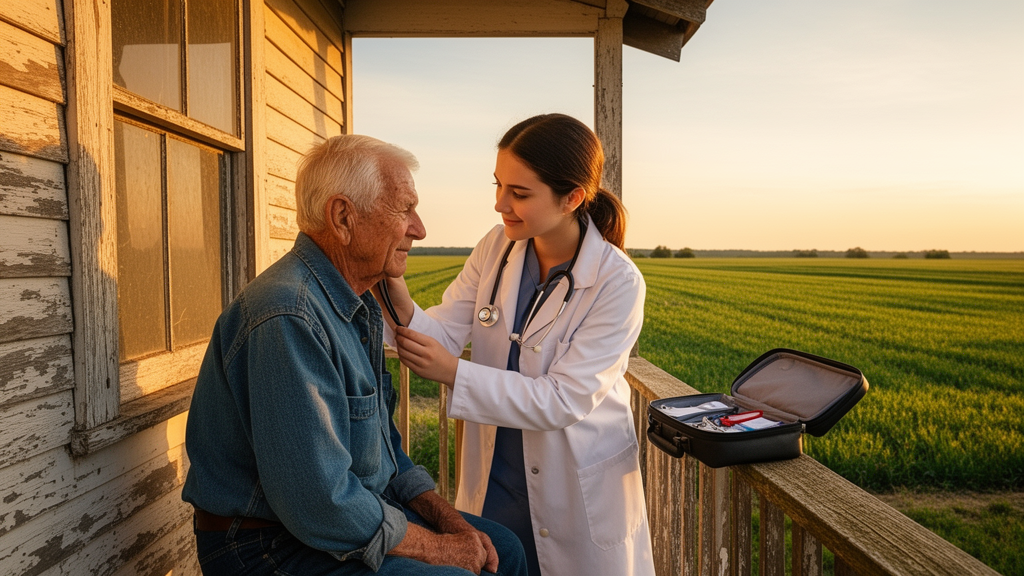
Where a doctor trains may shape where that doctor ultimately chooses to work, and a new paper led by Flinders University argues that this simple relationship could hold one of the most practical answers to a stubborn global problem: the chronic shortage of medical care in rural, regional and remote communities. Published in the British Medical Journal, the paper draws on evidence from Australia, the United States and other underserved regions to make the case that medical schools have a distinctive opportunity to strengthen healthcare access by preparing future doctors to deliver care that is locally relevant, culturally responsive and grounded in the actual needs of the communities they serve. The authors contend that rural medical education is not a peripheral niche of training but one of the most effective available strategies for building a sustainable health workforce in the places that need it most.
Lead author Professor James Smith, a Matthew Flinders Professor of Health and Social Equity and Co-Director of the FHMRI Health Equity Impact Program at Flinders University, frames the issue in starkly equitable terms. Where someone lives, he argues, should not determine the quality of healthcare they receive. His position reflects a growing body of international research showing that the geography of medical training matters as much as its content. Students who spend meaningful time living and learning in rural communities develop a deeper understanding of local health priorities, form professional and personal relationships in those settings, and are substantially more likely to build their careers there. The implication is that workforce distribution can be influenced long before a graduate ever signs an employment contract, simply by changing where education takes place.
The paper points to Australia’s sustained investment in rural medical education over the past two decades as evidence that targeted training programs can deliver measurable benefits. Between 2016 and 2018, more than 30 per cent of government-supported medical students spent a year or longer at a rural clinical school, an extended immersion that goes well beyond the short observational placements common in many curricula. Graduates with substantial rural placement experience were significantly more likely to enter rural medical practice after qualifying. This pattern, documented across multiple cohorts and consistent with findings from the United States and elsewhere, suggests that extended place-based learning functions as a form of workforce pipeline: the community effectively gets to know the student, and the student gets to know the community, before either commits.
The technical logic behind this effect is worth unpacking. Rural and remote practice demands a distinctive skill set that differs in important ways from metropolitan hospital medicine. Practitioners in small communities often work with broader scopes of practice, fewer on-site specialists, limited diagnostic infrastructure and greater reliance on telehealth and coordinated referral networks. They must also navigate the social determinants of health that weigh heavily in remote settings, including housing, food security, transport and environmental exposures. Training in these environments allows students to acquire procedural confidence, adaptability and systems literacy that classroom-based urban education struggles to replicate. Equally important, it cultivates relationships, with local clinicians, community organisations and patients, that make rural practice feel achievable and attractive rather than isolating.
Associate Professor Emma Kennedy AM, a co-author of the paper, emphasises that successful healthcare is built on strong community connections. Healthcare, she notes, is about more than treating illness; it is also about understanding people, families and communities. Rural medical education is at its best, in her view, when future doctors learn alongside the communities they will one day serve. This framing shifts the purpose of rural placements from a logistical exercise, sending students somewhere for a rotation, to an educational philosophy in which the community itself is a co-teacher. Community partnerships of this kind require sustained institutional commitment, mutual respect and genuine benefit flowing back to the host community, not merely the extraction of training opportunities.
A central argument of the paper concerns First Nations knowledge, sovereignty and leadership. The authors state that reconciling and recognising First Nations sovereignty is critical to advancing health and wellbeing outcomes, and they call on medical schools to increase support for First Nations students, strengthen opportunities for First Nations leadership, and embed cultural safety throughout medical training. Cultural safety, in this context, is not a checklist of cultural awareness content but an ongoing standard of practice in which healthcare is delivered in ways that recognise power imbalances, respect identity and meet the expectations of the community being served. Embedding it throughout training, rather than confining it to a single module, is presented as essential to producing graduates who can work effectively and respectfully with First Nations patients and communities.
Co-author Professor Jaquelyne Hughes, a Torres Strait Islander woman of the Wagadagam people, argues that First Nations perspectives are essential to building effective healthcare systems. Communities, she says, hold valuable knowledge about what works for their people. When First Nations voices are included in education, research and healthcare delivery, the result is a stronger system that is more culturally responsive and more effective for everyone. Her point carries a broader methodological implication for medical education: knowledge about health is not held exclusively by universities and hospitals. Communities with long histories of managing health, illness and wellbeing in their own contexts possess expertise that, when genuinely incorporated into curricula and governance, improves the fit between services and the populations they are meant to reach.
The paper also highlights the importance of recruiting more students from rural backgrounds into medical careers. The evidence here parallels the placement findings: students who come from regional, rural and remote areas are often more likely to return to those communities after graduating, bringing with them an existing understanding of local life and, frequently, family and social ties that anchor them in place. Admission policies, financial support and pathway programs that widen access for rural students are therefore not simply equity measures, although they are that too; they are workforce strategies. Combined with extended rural placements and community-embedded curricula, they form a coherent pipeline in which recruitment, training and retention reinforce one another rather than operating as disconnected stages.
The international scope of the argument is significant. Rural health workforce shortages are not unique to Australia; they affect the United States, Canada, and many low- and middle-income countries where remote communities face the compounding disadvantages of distance, infrastructure gaps and historical inequities. By drawing on evidence across these settings, the authors position rural medical education as a transferable model rather than a local experiment. The core principles, extended place-based learning, genuine community partnership, cultural safety, First Nations leadership in curriculum and governance, and targeted recruitment of rural-origin students, can be adapted to different health systems while retaining the same underlying mechanism: aligning the location and culture of training with the locations and cultures where care is most needed.
Professor Smith summarises the investment case plainly: investing in rural medical education is ultimately an investment in healthier communities. By building training opportunities in rural and remote settings and listening to communities, he argues, it is possible to build a stronger workforce, reduce health inequities and improve health outcomes for future generations. The paper, published as a commentary in the BMJ, arrives at a moment when health systems in multiple countries are grappling with maldistributed workforces and persistent gaps in outcomes between metropolitan and remote populations. Its message is that the solution does not begin in the clinic or the employment market, but earlier, in the design of medical education itself, and that the communities long underserved by that education are also the ones best placed to help redesign it.
Subject of Research: Rural and remote medical education with First Nations communities and its impact on healthcare workforce distribution
Article Title: Rural medical training key to stronger healthcare in First Nations communities
Article References: Rural medical training key to stronger healthcare in First Nations communities. Original publication (Bibliographic details unavailable.)
Image Credits: AI Generated
DOI: Not provided
Keywords: rural medical education, First Nations health, Flinders University, British Medical Journal, health equity, workforce sustainability, cultural safety, rural clinical schools, community partnerships, remote healthcare, medical training, health workforce
Cite Scienmag News
Courtney Benton. (October 19, 2026). Training Doctors Where People Live Could Fix Rural Healthcare Shortages. Scienmag. https://scienmag.com/training-doctors-where-people-live-could-fix-rural-healthcare-shortages/
Courtney Benton. "Training Doctors Where People Live Could Fix Rural Healthcare Shortages." Scienmag, 19 October 2026, https://scienmag.com/training-doctors-where-people-live-could-fix-rural-healthcare-shortages/. Accessed 19 October 2026.
Courtney Benton. "Training Doctors Where People Live Could Fix Rural Healthcare Shortages." Scienmag. October 19, 2026. https://scienmag.com/training-doctors-where-people-live-could-fix-rural-healthcare-shortages/


