


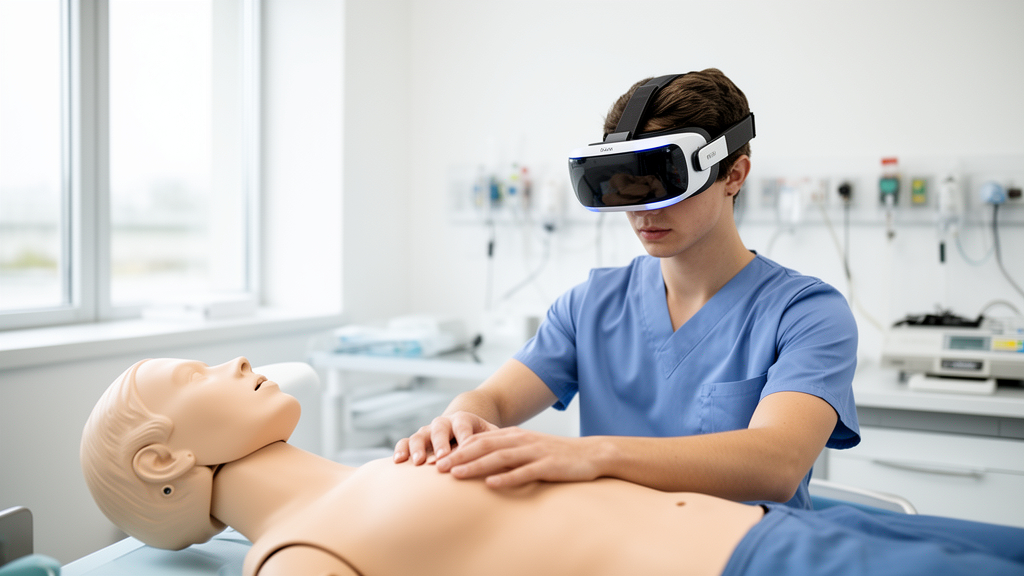
Medical students around the world are increasingly strapping on virtual reality headsets to practice everything from resuscitation to ultrasound-guided needle placement, and a new systematic review has now delivered the most rigorous verdict yet on whether this futuristic approach actually works. The review, published in Discover Education, examined 31 studies involving 4,926 undergraduate medical students and found that fully immersive virtual reality generally improved or matched conventional training for immediate clinical skill performance. But the researchers also issued a sobering caveat: the certainty of that evidence is low to very low, meaning educators should embrace the technology as a complement to hands-on teaching rather than a replacement.
The team, led by Farzad Abaszadeh of Kerman University of Medical Sciences and colleagues at Shiraz University of Medical Sciences in Iran, deliberately narrowed their focus in a way previous reviews had not. Earlier syntheses had lumped together desktop simulations, semi-immersive projection systems, augmented reality overlays, and fully immersive head-mounted displays, muddying the picture for educators deciding what to buy and how to deploy it. This review accepted only studies using head-mounted displays such as the Oculus Rift, HTC Vive, or Meta Quest, where the learner’s entire visual field is replaced by a computer-generated environment, and only where students actively practiced psychomotor skills rather than passively watching 360-degree videos. The search window began in January 2014, capturing the modern era of consumer-accessible high-fidelity headsets that started with the Oculus Rift DK2.
The technical distinction matters because immersion changes the learning mechanism. Fully immersive systems use stereoscopic visualization, head tracking, and motion-based hand interactions to generate a sense of presence, the subjective feeling of being physically situated inside the virtual environment, together with embodied interaction that approximates real clinical performance. That heightened realism theoretically supports deliberate practice, immediate feedback, and repeated exposure to rare or high-risk scenarios, all pillars of mastery-based education. Yet the review’s authors argued that evidence from older, non-immersive platforms cannot simply be assumed to transfer to these newer systems, which is precisely why they applied the GRADE framework to grade how much confidence the evidence actually deserves.
After screening 2,847 records from five databases plus grey literature, the reviewers included 19 randomized controlled trials and 12 observational studies published between 2016 and 2024 across Europe, North America, Asia, and Australia. Sample sizes ranged from 12 to 529 participants, with a median of 56. The studies fell into four clinical domains: emergency and urgent care procedures, diagnostic and physical examination skills, surgical and technical skills, and imaging and procedural guidance. So much clinical and methodological heterogeneity existed across hardware, instructional design, comparators, and outcome measures that the team could not pool results statistically and instead performed a narrative synthesis guided by the SWiM reporting guideline.
The strongest and most consistent evidence emerged from an unexpected quarter: imaging and procedural guidance. All four studies in this domain were randomized controlled trials, covering point-of-care ultrasound, ultrasound-guided vascular access, and arterial blood gas collection, and they consistently showed immersive VR was non-inferior or superior to conventional instruction. The greatest benefits appeared in tasks demanding spatial understanding, image interpretation, and coordination of psychomotor actions, where immersive three-dimensional visualization of anatomy seemed to accelerate learning. One high-quality trial even demonstrated that self-directed VR training matched instructor-led ultrasound teaching while substantially reducing start-up costs, a finding with significant implications for scalability in resource-strapped medical schools.
Emergency and urgent care training also fared well, with 12 studies involving 1,560 students. Structured procedural tasks such as basic life support, pediatric respiratory assessment, and nasopharyngeal swab collection showed clear gains or equivalence with conventional training, and a dose-response trial suggested repeated VR sessions maintained emergency skills better than single or infrequent exposures. But a cautionary note came from a crossover study finding that the physical constraints of VR equipment reduced the quality of chest compressions during CPR, with compression depth and recoil suffering. The reviewers concluded that immersive VR should complement rather than replace mannequin-based training for procedures requiring precise physical force.
For diagnostic and physical examination skills, the evidence was largely observational, drawn from 10 studies and 745 students. VR showed promise for history taking, neurological assessment, and examinations in dermatology, ophthalmology, and gynecology, particularly because it can simulate uncommon pathological findings and allow safe, repeatable practice of sensitive or difficult-to-access examinations. However, greater immersion was associated with higher cognitive load and occasional simulator sickness, underscoring that instructional design and learner support are critical. In the surgical domain, five studies found VR equivalent but not superior to conventional instruction for basic suturing, with the volume of deliberate practice, rather than the instructional medium, emerging as the strongest predictor of skill acquisition.
The GRADE assessment laid bare the fragility of the evidence base. For immediate post-training skill performance, based on 23 studies and 2,420 participants, certainty was rated low because of serious risk of bias and imprecision. For skill retention, resting on just six studies and 380 participants, certainty was very low, leaving the long-term durability of VR-acquired skills an open question. Learner satisfaction was consistently high across 21 studies, yet subjective outcomes are notoriously susceptible to bias, so this too earned a very low certainty rating. Among the randomized trials, only four had low overall risk of bias, eleven raised some concerns, and four were judged high risk, with inadequate randomization reporting and unblinded outcome assessment the most common flaws.
Subgroup analyses sharpened the practical message. Highly interactive VR outperformed minimally interactive 360-degree video for objective skill gains, while passive video was better suited to observational learning and clinical communication. The largest benefits appeared when VR replaced passive e-learning or nothing at all; against active hands-on training with mannequins or standardized patients, VR was generally non-inferior rather than superior, suggesting its real advantages lie in accessibility, standardization, scalability, and cost rather than raw educational superiority. The authors recommend integrating immersive VR as a complement to conventional teaching, prioritizing it for skills that rely on spatial understanding and visual interpretation, building in repeated practice over time, and keeping faculty actively involved. Future research, they argue, needs adequately powered randomized trials with blinded assessment, follow-up beyond six months, studies of skill transfer to real patients, and formal economic evaluations before the metaverse can claim a permanent place in the medical curriculum.
Subject of Research: Effectiveness of fully immersive virtual reality for clinical skills training in undergraduate medical education
Article Title: Immersive virtual reality for practical clinical skills training in undergraduate medical education: a systematic review
Article References: Abaszadeh, F., Boldaji, M. R., Jahromi, S. A. F., Hayat, A. A., Zare, S., & Motahedi, M. (2026). Immersive virtual reality for practical clinical skills training in undergraduate medical education: a systematic review. Discover Education, 5(1), Article 801. https://doi.org/10.1007/s44217-026-02080-x
Image Credits: AI Generated
DOI: 10.1007/s44217-026-02080-x
Keywords: virtual reality, medical education, clinical skills, systematic review, head-mounted display, simulation, GRADE, undergraduate medical students, ultrasound training, emergency medicine, skill retention, immersive learning
Cite Scienmag News
Courtney Benton. (October 19, 2026). Virtual Reality Headsets Show Promise for Training Medical Students in Clinical Skills. Scienmag. https://scienmag.com/virtual-reality-headsets-show-promise-for-training-medical-students-in-clinical-skills/
Courtney Benton. "Virtual Reality Headsets Show Promise for Training Medical Students in Clinical Skills." Scienmag, 19 October 2026, https://scienmag.com/virtual-reality-headsets-show-promise-for-training-medical-students-in-clinical-skills/. Accessed 19 October 2026.
Courtney Benton. "Virtual Reality Headsets Show Promise for Training Medical Students in Clinical Skills." Scienmag. October 19, 2026. https://scienmag.com/virtual-reality-headsets-show-promise-for-training-medical-students-in-clinical-skills/


