


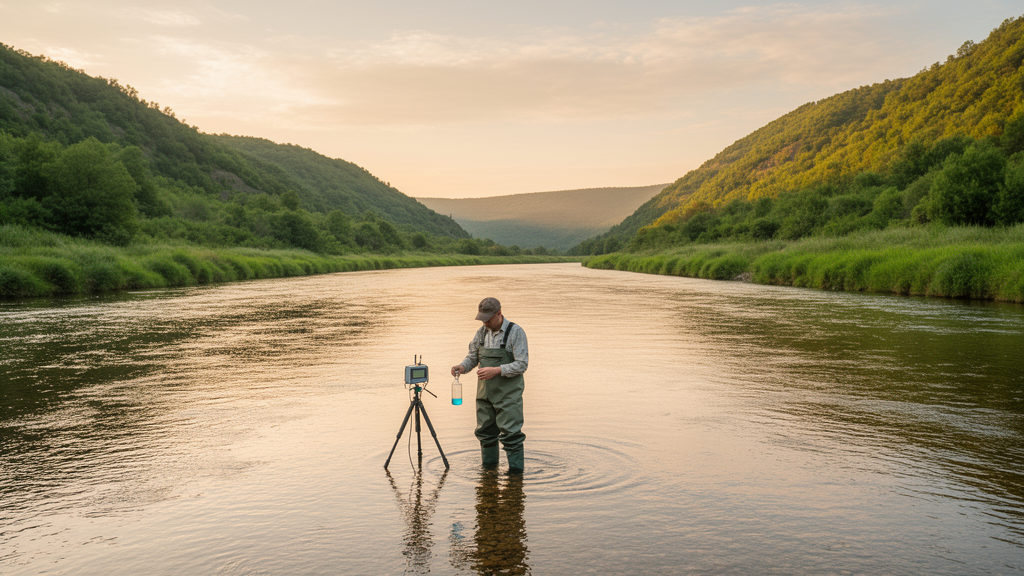
For decades, one of the most frustrating questions in freshwater science has been deceptively simple: how much do we need to reduce a polluting discharge before a river actually recovers? Environmental agencies can measure water chemistry, count macroinvertebrates, and track algal blooms, but they have rarely been able to translate those measurements into a defensible, quantitative prediction of what would happen under a specific management action. A new study published in Environmental Monitoring and Assessment by Rezvan Hatami, affiliated with La Trobe University and Macquarie University in Australia, tackles that gap head-on with a causal modelling workflow that turns ecological impact assessment from a descriptive exercise into a forecasting tool capable of quantifying counterfactual intervention effects.
The core challenge the study addresses is confounding bias, the chronic curse of observational environmental research. Unlike a laboratory experiment, a river cannot be randomly assigned to treatment and control conditions. Wastewater discharges arrive at particular points along a waterway, and the downstream reaches differ from upstream ones in ways that have nothing to do with the effluent: differences in geology, catchment land use, flow regime, season, and the natural downstream drift of organisms all shape what ecologists observe. Traditional before-after-control-impact designs, the workhorse of impact assessment since the early 1990s, attempt to disentangle these signals, but they require carefully planned sampling campaigns and still struggle when natural spatiotemporal variability is large relative to the impact of interest.
Hatami’s approach recasts an earlier validated causal architecture into a modular, reproducible workflow built on the structural causal model framework formalised by computer scientist Judea Pearl. Structural causal models describe a system as an interconnected network of variables linked by equations, in which each variable is generated from its direct causes plus random variation. Crucially, such models allow researchers to perform hypothetical interventions: instead of merely conditioning on an observation, the analyst mathematically reaches into the system, fixes a driver at a chosen value, and propagates that change through the entire supported network of equations. The result is a genuine counterfactual prediction of what the ecosystem would look like had the intervention occurred, not a passive correlation.
The workflow proceeds in distinct stages. First, community-level ecological responses are linked to an interconnected environmental network that represents the causal pathways connecting discharge-related drivers to water quality variables and, ultimately, to the biological community. Second, the framework tests structural sufficiency, checking whether the hypothesised causal structure is actually supported by the data rather than imposed by assumption. Third, once the spatiotemporal structure of the system has been modelled and validated, intervention effects can be estimated along the entire river continuum, from the point of discharge downstream. This explicit separation of model construction, structural validation, and counterfactual prediction is what makes the workflow modular, since each component can be audited, updated, or re-run independently as new data arrive.
The headline result is striking in its specificity. When the relevant discharge-related drivers were hypothetically reduced to one-tenth of their observed values, the model predicted that conductivity, total organic carbon, total phosphorus, nitrate, and chlorophyll a would all shift back towards baseline conditions. Even more telling, the downstream macroinvertebrate community, the biological yardstick most regulators rely upon, no longer exhibited a detectable effluent-related shift under that scenario. In other words, the model did not simply say that less pollution would be better; it identified a concrete reduction target at which a recognisable ecological signature of the discharge disappears from the biota.
Because the magnitude of improvement could be traced across the whole network of linked variables, the framework also provides something policy has long lacked: an estimate of the scale of reduction required for ecological recovery. Water managers facing investment decisions on wastewater treatment upgrades can use such estimates to compare scenarios, asking not only whether a proposed intervention will help but by how much, through which chemical and physical pathways, and where along the river the benefit will materialise. This positions the tool squarely within the movement towards probabilistic and quantitative environmental risk assessment, which argues that robust management decisions require explicit numbers with attendant uncertainty rather than qualitative judgments.
The technical machinery underlying the workflow draws on well-established statistical foundations. Multivariate techniques rooted in Legendre’s numerical ecology tradition, distance-based redundancy analysis for testing multispecies responses, and principal components methods for dimension reduction all feature in the analytical chain, alongside mixed effects models for handling the hierarchical structure of environmental data. The study also engages directly with the recent surge of interest in causal inference within ecology, citing work on applying structural causal models to observational ecological data and on causal methods for time series. The timing is significant: recent assessments have warned that roughly one quarter of freshwater fauna are threatened with extinction, and ecologists have increasingly argued that biodiversity change detection and attribution demand causal rather than purely correlative tools.
What distinguishes this contribution from earlier causal modelling efforts in the field is its extension from explanation to appraisal. Previous applications of structural equation modelling and Bayesian networks in environmental management have largely been used to explain observed variation, to test competing hypotheses about how a system works, or to organise expert knowledge. Hatami’s workflow takes the additional step of using a validated causal structure to run quantitative what-if analyses, simulating intervention scenarios that have not yet occurred. The framework’s focus on estimating how far stressors must be reduced to achieve ecological benefit, and on identifying the intervention targets most relevant to wastewater management, directly connects the abstract mathematics of causal inference to the practical economics of sewage treatment and freshwater ecosystem protection.
Transparency and reproducibility are baked into the study. The data and R code supporting the findings are publicly available in a GitHub repository named counterfactual-prediction, meaning that any regulator, consultant, or researcher can inspect the model structure, verify the validation tests, and rerun the intervention analyses with their own parameters. The work builds on the author’s earlier PhD research at La Trobe University, which developed protocols for environmental impact studies using causal modelling with particular reference to wastewater discharges to freshwater systems, and on published methods for controlling spatiotemporal confounding, including a practical method published in MethodsX in 2018. That lineage matters, because the credibility of a counterfactual prediction rests entirely on the credibility of the causal structure beneath it.
The broader implications reach beyond a single river or a single discharge. If the workflow proves portable to other systems, it could shift the entire framing of environmental impact assessment, moving agencies from asking whether an impact exists towards asking how large an intervention must be and where it should be applied for the greatest ecological return. It also offers a coherent answer to the long-standing complaint that BACI-style designs are reactive, detecting harm only after it has happened. By quantifying the relationship between discharge-related drivers and downstream ecological responses within a validated causal network, managers gain a forward-looking instrument: the ability to predict, before a single upgrade is funded, whether a tenfold reduction in a stressor will pull a river’s chemistry and its invertebrate communities back towards the conditions that define ecological health. For freshwater ecosystems under mounting pressure from multiple stressors across the globe, that kind of quantitative foresight may prove to be exactly the tool the field has been waiting for.
Subject of Research: Causal modelling for spatiotemporal ecological impact assessment and counterfactual prediction of wastewater intervention effects in freshwater ecosystems
Article Title: A causal modelling workflow for spatiotemporal ecological impact assessment with quantified counterfactual prediction of intervention effects
Article References: Hatami, R. (2026). A causal modelling workflow for spatiotemporal ecological impact assessment with quantified counterfactual prediction of intervention effects. Environmental Monitoring and Assessment, 198(9), Article 1005. https://doi.org/10.1007/s10661-026-15813-0
Image Credits: AI Generated
DOI: 10.1007/s10661-026-15813-0
Keywords: causal modelling, counterfactual prediction, ecological impact assessment, freshwater ecosystems, wastewater discharge, macroinvertebrates, spatiotemporal confounding, intervention analysis, water quality, structural causal models, river continuum, environmental monitoring
Cite Scienmag News
Violet Maxwell. (October 19, 2026). New Causal Model Predicts Exactly How Much Pollution Cuts Rivers Need. Scienmag. https://scienmag.com/new-causal-model-predicts-exactly-how-much-pollution-cuts-rivers-need/
Violet Maxwell. "New Causal Model Predicts Exactly How Much Pollution Cuts Rivers Need." Scienmag, 19 October 2026, https://scienmag.com/new-causal-model-predicts-exactly-how-much-pollution-cuts-rivers-need/. Accessed 19 October 2026.
Violet Maxwell. "New Causal Model Predicts Exactly How Much Pollution Cuts Rivers Need." Scienmag. October 19, 2026. https://scienmag.com/new-causal-model-predicts-exactly-how-much-pollution-cuts-rivers-need/


