


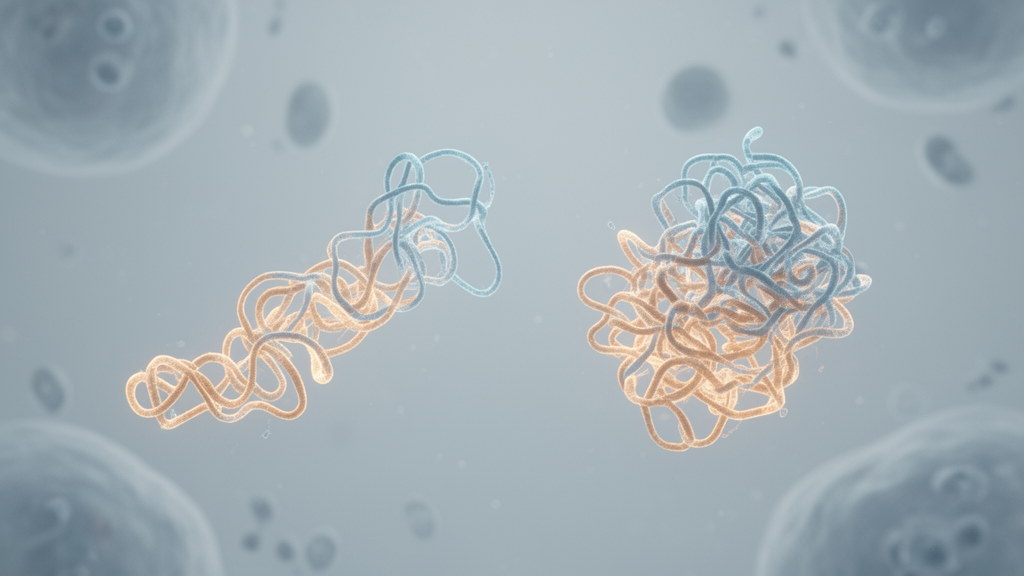
Amyotrophic lateral sclerosis has long been framed as a disease of misfolded proteins clumping inside motor neurons, but a new computational study argues that the real damage may begin far more quietly. Researchers at the Ionian University Research and Innovation Center and the Hellenic Open University have shown that three ALS-linked mutations in the RNA-binding protein FUS do not wreck the protein’s overall architecture. Instead, each mutation makes a small, precisely located change in how the protein flexes, binds, and recognizes its molecular partners — and those subtle shifts appear sufficient to set the disease in motion.
The team, led by Marios G. Krokidis, combined AlphaFold-based structure prediction, the disorder-focused FuzPred algorithm, and HADDOCK molecular docking simulations to compare wild-type FUS with three mutant variants: G156E, R234L, and R521C. Each mutation sits in a different functional region of the 526-residue protein, which is largely built from intrinsically disordered regions — stretches that never settle into one rigid shape but instead constantly sample many conformations. FUS uses this flexibility to bind RNA, regulate transcription, participate in DNA damage repair, and shuttle between the nucleus and cytoplasm.
The structural comparison revealed that none of the mutations causes a dramatic collapse of the protein’s folded domains. Global backbone deviations, measured on high-confidence residues, ranged from about 5.5 angstroms for R234L to roughly 15.4 angstroms for R521C, but these values mostly reflect changes in how the intact folded domains — such as the RNA recognition motif and zinc finger — are oriented relative to one another through flexible linkers, not classical misfolding. The mutations themselves all fall in regions that AlphaFold flags as low-confidence, consistent with their intrinsically disordered character.
More telling were the local measurements. Solvent-accessible surface area calculations showed that all three mutants expose additional surface to the aqueous environment, with G156E and R521C producing the largest increases — 104.24 and 108.44 square angstroms respectively — and strongly negative hydrophobicity-weighted values, indicating that hydrophobic patches are being pushed into contact with water. The authors suggest this creates a thermodynamic drive to bury those patches through aberrant intermolecular aggregation, a route that could push FUS away from its native dynamic state and toward pathological solid-like phase transitions.
The FuzPred analysis sharpened the picture. For each residue, the algorithm estimates the probability of a disorder-to-order transition upon binding (pDO), the probability of remaining disordered (pDD), and the multiplicity of binding modes (MBM), which captures how many different interaction geometries a region can explore. When the researchers subtracted the wild-type profile from each mutant’s, the global differences were tiny — but the local changes within ten residues of each mutation site were clearly visible. All three mutations reduced local pDD and increased local MBM, suggesting a loss of the protein’s healthy, fuzzy binding behavior and a drift toward less coordinated, more promiscuous interaction patterns.
The docking simulations then connected these local disorder changes to concrete functional consequences. For R521C, which sits in the C-terminal proline-tyrosine nuclear localization signal, the team docked the NLS peptide against Transportin-1, the nuclear import receptor that normally carries FUS into the nucleus. The wild-type peptide bound with a HADDOCK score of −87.8 ± 3.4 kcal/mol, while the R521C mutant scored −79.5 ± 3.6 — weaker, despite actually presenting a slightly larger buried surface area. The energy breakdown showed the mutant’s electrostatic contribution dropped sharply, from −382.9 to −264.5 kcal/mol, indicating that replacing a positively charged arginine with cysteine undermines the charge complementarity that drives recognition. This aligns with earlier experimental and computational work showing that R521C reduces Transportin-1 affinity and causes FUS to accumulate in the cytoplasm, a major pathogenic step in ALS.
For G156E, which lies just upstream of the RGG1 RNA-binding domain, the team docked a 60-residue peptide against a 23-nucleotide RNA fragment. The wild-type complex achieved a HADDOCK score of −74.7 ± 1.6 kcal/mol with a buried surface of roughly 1,736 square angstroms, reflecting the multivalent contacts typical of RGG-mediated RNA recognition. The G156E mutant scored −61.6 ± 5.7, with a smaller interface of about 1,401 square angstroms. The authors attribute this to the added glutamate’s negative charge sitting close to the RNA phosphate backbone, increasing electrostatic repulsion and weakening the interaction. Because RGG domains help drive RNA-dependent phase separation and the formation of ribonucleoprotein granules, weakening these contacts could destabilize normal condensates and promote the misregulated RNA metabolism seen in ALS.
R234L, located in the intrinsically disordered RGG2 domain, could not be docked in the conventional sense because no experimentally determined FUS–RNA complex involving that region exists, and standard docking platforms require well-defined structural templates. Instead, the researchers interpreted its effects through the disorder analysis, which showed a local reduction in pDD — a loss of the native, functional flexibility that RGG domains rely on for multivalent RNA recognition. Removing an arginine from this positively charged motif would be expected to diminish both electrostatic attraction and cation–π interactions with RNA, consistent with the mutation’s association with disrupted RNA metabolism.
Taken together, the findings support a view of FUS-related ALS in which pathogenicity arises not from wholesale misfolding but from localized rearrangements in intrinsic disorder, binding versatility, and molecular recognition. Each mutation prunes a different functional modality — R521C compromises nuclear import, G156E weakens RNA binding, R234L erodes RGG2-mediated interactions — yet all three converge on the same cellular outcome: impaired nucleocytoplasmic distribution, altered stress granule behavior, and a tendency toward pathological aggregation. The authors caution that AlphaFold-derived models of intrinsically disordered regions should be treated as plausible conformational hypotheses rather than definitive structures, and they propose extending the approach with molecular dynamics simulations, multiple RNA sequence contexts, and integration with experimental data from NMR, cross-linking, and cellular localization assays. The same computational framework could also be applied to other disordered ALS proteins such as TDP-43 and hnRNPA1, offering a route toward therapies that restore protein localization and RNA homeostasis rather than simply blocking aggregation.
Subject of Research: Computational analysis of how ALS-associated FUS mutations alter conformational dynamics, intrinsic disorder, and molecular interactions
Article Title: ALS-associated FUS mutations induce site-specific alterations in conformational dynamics and molecular interactions
Article References: Amourgianos, C., Exarchos, T. P., Vlamos, P., & Krokidis, M. G. (2026). ALS-associated FUS mutations induce site-specific alterations in conformational dynamics and molecular interactions. Frontiers in Chemical Biology, 5, Article 1851848. https://doi.org/10.3389/fchbi.2026.1851848
Image Credits: AI Generated
DOI: 10.3389/fchbi.2026.1851848
Keywords: ALS, FUS, intrinsically disordered proteins, AlphaFold, FuzPred, HADDOCK, molecular docking, RNA binding, nuclear import, Transportin-1, phase separation, neurodegeneration
Cite Scienmag News
Diana Fleming. (October 16, 2026). Subtle Shape Shifts, Not Misfolding: How FUS Mutations Drive ALS. Scienmag. https://scienmag.com/subtle-shape-shifts-not-misfolding-how-fus-mutations-drive-als/
Diana Fleming. "Subtle Shape Shifts, Not Misfolding: How FUS Mutations Drive ALS." Scienmag, 16 October 2026, https://scienmag.com/subtle-shape-shifts-not-misfolding-how-fus-mutations-drive-als/. Accessed 16 October 2026.
Diana Fleming. "Subtle Shape Shifts, Not Misfolding: How FUS Mutations Drive ALS." Scienmag. October 16, 2026. https://scienmag.com/subtle-shape-shifts-not-misfolding-how-fus-mutations-drive-als/


