


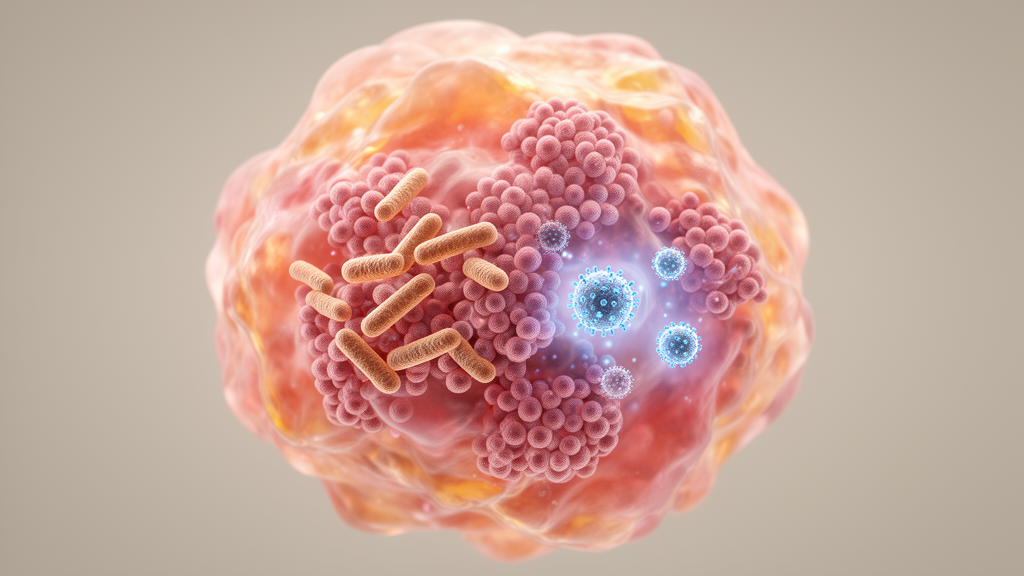
Deep within the tumors of patients with nasopharyngeal carcinoma, a distinct community of bacteria appears to reside — one that is measurably different from the microbes clinging to the surface of the same lesions. That is the central finding of a new study from researchers at Guangxi Medical University in China, published in Frontiers in Cellular and Infection Microbiology. By pairing surface swabs with tissue biopsies from the same patients and running them through an unusually rigorous sequencing pipeline, the team has provided some of the clearest evidence yet that the bacterial signature of a tumor is not simply a reflection of what sits on its surface.
Nasopharyngeal carcinoma, or NPC, is a cancer of the upper airway mucosa that is strongly linked to Epstein-Barr virus, or EBV. The nasopharynx is constantly bathed in commensal and environmental microorganisms, which makes it a notoriously difficult place to separate meaningful tumor-associated bacterial signals from background noise. Previous work has reported altered oral and nasopharyngeal microbiota in NPC patients, and some studies have linked intratumoral bacterial burden with clinical outcomes. What remained unclear was whether bacteria detected within tumor tissue are compositionally distinct from organisms present on the lesion surface — a question most earlier studies never addressed directly because they sampled only one compartment or the other.
The research team, led by Nan Shi, Zongjian Huang, and Wei Xia, enrolled 38 newly diagnosed NPC patients and 26 people with benign nasopharyngeal lymphoid hyperplasia, an inflammatory but noncancerous condition that served as the control. During endoscopic biopsy, each excised specimen was rinsed, swabbed with a sterile nylon-flocked swab to capture its surface microbiome, rinsed three more times, and then flash-frozen for tissue analysis. An air-exposed swab left in the operating room for thirty minutes served as an environmental control. This paired design allowed the investigators to compare surface and tissue communities within the same lesion from the same patient, minimizing the interindividual variability that plagues most microbiome studies.
Before any sequencing, the team first established that bacteria were genuinely present in the tumor tissue. Fluorescence in situ hybridization with a pan-bacterial 16S rRNA probe revealed discrete punctate bacterial signals within NPC biopsies, signals that were rare in the benign control tissue. Quantitative PCR on an independent cohort of 24 NPC and 18 NLH samples detected a median of roughly 7,760 bacterial 16S copies per nanogram of DNA in NPC tissue, about eight times higher than the 907 copies found in NLH tissue, and both values exceeded the non-template and environmental background controls. Cultures of tissue homogenates and enzymatically dissociated single-cell suspensions yielded bacterial growth, while PBS washes and environmental controls remained sterile — orthogonal evidence that viable bacteria inhabit NPC tissue.
Perhaps the most provocative culture finding was that growth persisted after treatment with ampicillin plus gentamicin, two antibiotics that struggle to penetrate host cells, but was suppressed by doxycycline, which penetrates cells far more readily. The authors interpret this pattern as compatible with a protected or intracellular bacterial fraction, echoing the landmark 2020 Science study by Nejman and colleagues that described tumor type-specific intracellular bacteria across many cancer types. They are careful, however, to note that the aerobic culture assay did not identify the recovered colonies taxonomically, so culture positivity supports viability but does not independently validate the specific taxa detected by sequencing.
For the microbial profiling itself, the team deployed a five-region 16S rRNA gene sequencing strategy, simultaneously targeting the V2, V3, V5, V6, and V8 hypervariable regions to squeeze more taxonomic resolution out of low-biomass samples than conventional single-region approaches allow. Sequencing was performed on an Illumina NovaSeq 6000, processed through QIIME 2, and subjected to a stringent contaminant-removal pipeline: any taxon appearing in at least half of the negative-control libraries was discarded as a probable laboratory or sampling artifact. Samples with fewer than 1,000 total reads were excluded entirely. These safeguards matter enormously, because low-biomass microbiome research is famously vulnerable to reagent and environmental contamination that can masquerade as biological signal.
The results were striking. Surface swabs showed higher species richness and diversity than the paired tissue samples, as expected for a mucosal surface exposed to the environment, but swab communities overlapped almost completely between NPC and NLH patients — an analysis-of-similarity statistic of negative 0.038 with a p-value of 0.88, meaning essentially no separation whatsoever. Tissue communities, by contrast, separated cleanly between the two groups, with ANOSIM R values above 0.5 and p-values below 0.01. Even after adjusting for age and sex, disease status remained significantly associated with tissue community composition (PERMANOVA p < 0.001) but not with swab composition. NPC tissue also retained higher Shannon diversity than NLH tissue after covariate adjustment. An exploratory random-forest classifier underscored the gap: tissue-derived features achieved an area under the ROC curve of 0.927, while swab-derived features managed only 0.408 — worse than a coin flip.
The team then integrated the microbial data with matched bulk RNA sequencing of the same tissues to ask whether bacterial abundance covaries with host and viral biology. As expected, EBV transcript levels were higher in NPC, and the tumors showed elevated activity of proliferation and cell-cycle programs including E2F, MYC, G2M checkpoint, and mTORC1 signaling, alongside a remodeled immune landscape inferred by CIBERSORTx deconvolution. Within the NPC group, several tissue-enriched bacterial taxa — including species-level assignments for Comamonas, Streptococcus, Prevotella intermedia, Corynebacterium striatum, and Peptostreptococcus stomatis — showed associations with higher EBV transcript levels, proliferative pathway activity, and lower inferred CD8 T-cell and plasmacytoid dendritic-cell signatures. Neisseria perflava stood out for its extensive connectivity, correlating with MYC targets, the G2M checkpoint, DNA-repair programs, EBV transcripts such as A73 and RPMS1, and inferred CD8 T-cell abundance.
The authors are appropriately measured about what these correlations mean. Because the data derive from 16S profiling and bulk RNA sequencing, the directionality of the relationships cannot be resolved: bacteria might promote viral activity or immune remodeling, EBV-driven transformation might create a tissue environment permissive to particular bacteria, or the microbial signatures might simply mark a pre-existing tumor niche shaped by hypoxia, altered barrier function, and dampened immune surveillance. Co-occurrence networks built from the compositional 16S data suggested that the NPC tissue microbial community is more clustered yet less densely connected and apparently less robust than that of benign tissue — a hypothesis-generating observation, the authors stress, rather than proof of ecological instability.
Several limitations temper the conclusions. The cohort was modest and drawn from a single institution, the NLH controls are inflammatory rather than histologically normal mucosa, and lifestyle variables such as smoking, diet, oral health, and recent antibiotic use were unavailable, leaving residual confounding possible. The biopsy-surface swabs were taken from excised, rinsed specimens rather than the living mucosa, so they cannot speak to non-invasive screening strategies. Despite the rinsing protocol, residual surface-adherent bacteria may still contribute to the tissue profiles. Still, the core message stands: nasopharyngeal carcinoma harbors a tissue-resident microbiome that is compositionally distinct from both the surface of the lesion and from benign inflammatory tissue, and its members covary with EBV activity and immune composition. The authors call for larger cohorts, spatial localization techniques such as FISH-based co-localization, isolate-level characterization by whole-genome sequencing, and epithelial–EBV–bacteria co-culture models to determine whether these bacteria play a functional role in one of the world’s most geographically concentrated cancers — or merely serve as fingerprints of an EBV-conditioned tumor microenvironment.
Subject of Research: Tissue-associated bacterial microbiome signatures and their association with EBV transcription and immune composition in nasopharyngeal carcinoma
Article Title: Paired biopsy-surface and tissue microbiome profiling reveals tissue-associated bacterial signatures in nasopharyngeal carcinoma
Article References: Paired biopsy-surface and tissue microbiome profiling reveals tissue-associated bacterial signatures in nasopharyngeal carcinoma. (n.d.). https://doi.org/10.3389/fcimb.2026.1892233
Image Credits: AI Generated
DOI: 10.3389/fcimb.2026.1892233
Keywords: nasopharyngeal carcinoma, tumor microbiome, Epstein-Barr virus, 16S rRNA sequencing, intratumoral bacteria, biopsy-surface swabs, immune microenvironment, RNA-seq, Neisseria perflava, bacterial culture, Guangxi, cancer biomarkers
Cite Scienmag News
Nathaniel Bowman. (October 16, 2026). Bacteria Hiding Inside Tumors May Shape Epstein-Barr Virus Activity in Nasopharyngeal Cancer. Scienmag. https://scienmag.com/bacteria-hiding-inside-tumors-may-shape-epstein-barr-virus-activity-in-nasopharyngeal-cancer/
Nathaniel Bowman. "Bacteria Hiding Inside Tumors May Shape Epstein-Barr Virus Activity in Nasopharyngeal Cancer." Scienmag, 16 October 2026, https://scienmag.com/bacteria-hiding-inside-tumors-may-shape-epstein-barr-virus-activity-in-nasopharyngeal-cancer/. Accessed 16 October 2026.
Nathaniel Bowman. "Bacteria Hiding Inside Tumors May Shape Epstein-Barr Virus Activity in Nasopharyngeal Cancer." Scienmag. October 16, 2026. https://scienmag.com/bacteria-hiding-inside-tumors-may-shape-epstein-barr-virus-activity-in-nasopharyngeal-cancer/


