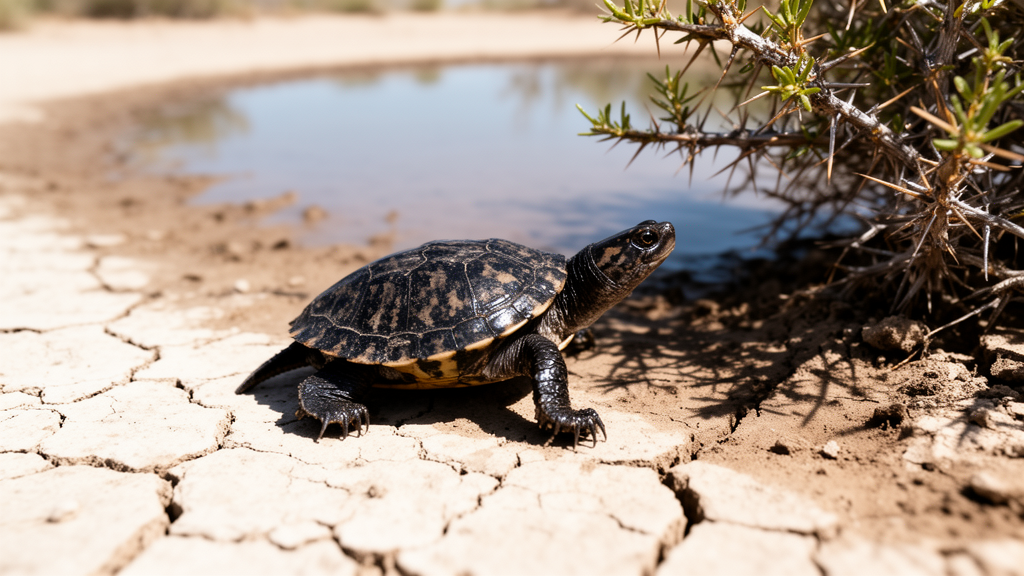
In the shallow pools and desert waterholes of Mexico, three little-known species of mud turtle are quietly revealing how they might survive a warming world. A new field study published in Neotropical Biology and Conservation has, for the first time, measured the body temperatures of Kinosternon cora, Kinosternon durangoense, and Kinosternon herrerai — three restricted-range kinosternid turtles whose fates may hinge on how tightly their bodies track the temperature of the water around them. The answer, according to the researchers, is more hopeful than expected: these turtles are not simply at the mercy of their environment, but appear to hold at least a limited ability to keep their bodies at temperatures different from the water they swim in.
The study fills a striking gap in reptile biology. Mud turtles of the family Kinosternidae are among the most aquatic of all turtles, rarely leaving the water and seldom basking in the open sun. Because they are ectotherms, their body temperature depends heavily on heat exchanged with their surroundings, and climate models have already flagged some Mexican kinosternids as candidates for extinction driven by rising temperatures. Yet until now, almost nothing was known about the thermal ecology of the species examined in this study. Two of them, K. durangoense and K. herrerai, have been identified as potentially at risk of extinction due to climate change, while K. cora has not even been assessed by the IUCN Red List. All three have small geographic ranges, a trait that makes species especially vulnerable to rapid environmental shifts.
The fieldwork spanned three very different Mexican landscapes. Kinosternon cora was sampled in tropical dry and deciduous forest habitats in Sinaloa and Nayarit, in permanent and natural pools at low elevations. Kinosternon durangoense was captured in a single temporary cattle watering hole in the Bolsón de Mapimí, a desert shrubland basin where the borders of Chihuahua, Coahuila, and Durango meet, at an elevation of 1,120 meters. Kinosternon herrerai came from small pools in the tropical sub-deciduous forest of Cuetzalán, Puebla, at 630 meters. The team used collapsible box traps baited with canned tuna or sardines, checked every thirty minutes over hours of monitoring both day and night. Interestingly, the species kept different schedules: K. cora was caught only at night, K. durangoense only by day, and K. herrerai in both day and night.
For each captured turtle, the researchers measured three temperatures to the nearest tenth of a degree with a digital thermometer: cloacal body temperature, air temperature two centimeters above the water surface, and water temperature three centimeters below the surface. Each animal was sexed and then released where it was found. Earlier research on snapping turtles had suggested that the body temperatures of trapped turtles can reasonably approximate those of actively moving animals, lending confidence to the technique. The team then ran linear regressions comparing body temperature with air and water temperature, tested whether the difference between body and water temperature differed from zero, and used analysis of covariance to check for differences between males and females.
The headline numbers were modest but telling. Mean body temperatures were 25.0 degrees Celsius for K. cora, 21.9 degrees for K. durangoense, and 23.3 degrees for K. herrerai — all at the low end of the range recorded across the kinosternid family, which spans roughly 19.8 to 33.3 degrees Celsius in previous studies. Across all three species, water temperature emerged as the dominant predictor of body temperature, equaling or surpassing air temperature in explanatory power. That makes intuitive sense for animals that spend nearly their entire lives submerged and rarely bask aerially. In K. durangoense, body temperature rose with water temperature according to the equation Tb = 12.2 + 0.45Tw, explaining about 62 percent of the variation. In K. herrerai, both air and water temperature explained roughly 72 to 73 percent of the variation in body temperature.
But the more provocative finding lurked in the differences between body and water temperature. In K. durangoense, turtles maintained body temperatures above water temperature when the water was cooler than roughly 22 degrees Celsius, and body temperatures below water temperature when the water was warmer than about 22 degrees. Kinosternon herrerai showed the same pattern with a threshold near 23.5 degrees Celsius. In other words, when conditions were chilly the turtles warmed themselves relative to the water, and when conditions got too hot they actively kept their bodies cooler than their surroundings. Those threshold temperatures closely match laboratory-determined preferred temperatures for Mexican kinosternids, which range from about 19.2 to 25 degrees Celsius in related species — evidence that the animals in the wild were not drifting passively but nudging themselves toward a physiological target.
Kinosternon cora proved the most surprising of all. Its body temperature was negatively related to water temperature, declining as water warmed, and on average its body ran about 0.39 degrees Celsius cooler than the water itself. The gap between body and water temperature grew larger as water temperature rose, suggesting that these turtles may have been deliberately reducing their body temperature as their pools heated up. The researchers caution that this negative relationship may partly reflect the narrow and comparatively warm range of water temperatures they recorded for the species, but the pattern is consistent with active behavioral cooling — a mechanism such as moving to shaded, deeper, or cooler microhabitats within a pool. Detailed behavioral observations of this poorly known species remain scarce, leaving the precise mechanism an open question.
Sex, meanwhile, turned out not to matter. In all three species, males and females showed no significant differences in body, air, or water temperature, either directly or once water temperature was statistically accounted for. This likely reflects the fact that both sexes share the same aquatic habitat and therefore experience the same thermal environment. The finding contrasts with some earlier turtle studies: female K. integrum in central Mexico have been found to run hotter than males, probably due to longer basking, and female musk turtles in Canada maintain higher body temperatures, especially when gravid. For the three species studied here, though, the overriding influence of water temperature appears to wash out any sex-based thermal strategies.
Previous work had concluded that kinosternid turtles are broadly thermoconformers — animals whose body temperature conforms to the environment rather than being regulated independently — with thermoregulatory efficiency estimates for four species ranging from 0.3 to 0.69. The new results paint a more nuanced picture. While water temperature clearly drives body temperature in these Mexican mud turtles, the consistent crossover points, the below-water body temperatures of K. cora, and the month-to-month adjustments in K. herrerai all hint at a capacity for limited thermoregulation. In K. herrerai, body temperature did not differ among September, October, and November once water temperature was taken into account, even though air and water temperatures varied significantly between months, and the body-water temperature gap was widest in the coolest month. That kind of statistical signature is exactly what an animal capable of partial thermal buffering would produce.
Why does this matter? For ectotherms, the ability to regulate body temperature can buffer the effects of climate change on environmental temperatures, and the new findings suggest these three species may possess some limited capacity to shield themselves from rising heat. That could be good news for K. durangoense, listed as Data Deficient by the IUCN, and for K. herrerai, considered Near Threatened and threatened by over-exploitation for food and medicine as well as agricultural water use. K. cora, recommended for legal protection in Mexico and apparently scarce within its small range, faces agricultural pressure on its aquatic habitat. But the researchers are careful not to overpromise. A limited ability to hold body temperature different from the environment may not be enough to avoid the most severe consequences of climate change, particularly for species confined to small distributions and vulnerable water bodies. The team calls for future studies to uncover how these turtles actually maintain their thermal independence in the wild — whether through microhabitat selection, shifts in activity timing, or other behaviors — and whether that capacity will prove sufficient as temperatures continue to climb. For now, these obscure mud turtles offer a small but genuine reason for cautious optimism in the face of a warming future.
Subject of Research: Thermal ecology and thermoregulation of three Mexican kinosternid turtle species
Article Title: Thermal ecology of three potentially at-risk species of Mexican kinosternid turtles
Article References: Woolrich-Piña, G. A., Smith, G. R., Loc-Barragán, J. A., Loaiza-Ramírez, R., Torres-Romero, E. J., & Lemos-Espinal, J. A. (2026). Thermal ecology of three potentially at-risk species of Mexican kinosternid turtles. Neotropical Biology and Conservation, 21(1), 87-100. https://doi.org/10.3897/neotropical.21.e186009
Image Credits: AI Generated
DOI: 10.3897/neotropical.21.e186009
Keywords: Kinosternon, mud turtles, thermal ecology, thermoregulation, ectotherms, climate change, Mexico, body temperature, conservation, Neotropical Biology and Conservation, water temperature, reptiles
Cite Scienmag News
Sloane Callahan. (October 16, 2026). Mexican Mud Turtles Show Surprising Skill at Dodging Lethal Heat. Scienmag. https://scienmag.com/mexican-mud-turtles-show-surprising-skill-at-dodging-lethal-heat/
Sloane Callahan. "Mexican Mud Turtles Show Surprising Skill at Dodging Lethal Heat." Scienmag, 16 October 2026, https://scienmag.com/mexican-mud-turtles-show-surprising-skill-at-dodging-lethal-heat/. Accessed 16 October 2026.
Sloane Callahan. "Mexican Mud Turtles Show Surprising Skill at Dodging Lethal Heat." Scienmag. October 16, 2026. https://scienmag.com/mexican-mud-turtles-show-surprising-skill-at-dodging-lethal-heat/