


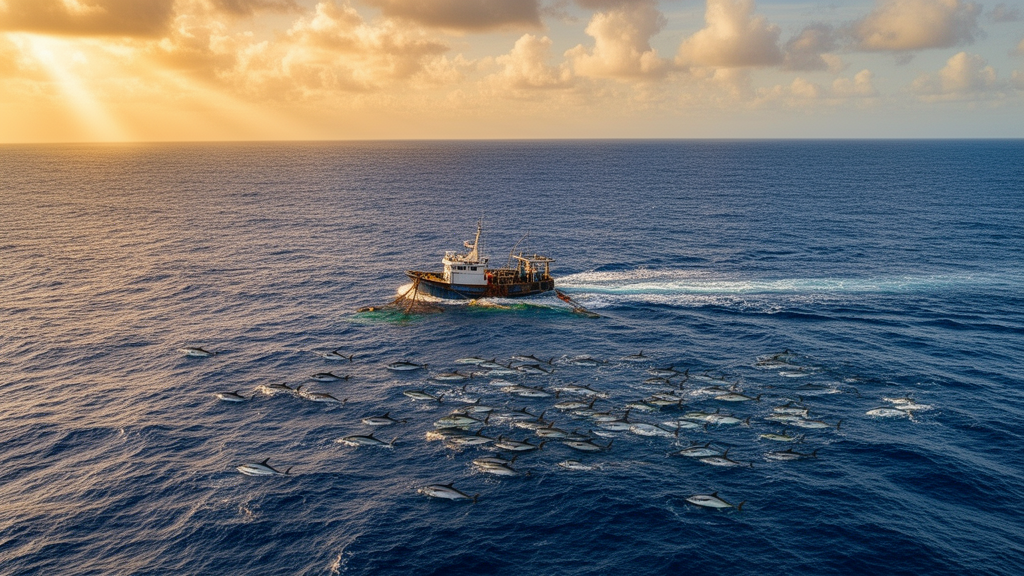
Climate change is quietly redrawing the map of the world’s fisheries, and the consequences could reshape ocean politics for decades. A new analysis published in Frontiers of Biogeography argues that even under a low-emissions scenario, roughly 22 percent of straddling fish stocks—species that migrate across the boundary between national waters and the open ocean—may shift out of countries’ exclusive economic zones and into the high seas by 2030. That single projection, the study’s authors contend, transforms the long-standing debate over banning fishing in international waters from a question of conservation preference into one of urgent climate adaptation. As warming waters push tuna, sharks, and other highly mobile species beyond the reach of national regulators, the world’s most vulnerable coastal nations could watch their fisheries drift into a legal no-man’s-land where a handful of wealthy, heavily subsidized distant-water fleets hold all the advantages.
The high seas—the vast areas of ocean lying beyond the jurisdiction of any single state—have long been among the least regulated environments on the planet. Fishing there is often poorly monitored compared with activity inside country waters, creating fertile ground for overexploitation, illegal, unreported, and unregulated fishing, and even forced labor aboard vessels that may go months without port inspections. The four traditional justifications for closing these waters to fishing have rested on biodiversity conservation, economic efficiency, equity among nations, and carbon mitigation. Proponents argue that removing fishing from areas where governance is fragmented and fuel-intensive would simultaneously safeguard marine life, strengthen the economic returns of coastal states, prevent a small club of powerful fleets from monopolizing shared resources, and cut greenhouse gas emissions. What the new research adds is a climate-driven deadline to an argument that previously could be deferred indefinitely.
The projected redistribution of fish is not uniform, and that is precisely what makes it politically explosive. Tropical exclusive economic zones are expected to lose the largest amounts of biomass to the high seas, while temperate and polar waters stand to gain as species track cooler temperatures poleward and offshore. This geographic asymmetry lands hardest on tropical countries, many of them in the Global South, where fisheries underpin livelihoods, food security, and national income. Previous research has projected that seafood availability in these nations will decline substantially under climate change, compounding nutritional risks for populations that depend on fish as a primary protein source. If the fish that historically sustained coastal economies simply swim beyond national jurisdiction, those countries lose not only food but also revenue from fishing rights, licenses, and domestic processing industries—losses inflicted not by mismanagement but by a changing climate they did little to cause.
Without intervention, the study’s authors warn, these displaced stocks would be captured disproportionately by distant-water fleets from wealthy nations, entrenching and amplifying existing inequities. High seas fishing is already an economically peculiar enterprise: vessels must travel enormous distances, remain at sea for extended periods, and depend heavily on government subsidies to remain profitable at all. Only a handful of companies from an even smaller number of countries dominate the enterprise, and the sector has repeatedly been linked to human rights abuses at sea. If climate change hands these fleets an expanding pool of newly internationalized fish, the result would be a perverse transfer of resources from the nations least responsible for global warming to those most capable of exploiting the shift. A ban, the authors argue, would keep displaced stocks effectively off-limits, preventing powerful actors from capitalizing on the misfortune of coastal countries.
There is also a compelling ecological case. As biomass concentrates in the high seas under weaker or fragmented management, the risk of overfishing intensifies, threatening to disrupt marine food webs and erode biodiversity at precisely the moment conservation targets demand progress. Some straddling stocks are already in trouble: oceanic sharks, which routinely cross jurisdictional boundaries, are considered threatened or endangered largely because of fishing pressure, much of it in international waters. A ban would function as a buffer, transforming the high seas into a biodiversity refuge—a kind of global fish bank where stocks forced to relocate by warming waters could survive and recover. The concept echoes terrestrial migratory corridors, preserving connectivity between national waters and the open ocean so that climate-displaced species are not met with unrestrained exploitation at the boundary. Notably, some regional fisheries management organizations, including the Western and Central Pacific Fisheries Commission, have already begun examining these dynamics with respect to Pacific Island nations, suggesting the policy conversation is starting to catch up with the science.
The carbon arithmetic adds yet another layer of urgency. High seas fishing is inherently energy-intensive, with vessels burning vast quantities of fuel simply to reach distant grounds. If climate change drives more fish offshore, fleets can be expected to respond by extending their time at sea and increasing fuel consumption in pursuit of migrating stocks—a feedback loop in which climate change triggers fishing behavior that worsens climate change. Beyond fuel emissions, the study points to a subtler carbon cost: the historical removal of large fish from the high seas has already released substantial amounts of carbon dioxide since 1950, effectively dismantling part of the ocean’s natural carbon storage capacity. Continued expansion of fishing into offshore waters therefore risks not only raising fuel-related emissions but also degrading a functioning carbon sink, undermining global climate goals from an unexpected direction. Restricting fishing to coastal and regional waters would reduce the incentive for long-distance operations and shrink the carbon footprint of global blue food systems.
None of this means a ban would be simple. The authors are candid about the transitional risks. If fish stocks move offshore, coastal nations may perceive themselves as losing resources to a global commons from which no one can benefit, eroding the political legitimacy of closure. Any ban must therefore be coupled with policies that recognize and compensate for climate-driven shifts—international funds, benefit-sharing arrangements, or dynamic management strategies that account for the redistribution of fish and its consequences for food security. Equally critical, a high seas closure would need to be paired with substantially strengthened fisheries management inside national waters, especially in countries where governance is currently weak. Without better domestic management, displaced fishing effort could simply concentrate in coastal zones, and interceptions of straddling stocks within exclusive economic zones could still damage populations before they ever reach international waters. A ban, in other words, is necessary but not sufficient.
The stakes of inaction are considerable. In the absence of both a ban and improved national management, the relocation of straddling stocks could usher in a new era of competition and conflict, as fleets scramble for access to newly internationalized resources and governance gaps widen. The high seas could become a stage for a free-for-all in which the fastest, richest, and least scrupulous operators win, while the nations that depended on those fish for generations absorb the losses. With a ban, by contrast, the high seas could serve as a global insurance policy—a shared commitment to safeguard biodiversity, equity, and climate stability in an uncertain future, provided it is coupled with genuine improvements in the stewardship of stocks within national waters so that sustainable yields can be maintained close to shore.
What emerges from the analysis is a reframing of a familiar proposal. The case for banning high seas fishing has always rested on biodiversity, economics, equity, and carbon, but the new findings elevate it into an adaptive governance response to climate-driven ecological change. The science is clear that climate change is reshaping the geography of the ocean, moving marine life across political boundaries and exposing the gaps in a governance system designed for a more stationary world. While a ban involves real transitional risks—including the potential redistribution of fishing effort into coastal waters and immediate food security concerns—these could be mitigated over the long term as the high seas recover and begin to replenish adjacent fisheries. The authors frame their conclusion not as a call for despair but for ambition: by embracing closure, the global community can help ensure that climate change does not translate into new inequities for the world’s most vulnerable nations, and that the high seas are secured as a true global commons—protected for biodiversity, shielded from inequitable exploitation, and aligned with humanity’s broader goals of sustainability and justice.
Subject of Research: Climate-driven redistribution of straddling fish stocks from national waters to the high seas and its implications for a proposed high seas fishing ban
Article Title: Climate change strengthens the case for a high seas fishing ban
Article References: Climate change strengthens the case for a high seas fishing ban. (n.d.). https://doi.org/10.21425/fob.19.183549
Image Credits: AI Generated
Keywords: high seas fishing ban, climate change, straddling fish stocks, exclusive economic zones, biodiversity, fisheries equity, distant-water fleets, ocean governance, carbon emissions, food security, overfishing, climate adaptation
Cite Scienmag News
Sloane Callahan. (October 16, 2026). Warming Oceans Push Fish Into Lawless Waters, Boosting the Case for a High Seas Fishing Ban. Scienmag. https://scienmag.com/warming-oceans-push-fish-into-lawless-waters-boosting-the-case-for-a-high-seas-fishing-ban/
Sloane Callahan. "Warming Oceans Push Fish Into Lawless Waters, Boosting the Case for a High Seas Fishing Ban." Scienmag, 16 October 2026, https://scienmag.com/warming-oceans-push-fish-into-lawless-waters-boosting-the-case-for-a-high-seas-fishing-ban/. Accessed 16 October 2026.
Sloane Callahan. "Warming Oceans Push Fish Into Lawless Waters, Boosting the Case for a High Seas Fishing Ban." Scienmag. October 16, 2026. https://scienmag.com/warming-oceans-push-fish-into-lawless-waters-boosting-the-case-for-a-high-seas-fishing-ban/


