


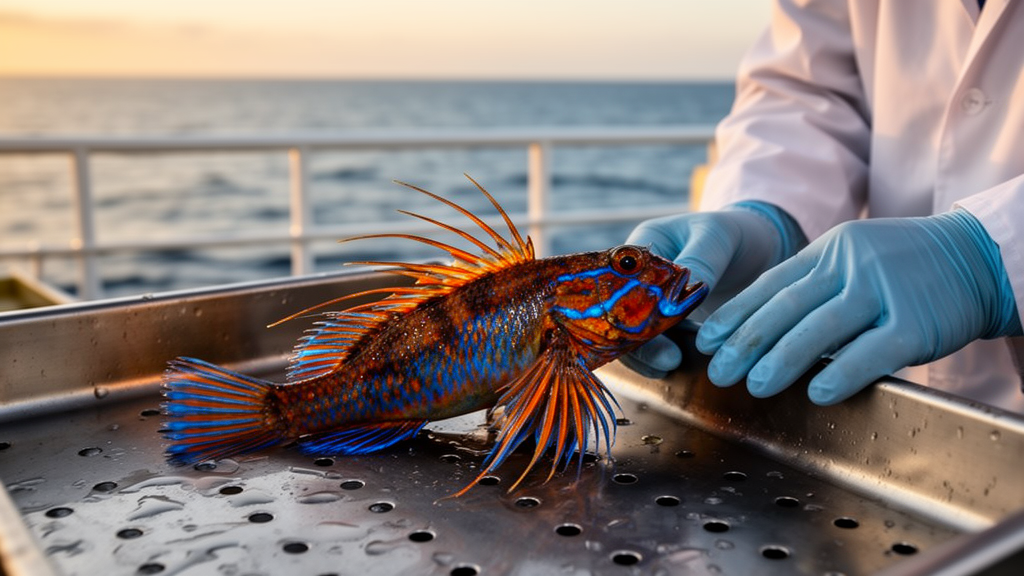
A slender, crimson-marbled fish hauled up in a trawler’s nets off the southeastern coast of India has turned out to be a species scientists never expected to find anywhere near the subcontinent. The South African bigeye dragonet, Synchiropus monacanthus, a small bottom-dwelling fish first described from South Africa in 1935, has been recorded for the first time in Indian waters. The discovery, published in the journal Acta Ichthyologica et Piscatoria, stretches the species’ known geographic range eastward by roughly 2,500 kilometers across the Indian Ocean, and it adds a second member of the dragonet genus Synchiropus to India’s marine fish fauna.
The story began in March 2025, when researchers examining the bycatch of multiday trawlers operating off Pudukkottai in Tamil Nadu encountered six unusual dragonet specimens. The fish had been landed at the Kottaipattinam Fish Landing Centre on the Palk Bay coast, at coordinates of approximately 9°58’50″N, 79°12’12″E. Fishing crews reported that the trawling operations that yielded the specimens took place at depths of roughly 100 to 150 meters. All six individuals were females, ranging from 68.2 to 104.5 millimeters in standard length, the measurement biologists use from the tip of the snout to the base of the tail.
Dragonets, the family Callionymidae, are small, flattened fishes that live on the sea floor from tropical to temperate waters worldwide, from coastal shallows down to depths exceeding 900 meters. The family currently contains 201 valid species across 11 genera. Within it, the genus Synchiropus is especially diverse, with 56 valid species, and is known for a depressed body, large dorsally positioned eyes, a serrated preopercular spine on the cheek, and a gill opening reduced to a tiny pore. Members of the genus are also famous among ichthyologists for pronounced sexual dimorphism, cryptic colouration, and elaborate courtship behavior. Until now, only one Synchiropus species, the lined dragonet Synchiropus lineolatus, had been documented from Indian waters.
To confirm the identity of the Palk Bay fish, the team took detailed morphometric measurements to the nearest 0.1 millimeter with digital calipers and recorded meristic counts, the numbers of fin spines and rays, following the standard taxonomic methods established for the family. The specimens were fixed in 5% formalin and deposited as vouchers in the Marine Fish Reference Collection of the Department of Fisheries Resource Management at Kerala University of Fisheries and Ocean Studies, ensuring that future researchers can verify the record.
The diagnostic anatomy matched the original description of Synchiropus monacanthus with striking precision. The fish possess a preopercular spine bearing a single forward-pointing serration on its dorsal margin, with a smooth ventral margin and a strongly upcurved main tip. The first dorsal fin carries four spines that are not drawn out into filaments, which is one of the features identifying the specimens as females, since mature males of the species develop elongated filamentous rays on this fin. The second dorsal fin has seven to eight elements plus one, the anal fin six to eight plus one, and the pectoral fin a pattern of 17 to 19 rays. In fresh specimens, the head and body are dark red, marbled and spotted with darker pigment, the caudal fin bears three vertical white bands with a dark distal margin, and the first spine of the first dorsal fin is black.
Two characters proved especially important in separating the new specimens from their closest lookalike in Indian waters. Synchiropus lineolatus, the only other congener previously recorded from the region, possesses two serrae on the preopercular spine rather than one, and a proportionally shorter caudal fin measuring 3.0 to 3.5 in standard length, compared with 2.22 to 2.53 in the Palk Bay fish. The new species is also morphologically similar to the western Pacific Synchiropus altivelis, but that relative has a straight rather than upcurved main tip on the preopercular spine and a longer caudal fin of 2.8 to 3.6 in standard length. Such fine anatomical differences are exactly the kind of detail that determines whether a fish is a familiar neighbor or a 2,500-kilometer wanderer on the regional checklist.
The geographic implications of the find are considerable. Synchiropus monacanthus was originally described by J. L. B. Smith in 1935 from a holotype collected at Port Alfred, South Africa. A second nominal species, Callionymus bicornis, described by Norman in 1939 from off Zanzibar, was later placed in synonymy with it. Over the decades the species has been documented in scattered records across the western Indian Ocean, including South Africa’s Eastern Cape, Tanzania, Kenya, Mozambique, Madagascar, and the Socotra Archipelago belonging to Yemen. Because it lives in deep water and is rarely encountered, it has remained poorly documented across much of that range. The closest previously reported localities to India lie near Socotra or the Tanzanian coast, making the Palk Bay record a dramatic leap eastward.
Just as intriguing is the depth at which the Indian specimens were caught. The previously documented bathymetric range for the species was 175 to 428 meters, yet the trawlers that captured these fish were working at approximately 100 to 150 meters, considerably shallower than anything on record. The authors suggest several possible explanations. The species may simply tolerate a broader depth range than currently recognized, occasionally venturing onto the upper continental slope. Alternatively, local bathymetric and oceanographic conditions in the Palk Bay and the adjacent Gulf of Mannar might create cooler-water habitats at relatively shallow depths, allowing a typically deeper-water species to persist there. Because all six specimens were females, none displaying the elongated dorsal filaments of males, the collection offers no opportunity to analyze sexual dimorphism in this population, leaving many questions open for future study.
The occurrence of the species in Palk Bay hints that its distribution may be more continuous along the northern Indian Ocean rim than scientists had assumed, and that it may simply have been overlooked in the region because of its deep-water habitat and the difficulty of sampling such environments. Trawl bycatch, the unintended catch swept up alongside commercial species, is often discarded without examination, yet as this discovery shows, it can hide significant biogeographic records. The authors emphasize that the diversity of dragonets in the region remains incompletely known and that further sampling, particularly across a depth gradient, is needed to understand the full distribution, depth range, and ecology of Synchiropus monacanthus in the northern Indian Ocean.
For a small fish that most people will never see, the deep-water dragonet has delivered a outsized lesson in marine biodiversity: the maps of where species live are only as good as the nets we drop and the specimens we bother to identify. With a second Synchiropus now on India’s marine roster and a range extension of some 2,500 kilometers in the books, the Palk Bay bycatch stands as a reminder that even well-charted fishing grounds can still yield firsts, and that the floor of the Indian Ocean keeps secrets worth hauling into the light.
Subject of Research: First record of the dragonet fish Synchiropus monacanthus from India and its eastward range extension in the Indian Ocean
Article Title: First record of the dragonet species, Synchiropus monacanthus ( Callionymiformes , Callionymidae ), from India: An eastward range extension in the Indian Ocean
Article References: First record of the dragonet species, Synchiropus monacanthus ( Callionymiformes , Callionymidae ), from India: An eastward range extension in the Indian Ocean. (n.d.). https://doi.org/10.3897/aiep.56.190543
Image Credits: AI Generated
Keywords: dragonet, Synchiropus monacanthus, Callionymidae, India, Palk Bay, range extension, marine biodiversity, trawl bycatch, deep-sea fish, taxonomy, Indian Ocean, ichthyology
Cite Scienmag News
Violet Maxwell. (October 16, 2026). Rare Deep-Sea Dragonet Turns Up 2,500 Kilometers From Its Known Home. Scienmag. https://scienmag.com/rare-deep-sea-dragonet-turns-up-2500-kilometers-from-its-known-home/
Violet Maxwell. "Rare Deep-Sea Dragonet Turns Up 2,500 Kilometers From Its Known Home." Scienmag, 16 October 2026, https://scienmag.com/rare-deep-sea-dragonet-turns-up-2500-kilometers-from-its-known-home/. Accessed 16 October 2026.
Violet Maxwell. "Rare Deep-Sea Dragonet Turns Up 2,500 Kilometers From Its Known Home." Scienmag. October 16, 2026. https://scienmag.com/rare-deep-sea-dragonet-turns-up-2500-kilometers-from-its-known-home/


