


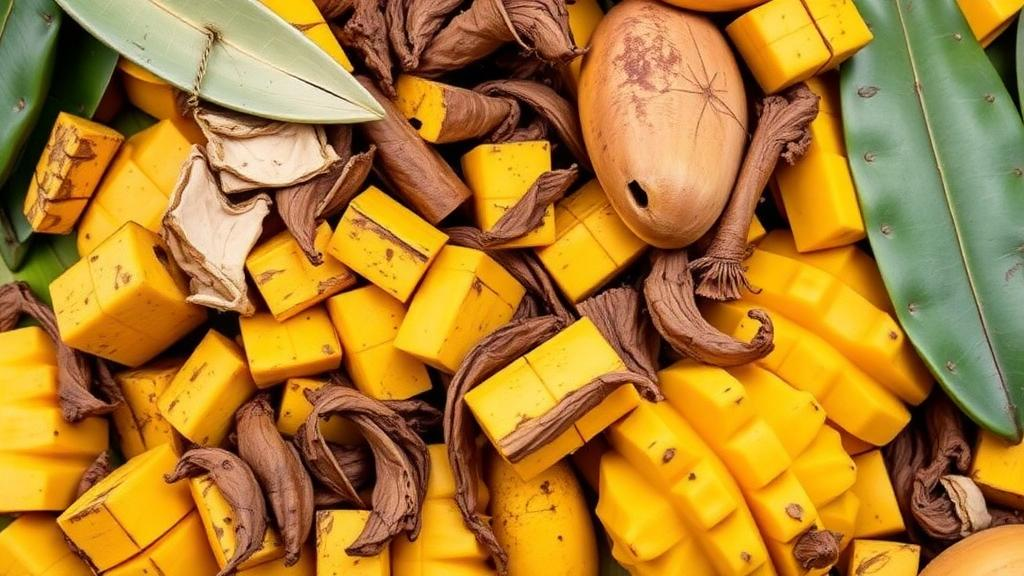
The part of the mango most people throw away may be the most valuable part of the fruit. A new study from Navsari Agricultural University in Gujarat, India, has systematically measured the antioxidant power and phenolic acid content of the peel, pulp, and seed kernels of eight commercially important Indian mango cultivars, and the results make a striking case for treating mango processing waste as a resource rather than refuse. Published in Discover Plants, the research found that the seed kernel, a component routinely discarded along with the stone, contained the highest concentrations of polyphenolic compounds of any fruit part, running four to thirteen times higher than the pulp or peel across all eight varieties tested.
The scale of the opportunity is enormous. Global mango production reached 33.75 million tonnes in 2024-25, and processing the fruit for juice, pulp, and other products generates more than 20 million tonnes of by-products, mostly peel and kernel, which are typically dumped as waste. That disposal carries real environmental costs, including greenhouse gas emissions, water pollution, and foul odors. Because the peel and stone together account for 35 to 55 percent of the whole fruit, the researchers argue that India, the world’s largest producer and exporter of mango products, is discarding a substantial reservoir of bioactive compounds every season.
The team, led by Tulsi Gurjar and Chintan Kapadia, selected eight cultivars that dominate Indian markets and diets: Alphonso, Amrapali, Dashehari, Kesar, Langra, Rajapuri, Sonpari, and Totapuri. All fruit was harvested from ten to twelve year old orchards at a single research station, with ten to twelve mature, undamaged fruits collected per cultivar from different sides of the orchard to smooth out localized environmental variation. Five independent biological replicates were prepared, each pooled from different trees, and each was extracted and analyzed separately, a design that strengthens confidence that the differences observed reflect genuine cultivar biology rather than sampling noise.
Methodologically, the study combined classical spectrophotometric assays with chromatographic precision. Fresh tissue was powdered in liquid nitrogen and extracted with 70 percent methanol, then total polyphenol content was quantified with the Folin-Ciocalteu reagent and expressed as gallic acid equivalents, while total flavonoids were measured with an aluminum nitrate colorimetric method calibrated against rutin. Antioxidant capacity was assessed three independent ways: the DPPH radical discoloration assay, which tracks hydrogen or electron donation to a stable purple free radical; the FRAP assay, which measures the reduction of a ferric-tripyridyltriazine complex to an intensely blue ferrous form; and the ABTS radical scavenging assay, which has the advantage of responding to both water-soluble antioxidants such as ascorbic acid and fat-soluble ones such as carotenoids.
The headline finding concerns the Langra cultivar, which emerged as the standout performer across nearly every metric. Langra pulp recorded the highest total polyphenol content at 431.98 milligrams per 100 grams fresh weight, and Langra peel topped the peel rankings at 1195.42 milligrams per 100 grams. Langra peel also carried the maximum flavonoid load at 1.90 milligrams of rutin equivalents per gram, and the highest ascorbic acid concentrations in both pulp and peel, at 86.43 and 21.79 milligrams per 100 grams respectively. Crucially, Langra extracts showed the highest antioxidant activity in pulp, peel, and kernel regardless of which of the three assays was used, suggesting the effect is robust rather than an artifact of any single measurement technique.
The peel, in particular, demonstrated remarkable radical-scavenging performance. Langra peel neutralized 92.94 percent of DPPH radicals, with Dashehari close behind at 92.56 percent, figures the authors link to the peel’s consistently high phenolic content. At the other end of the spectrum, Totapuri showed the lowest polyphenol values in pulp and peel, at just 117.87 milligrams of gallic acid equivalents per 100 grams in the pulp, underscoring how dramatically cultivar genetics shapes the fruit’s phytochemical profile. In the kernel, total phenol content ranged from 1292.00 milligrams per 100 grams in Sonpari to 1466.72 in Rajapuri, with most cultivars statistically indistinguishable from one another.
Reverse-phase high-performance liquid chromatography then resolved the individual phenolic acids behind these totals. Eight major phenolic acids were quantified, and gallic acid emerged as the dominant compound in every cultivar and every fruit part, followed by vanillic acid. The distribution was far from uniform, however. Amrapali pulp contained all eight phenolic acids in measurable amounts, while Totapuri pulp yielded only vanillic and gallic acid. The Langra kernel held thirty times more gallic acid than its own peel, the single largest concentration of any phenolic acid across the study, and p-coumaric acid was conspicuously absent from the kernels of all eight cultivars. Some acids, including sinapic and ferulic acid, appeared in the peel of only three cultivars, and several compounds fell below detection limits entirely.
Statistical analysis added mechanistic texture to the raw numbers. In the pulp, ascorbic acid correlated strongly with DPPH scavenging activity, with a coefficient of 0.920, and caffeic acid tracked closely with total phenol content, FRAP values, and ascorbic acid levels, indicating that these two metabolites drive much of the pulp’s antioxidant behavior. In the peel, syringic acid correlated significantly with total flavonoids, FRAP, ABTS, and ascorbic acid, and total phenol content correlated with DPPH, flavonoids, and FRAP, supporting the idea that the peel’s antioxidant strength flows directly from its phenolic richness. Intriguingly, the kernel showed no notable correlations despite its towering phenolic and flavonoid levels, and flavonoid content actually correlated negatively with kernel antioxidant capacity, hinting that other, unmeasured metabolites may dominate radical scavenging in that tissue. Principal component analysis reinforced the picture, with the first two components explaining 66.78 percent of total variation and cleanly separating kernel, peel, and pulp samples into three non-overlapping clusters.
The broader implications reach into nutrition, pharmaceuticals, and waste policy. Mango kernels are already known to contain 54 to 77 percent carbohydrates, 5 to 11 percent protein, dietary fiber, and essential amino acids including valine, phenylalanine, threonine, and lysine, alongside flavonoids such as rutin, quercetin, kaempferol, catechin, and myricetin, and the potent polyphenol mangiferin, which has been measured at concentrations ranging from 4 to 516 milligrams per 100 grams in various mango tissues. The new data suggest that kernel flours or extracts could be developed into functional food ingredients, while peel-derived powders and oils are already being explored for nutraceutical and cosmeceutical applications. The authors caution that agro-climatic factors, genotype, season, fertigation, and maturity stage all influence phytochemical content, so cultivar and growing conditions matter when selecting raw material for extraction.
What makes the study resonate beyond the laboratory is its reframing of a waste problem as a supply chain opportunity. India exported roughly 93,000 tonnes of mangoes and pulp in 2023-24, and every tonne of processed fruit leaves behind peel and stone rich in compounds the food and health industries pay dearly to synthesize or source elsewhere. By documenting, cultivar by cultivar and tissue by tissue, exactly where the antioxidant wealth of the mango resides, the Gujarat team has provided a practical map for processors, and a reminder that in one of the world’s most beloved fruits, the best nutrition may be hiding in the part that ends up in the bin.
Subject of Research: Antioxidant activities and phenolic acid profiles of peel, pulp, and seed kernels of Indian mango cultivars
Article Title: Comparative assessment of antioxidant activities and phenolic acids from peel, pulp, and seed kernels of Indian mango (Mangifera indica L.) cultivars
Article References: Gurjar, T., Kapadia, C., Mayani, J., Patel, B., Vaidya, H., Tandel, B., Kumar, S., & Varshney, N. (2026). Comparative assessment of antioxidant activities and phenolic acids from peel, pulp, and seed kernels of Indian mango (Mangifera indica L.) cultivars. Discover Plants, 3(1), Article 455. https://doi.org/10.1007/s44372-026-00909-1
Image Credits: AI Generated
DOI: 10.1007/s44372-026-00909-1
Keywords: mango, Mangifera indica, antioxidants, phenolic acids, seed kernel, mango peel, Langra, polyphenols, RP-HPLC, food waste, nutraceuticals, flavonoids
Cite Scienmag News
Daisy Hatcher. (October 12, 2026). Mango Waste Turns Out to Be a Nutritional Goldmine, Indian Study Finds. Scienmag. https://scienmag.com/mango-waste-turns-out-to-be-a-nutritional-goldmine-indian-study-finds/
Daisy Hatcher. "Mango Waste Turns Out to Be a Nutritional Goldmine, Indian Study Finds." Scienmag, 12 October 2026, https://scienmag.com/mango-waste-turns-out-to-be-a-nutritional-goldmine-indian-study-finds/. Accessed 12 October 2026.
Daisy Hatcher. "Mango Waste Turns Out to Be a Nutritional Goldmine, Indian Study Finds." Scienmag. October 12, 2026. https://scienmag.com/mango-waste-turns-out-to-be-a-nutritional-goldmine-indian-study-finds/


