


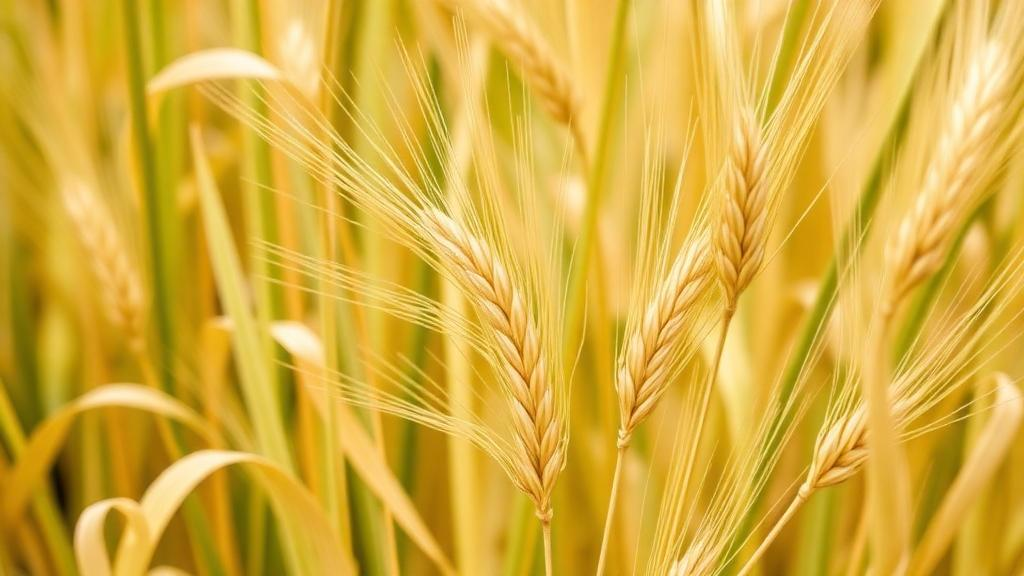
On the saline steppes of northwestern China, a wild barley with an unglamorous name may hold one of agriculture’s most practical secrets. Hordeum brevisubulatum, a perennial relative of cultivated barley, thrives in salty soils where most forage grasses fail, and it does so with the help of an invisible companion: Epichloë, a fungal endophyte that lives entirely within the plant’s tissues. A new study published in Plant and Soil by researchers at Lanzhou University and the Gansu Academy of Agricultural Science has now systematically compared wild barley accessions collected from different regions, asking a deceptively simple question with far-reaching consequences: if you want a grass that grows well, feeds animals well, and shrugs off salt, which natural strains should you choose, and what trade-offs must you accept?
The answer matters because the world is losing arable land at an alarming rate. Soil salinity now degrades millions of hectares globally, and the Food and Agriculture Organization has documented the expanding footprint of salt-affected soils as irrigation, climate change, and unsustainable land management push dissolved salts into root zones. Conventional crops respond poorly to salinity: sodium ions disrupt photosynthesis, impair chloroplast function, and interfere with the delicate sodium-to-potassium balance that plant cells depend on. For livestock producers, the squeeze is doubly painful, because degraded saline land produces less and worse forage. Wild relatives of crop species have long been recognized as reservoirs of salinity tolerance, and Hordeum brevisubulatum, long prized in China’s pastoral regions as a high-quality forage grass, is a prime candidate for breeding programs aimed at reclaiming these marginal lands.
What makes this new study distinctive is its comprehensive, dual-track design. The researchers gathered ecotypes of the wild barley from different geographic regions and subjected them to two complementary evaluation systems. In field experiments, they measured the full suite of agronomic traits and forage quality parameters that determine whether a grass is commercially useful: plant height, crown breadth, and related growth characteristics, alongside the nutritional chemistry that governs animal feeding value. In parallel greenhouse experiments, they exposed the same ecotypes to salt stress treatments and monitored how growth responded. This combination allowed the team to ask not only which plants were best in any single dimension, but how those dimensions relate to one another across the whole collection.
The nutritional analysis is technically rich and worth unpacking. Forage quality is conventionally judged through a battery of fiber and protein measurements. Neutral detergent fiber and acid detergent fiber capture the structural carbohydrates that ruminants digest slowly or not at all, while acid detergent lignin quantifies the indigestible fraction most strongly. Crude protein, ether extract, and nitrogen-free extract round out the picture, together with dry matter digestibility and dry matter intake. These values feed into a single industry-standard index, the relative feeding value, which combines intake potential with digestibility into one number that farmers and feed specialists can compare across forages. The Lanzhou team applied this framework across their ecotype panel and found, strikingly, that these quality traits varied enormously between accessions collected from different regions, revealing that the species harbors far more usable diversity than any single population would suggest.
Using path analysis, a statistical technique that separates direct effects from indirect ones, the researchers identified which traits exerted the strongest influence on relative feeding value. Three emerged as the principal drivers: crown breadth, a structural trait reflecting the perennial plant’s vegetative vigor; acid detergent fiber, the digestibility-relevant carbohydrate fraction; and relative membrane permeability, a physiological marker of cellular stress damage. That last trait deserves special attention. When plant cells are stressed, their membranes leak electrolytes, and the degree of leakage, measured as relative membrane permeability, provides a sensitive readout of how badly the tissue is being damaged. In saline conditions, membranes are among the first casualties, because excess sodium destabilizes ion transport and reactive oxygen species assault lipid bilayers. Finding that this stress-damage marker was a significant direct contributor to feeding value suggests a physiological coupling between how well a plant withstands salt and how nutritious its forage ultimately is.
Yet the correlation analysis also revealed an uncomfortable biological tension. The researchers detected significant negative correlations between forage quality and agronomic traits, and between forage quality and salt tolerance. In other words, the plants that grow biggest and tolerate salt best are not necessarily the ones that produce the most digestible, protein-rich forage. This pattern echoes a well-documented principle in plant biology: the growth-defense trade-off. Plants have finite resource budgets, and investing in robust structures, salt exclusion machinery, and stress protection can come at the expense of the tender, nutrient-dense tissues that make forage valuable. Fiber content in particular tends to rise with plant size and structural investment, diluting protein and lowering digestibility. Breeders hoping to combine every desirable trait in a single line will therefore face genuine constraints, and the study’s correlation structure quantifies precisely where those trade-off lines fall.
Against that backdrop, the positive correlation between agronomic performance and salt tolerance is encouraging news. It means that the two traits a restoration ecologist cares most about, biomass and salt resilience, can plausibly be improved together. The physiological logic is coherent: a plant that maintains crown vigor, root activity, and membrane integrity under salinity is fundamentally a healthier plant, and healthier plants produce more vegetative growth even on compromised land. Previous work by the same research group and collaborators has shown that Epichloë infection enhances salt tolerance in this species through multiple mechanisms, including modulation of polyamine metabolism and anatomical changes that protect internal tissues, as well as improved root growth and nutrient absorption in related grass-endophyte systems. The endophyte, transmitted vertically through seed, effectively functions as a stress-shielding layer that the plant does not have to pay a full genetic price for.
From the entire evaluation, the team identified three ecotypes that stand out for combining good agronomic traits with salt tolerance, flagging them as candidate germplasm for developing new varieties. For ecological restoration of saline-alkali land in China’s northern pastoral zones, these lines could anchor revegetation programs that stabilize degraded soils while simultaneously producing usable forage, a dual benefit that few plant candidates can match. For forage breeding, they represent a starting point for crossing programs that might, through careful selection, push back against the quality-versus-vigor trade-off documented in the correlation data. The vertical transmission of Epichloë also simplifies deployment: once a superior symbiotic line is bred, its fungal partner travels with the seed.
The study also carries a broader message about conserving wild genetic resources before they disappear. Each ecotype in the panel embodied a unique combination of local adaptation, nutritional chemistry, and stress physiology shaped by the specific environment from which it was collected. As grasslands across arid Central Asia face intensifying grazing pressure, climate shifts, and salinization, that diversity erodes. The Lanzhou analysis demonstrates quantitatively that no single population captures the full range of useful variation, which means collections from multiple regions, like the one assembled here, are irreplaceable raw material for future breeding. The same logic applies to wild barley relatives worldwide, which geneticists have repeatedly mined for salinity tolerance traits transferable to cultivated barley and wheat.
What began as a systematic comparison of grass accessions ends as a blueprint for the next generation of salt-tolerant forage crops. By linking field agronomy, feed chemistry, and stress physiology in a single evaluation framework, and by pinpointing the measurable traits, crown breadth, acid detergent fiber, and membrane stability, that most directly shape feeding value, the researchers have given breeders a concrete selection toolkit. The three elite ecotypes they identified are not a finished product but a launchpad: lines to be crossed, endophyte partnerships to be optimized, and trade-offs to be navigated. If the work fulfills its promise, the salty soils that now mock conventional agriculture could one day support pastures of tough, fungus-armed wild barley, turning a mounting global liability into productive grazing land.
Subject of Research: Ecotypic variation in growth, forage quality, and salt tolerance of Epichloë-infected wild barley
Article Title: Ecotypic discrepancy in growth traits, nutritional quality and salt tolerance of Hordeum brevisubulatum—Epichloë endophyte symbionts
Article References: Zhai, Y., Malik, K., Li, C., Chen, Z., & ZhengfengWang (2026). Ecotypic discrepancy in growth traits, nutritional quality and salt tolerance of Hordeum brevisubulatum—Epichloë endophyte symbionts. Plant and Soil. https://doi.org/10.1007/s11104-026-09059-5
Image Credits: AI Generated
DOI: 10.1007/s11104-026-09059-5
Keywords: Hordeum brevisubulatum, Epichloë endophyte, salt tolerance, forage quality, soil salinity, plant breeding, germplasm, wild barley, symbiosis, agronomic traits, relative feeding value, ecotypes
Cite Scienmag News
Alan Morgan. (October 12, 2026). Fungal Partners and Wild Barley: The Hidden Variability Shaping Future Salt-Tolerant Forage. Scienmag. https://scienmag.com/fungal-partners-and-wild-barley-the-hidden-variability-shaping-future-salt-tolerant-forage/
Alan Morgan. "Fungal Partners and Wild Barley: The Hidden Variability Shaping Future Salt-Tolerant Forage." Scienmag, 12 October 2026, https://scienmag.com/fungal-partners-and-wild-barley-the-hidden-variability-shaping-future-salt-tolerant-forage/. Accessed 12 October 2026.
Alan Morgan. "Fungal Partners and Wild Barley: The Hidden Variability Shaping Future Salt-Tolerant Forage." Scienmag. October 12, 2026. https://scienmag.com/fungal-partners-and-wild-barley-the-hidden-variability-shaping-future-salt-tolerant-forage/


