


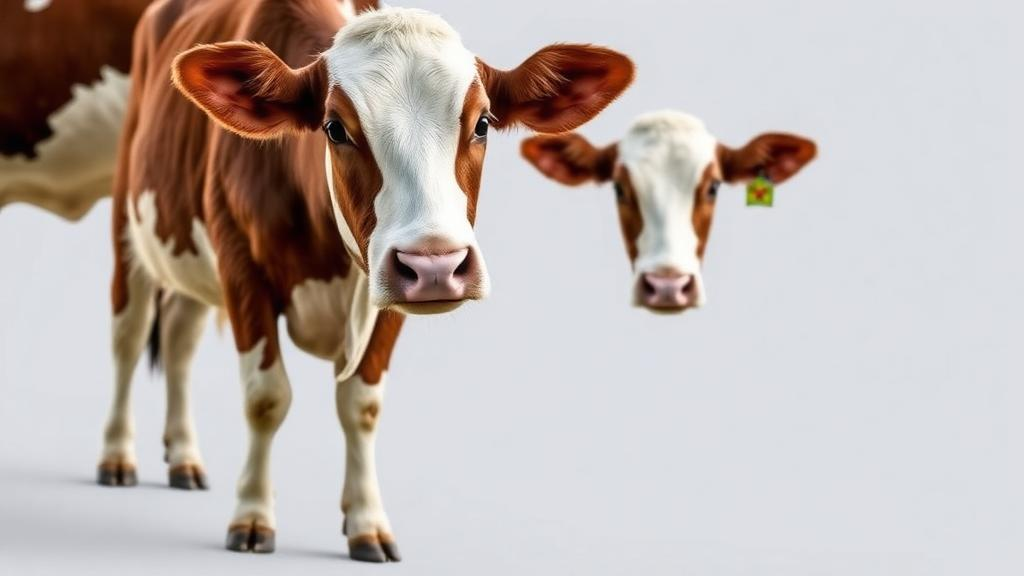
For dairy farmers, few problems are as costly and persistent as lameness. When a cow’s claws and hooves deteriorate, everything else follows: she walks less, eats less, produces less milk, and leaves the herd earlier than she should. Hoof disorders are among the most common reasons for premature culling in modern dairy operations, which makes the genetics of claw and hoof conformation a subject of intense practical interest. A new study published in BMC Genomics by researchers at Yangzhou University and their collaborators has now taken a detailed look at the genetic architecture of these traits in a large Chinese Jersey population, combining genome-wide association analysis with transcriptome-wide prediction and functional annotation to identify candidate genes that may shape the feet on which the dairy industry literally stands.
The research team, led by Hui Jiang, Tianqi Zhao, Zhijian Zhu, Zeliang Huang, Zhaoying Song, Xubin Lu, and Zhangping Yang, worked with phenotypic and genomic data from 1,593 Jersey cattle raised on a commercial dairy farm in Jiangsu Province, China. Jersey cattle are a globally important dairy breed, prized for the high fat and protein content of their milk, but like all high-producing dairy breeds they face relentless selection pressure on traits that are easy to measure in the milking parlor. Conformation traits of the feet and legs, by contrast, are scored visually by trained classifiers, and their genetic basis has remained only partially resolved. The five traits examined in this study were foot angle, heel depth, bone quality, side view of rear legs, and rear leg rear view, each of which describes a distinct aspect of how the hoof is shaped and how the leg is positioned beneath the cow.
What sets this study apart technically is the depth and quality of the genomic data. Rather than relying solely on a standard genotyping chip, the researchers generated low-depth whole-genome sequencing data at approximately one-times coverage using an Illumina NovaSeq 6000 platform, alongside conventional single-nucleotide polymorphism genotyping with the GGP Bovine 100 K chip. Low-depth sequencing on its own produces many missing or uncertain genotype calls, so the team performed read alignment, haplotype phasing, and multi-stage genotype imputation to recover a complete picture. The result was a high-density dataset of roughly 7.1 million autosomal SNPs, an order of magnitude denser than typical chip-based studies. This density matters because association mapping is fundamentally a search for correlations between genetic variants and measured traits, and rare or poorly tagged variants can hide the true causal signals when the marker panel is sparse.
Before hunting for genes, the team characterized the genetics of the traits themselves by estimating heritability, the proportion of variation in a trait that can be attributed to genetic differences among individuals. The results were sobering for anyone hoping that hoof quality could be rapidly improved through selection. All five traits showed low heritability, with estimates ranging from 0.039 plus or minus 0.028 for foot angle to 0.242 plus or minus 0.045 for bone quality. In practical terms, this means that most of the variation in these traits within this population is driven by environmental factors such as flooring, nutrition, hygiene, and management, rather than by inherited differences. Bone quality, at roughly a quarter heritable, offers the most genetic signal to work with, while foot angle sits near the edge of statistical detectability. Low heritability does not mean genetics is irrelevant, but it does mean that larger sample sizes and more precise measurements are needed to detect the underlying variants.
The genome-wide association study used a standard mixed linear model, a statistical framework that accounts for the relatedness among individuals in the herd so that population structure does not masquerade as genetic association. The outcome was strikingly asymmetric. For heel depth, the analysis identified 23 SNPs reaching genome-wide significance, while for rear leg rear view it identified 478 significant SNPs, a far larger haul that suggests this trait has a somewhat richer genetic basis or a more favorable signal-to-noise ratio in this dataset. For the remaining three traits, foot angle, bone quality, and side view of rear legs, no SNPs crossed the genome-wide significance threshold at all. This pattern is consistent with the heritability estimates and illustrates a common reality in quantitative genetics: traits with low heritability often yield few or no individually significant variants even when thousands of animals are analyzed, because each variant contributes only a tiny sliver of the total variation.
To squeeze more information out of the data, the researchers turned to a complementary approach known as transcriptome-wide association study, or TWAS. Instead of testing genetic variants directly against traits, TWAS uses reference panels to predict how strongly each individual’s genes are expressed based on their genotypes, and then asks whether genetically predicted expression correlates with the trait of interest. This has two advantages. First, it aggregates the effects of many variants across a gene into a single test, boosting statistical power. Second, it points directly at genes rather than at anonymous SNPs that may lie far from the genes they regulate. The TWAS in this study identified 13 significant named gene-tissue pairs spanning four of the five traits: foot angle, heel depth, bone quality, and rear leg rear view. The researchers also examined cross-tissue correlations of TWAS Z-scores, which measure how consistently the association patterns for a trait align across different tissues, revealing varying degrees of concordance that hint at which biological tissues matter most for each trait.
Functional enrichment analysis of the candidate set then asked what these genes actually do. The results pointed toward three broad biological themes: lipid metabolism, neural signaling, and cell adhesion. Each of these makes intuitive sense once you consider what a hoof is. The claw is a highly specialized epidermal structure whose hard keratinized wall depends on well-organized lipid barriers and cell-cell adhesion to maintain its integrity against the mechanical pounding of a half-tonne animal on concrete. Neural signaling enters the picture because leg conformation and posture are shaped by the neuromuscular system, and altered sensation or nerve function in the digit is a known feature of several claw disorders. By integrating the GWAS and TWAS results with this functional annotation, the team prioritized six candidate genes: ACER1, MICALL2, CLDN18, COL28A1, SRXN1, and TIGAR.
Each of these candidates tells a plausible biological story. ACER1 encodes an enzyme involved in ceramide metabolism, placing it squarely in the lipid-processing pathways that govern the skin and hoof barrier. MICALL2 participates in actin cytoskeleton dynamics and cell adhesion, processes central to how epithelial cells hold together under mechanical stress. CLDN18 is a tight-junction protein, a molecular gasket that seals the spaces between cells, and its role in epithelial integrity is well documented in other tissues. COL28A1 encodes a collagen of the extracellular matrix, the structural scaffold on which bone and connective tissue are built, making it a natural candidate for traits like bone quality. SRXN1 and TIGAR, meanwhile, are involved in cellular responses to oxidative and metabolic stress, which accumulate in hoof tissue subjected to inflammation and mechanical injury. Together, the six genes sketch a picture of hoof health as a product of epithelial resilience, skeletal and extracellular-matrix organization, and the cell’s capacity to withstand stress.
The authors are careful, appropriately, about what these findings do and do not establish. They emphasize that independent replication in other populations and functional validation in the laboratory are required before any causal inference can be drawn or before the results can be applied in breeding programs. This caution is standard and warranted in livestock genomics, where association signals frequently fail to replicate across breeds and environments, and where a candidate gene list is a hypothesis-generating tool rather than a finished product. Still, the study delivers a genuinely useful resource: a densely imputed genomic dataset from a well-characterized Jersey population, heritability estimates for five economically important traits, and a short list of biologically coherent candidate genes that can now be interrogated directly.
The broader significance of the work lies in its methodological template. By combining low-depth whole-genome sequencing with multi-stage imputation, the researchers showed that it is possible to build a multi-million-variant dataset at a fraction of the cost of deep sequencing, opening the door for similar studies in other herds and breeds. By layering TWAS and functional enrichment on top of conventional GWAS, they extracted candidate genes from traits whose low heritability would otherwise have yielded almost nothing. As dairy producers worldwide grapple with the welfare and economic burden of lameness, studies like this one inch the field closer to a future where genetic selection, alongside better management and housing, can help build cows whose feet are as robust as their milk yields. The genes identified here are candidates, not conclusions, but they are now on the map, and the map is precisely what the next generation of hoof-health research needed.
Subject of Research: Genetic basis of claw and hoof conformation traits in Jersey dairy cattle identified through integrated GWAS, TWAS, and functional enrichment analysis
Article Title: Integrated GWAS, TWAS, and functional enrichment reveal candidate genes for claw and hoof traits in Jiangsu Jersey cattle
Article References: Jiang, H., Zhao, T., Zhu, Z., Huang, Z., Song, Z., Lu, X., & Yang, Z. (2026). Integrated GWAS, TWAS, and functional enrichment reveal candidate genes for claw and hoof traits in Jiangsu Jersey cattle. BMC Genomics. https://doi.org/10.1186/s12864-026-13378-3
Image Credits: AI Generated
DOI: 10.1186/s12864-026-13378-3
Keywords: Jersey cattle, claw and hoof traits, GWAS, TWAS, functional enrichment, candidate genes, genotype imputation, low-depth whole-genome sequencing, heritability, dairy cattle genetics, lameness, BMC Genomics
Cite Scienmag News
Juliet Wilcox. (October 12, 2026). Genome-Wide Hunt in Jersey Cattle Uncovers Genes Behind Healthy Hooves. Scienmag. https://scienmag.com/genome-wide-hunt-in-jersey-cattle-uncovers-genes-behind-healthy-hooves/
Juliet Wilcox. "Genome-Wide Hunt in Jersey Cattle Uncovers Genes Behind Healthy Hooves." Scienmag, 12 October 2026, https://scienmag.com/genome-wide-hunt-in-jersey-cattle-uncovers-genes-behind-healthy-hooves/. Accessed 12 October 2026.
Juliet Wilcox. "Genome-Wide Hunt in Jersey Cattle Uncovers Genes Behind Healthy Hooves." Scienmag. October 12, 2026. https://scienmag.com/genome-wide-hunt-in-jersey-cattle-uncovers-genes-behind-healthy-hooves/


