


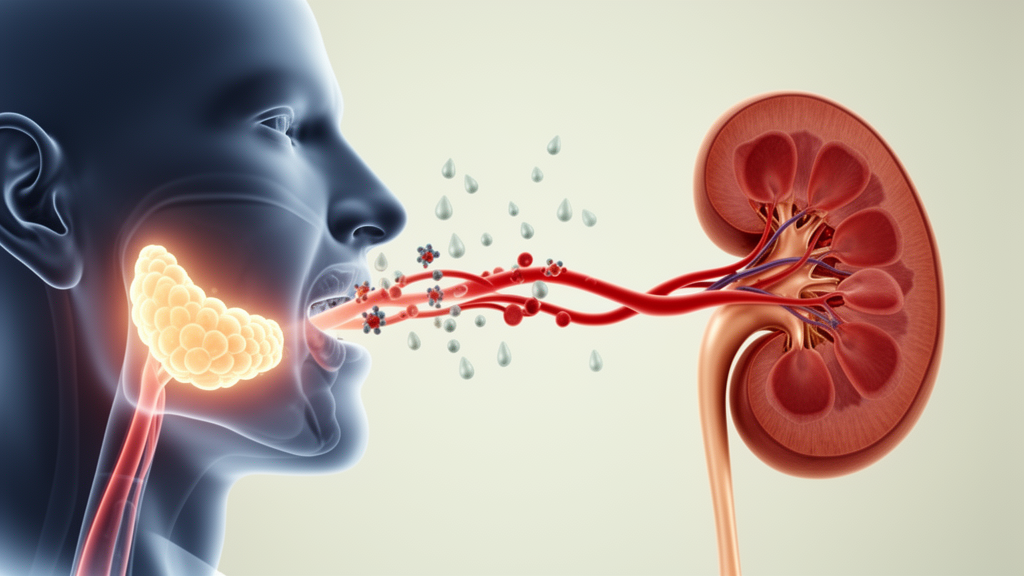
Saliva is not the first place clinicians look when they want to know how well a patient’s kidneys are working. The standard toolkit is drawn from blood and urine: estimated glomerular filtration rate, or eGFR, derived from serum creatinine, and a growing roster of tubular injury and mineral metabolism markers. Yet a new study published in the journal Clinical Proteomics argues that one of the most abundant protein families in human saliva, the salivary proline-rich proteins, may deserve a place in that conversation, not because of what they do in the mouth, but because of what their levels in blood reveal about the kidney.
The research, led by Satoshi Kozawa, Kyoji Urayama, and Kengo Tejima together with senior author Thomas N. Sato and colleagues at Karydo TherapeutiX, the Advanced Telecommunications Research Institute International, and Nara Medical University in Japan, set out to answer a question that has long been neglected. Salivary proline-rich proteins, abbreviated sPRPs, are secreted in large quantities by the salivary glands and are known to contribute to oral lubrication and to the formation of the protective enamel pellicle. Beyond these local roles, however, their physiology has remained poorly characterized, and their behavior in systemic disease has been almost entirely unexplored.
To probe what these proteins might be doing in chronic kidney disease, the team turned first to mouse models. They used a unilateral nephrectomy model, in which one kidney is surgically removed, combined with a high-phosphate diet to accelerate renal stress, and they also studied mice lacking fibroblast growth factor 23, or FGF23, a bone-derived hormone that is central to phosphate homeostasis and rises dramatically as kidney function declines. The result was striking: expression of the genes encoding salivary proline-rich proteins was upregulated by the high-phosphate diet in the CKD model, and the expression was positively regulated by FGF23. In other words, the salivary glands appear to respond to a systemic mineral-metabolism signal that is itself driven by failing kidneys.
Single-cell RNA sequencing provided the anatomical foundation for this observation. By profiling gene expression cell by cell in both mouse and human salivary gland tissue, the researchers identified the specific cell types that produce the proline-rich proteins, confirming that the signal they were tracking originates from defined secretory populations within the glands rather than from contaminating blood or inflammatory cells. This cell-level resolution matters, because it anchors the biomarker story in a plausible biological mechanism: a hormone from the bone-kidney axis acting on salivary gland cells to change what they secrete.
The most consequential finding, however, came from the human data. Analyzing samples from 1,023 human subjects, the team discovered that salivary proline-rich proteins are present not only in saliva, where everyone expected them, but also in serum, where they had not been appreciated as measurable analytes. This is the sense in which the authors call them non-canonical biomarkers: proteins named for their salivary origin turn out to circulate in blood, and their blood levels, rather than their salivary levels, carry the clinical information.
That distinction proved critical. When the researchers correlated protein measurements with standard kidney function indices, it was serum sPRP levels, not salivary sPRP levels, that tracked with the canonical CKD biomarkers eGFR and ePTFp. The latter abbreviation, estimated proximal tubule fluid phosphate concentration, is a newer index that estimates the phosphate concentration in the fluid processed by the kidney’s proximal tubules, capturing aspects of tubular phosphate handling that eGFR alone cannot. The finding that serum sPRPs associate with both indices suggests they reflect a dimension of kidney physiology that spans filtration and tubular function.
To understand what dimension that might be, the investigators took a proteome-wide view. Using two large-scale affinity-based proteomic platforms, Olink and SomaScan, they examined how the entire serum proteome associates with serum sPRP levels, with eGFR, and with ePTFp. The analysis revealed that each of the three measures captures both common and distinct molecular signatures of chronic kidney disease, and that the signatures associated with serum sPRPs correspond predominantly to the features shared by eGFR and ePTFp. In mechanistic terms, the sPRP signal appears to represent the systemic biology that both standard indices see, rather than a redundant copy of either one.
Specificity is the make-or-break question for any proposed biomarker, and this is where the study delivers its most provocative number. The team compared the serum sPRP-associated proteomic signatures against a comprehensive panel of serum biomarkers spanning 59 non-CKD human diseases. Of the 1,685 signature features examined, 1,106, or 65.64 percent, showed no association with any of the 59 other diseases. The authors interpret this as evidence that serum sPRPs reflect potentially CKD-specific systemic mechanisms, a degree of disease specificity that few candidate biomarkers achieve when tested against broad disease panels.
The practical implication is not that saliva-based kidney tests are around the corner, but rather that a third measurement axis could complement the two that clinicians already use. The authors conclude that eGFR, ePTFp, and serum sPRPs are complementary, each capturing overlapping but non-identical information about CKD biology, and that combining them could improve both mechanistic studies of the disease and, potentially, diagnosis and treatment. Because the sPRP signal is regulated by FGF23 and responsive to dietary phosphate, it may be particularly informative in the mineral and bone disorder that complicates advanced kidney disease, where phosphate handling is a central therapeutic target.
There are caveats worth keeping in view. The human parotid gland tissue used for single-cell sequencing came from a single patient undergoing cancer surgery, and the cohort enrolled patients already diagnosed with kidney disease, cardiovascular disease, diabetes, or hypertension, so prospective validation in general populations will be needed before serum sPRP measurements enter clinical practice. Several of the authors are employees of Karydo TherapeutiX, which files patents related to the work, and the article was released as an early-access version subject to further edits. Even so, the study opens an unexpected window: proteins long treated as mere saliva lubricants, governed by a bone-kidney hormone and modulated by dietary phosphate, turn out to circulate in blood and to carry a molecular fingerprint of kidney failure that is largely invisible to other diseases. It is a reminder that biomarker discovery sometimes means looking again at molecules so familiar that no one thought to ask what they were doing outside their assigned tissue.
Subject of Research: Serum salivary proline-rich proteins as biomarkers of chronic kidney disease
Article Title: Salivary proline-rich proteins are non-canonical serum biomarkers of chronic kidney disease
Article References: Kozawa, S., Urayama, K., Tejima, K., Nakanishi, M., Nakagawa, Y., Eriguchi, M., Watanabe, M., Kosugi, T., Kirita, T., Tsuruya, K., Saito, Y., Kuro-o, M., & Sato, T. N. (2026). Salivary proline-rich proteins are non-canonical serum biomarkers of chronic kidney disease. Clinical Proteomics. https://doi.org/10.1186/s12014-026-09640-1
Image Credits: AI Generated
DOI: 10.1186/s12014-026-09640-1
Keywords: salivary proline-rich proteins, chronic kidney disease, biomarkers, FGF23, eGFR, ePTFp, proteomics, Olink, SomaScan, single-cell RNA sequencing, saliva, serum
Cite Scienmag News
Jerry Hayes. (October 9, 2026). Spit Proteins Turn Up in Blood and Track Kidney Disease, Study Finds. Scienmag. https://scienmag.com/spit-proteins-turn-up-in-blood-and-track-kidney-disease-study-finds/
Jerry Hayes. "Spit Proteins Turn Up in Blood and Track Kidney Disease, Study Finds." Scienmag, 9 October 2026, https://scienmag.com/spit-proteins-turn-up-in-blood-and-track-kidney-disease-study-finds/. Accessed 9 October 2026.
Jerry Hayes. "Spit Proteins Turn Up in Blood and Track Kidney Disease, Study Finds." Scienmag. October 9, 2026. https://scienmag.com/spit-proteins-turn-up-in-blood-and-track-kidney-disease-study-finds/


