


Every solar panel loses a surprising fraction of its potential power before a single electron is generated, and the culprit is something as mundane as glare. When sunlight strikes the cover glass of a photovoltaic cell, a portion of it bounces straight back into the sky instead of passing through to the silicon below. That reflected light represents pure waste, and for decades engineers have fought it with antireflection coatings that coax photons across the air-glass boundary. Now a research team from Kirsehir Ahi Evran University and Ankara University in Turkey has reported a deceptively simple way to make such coatings work better: stir a common acrylic polymer into a zinc oxide solution and let the polymer burn away to leave behind a sponge-like film. The result, published in the Journal of Nanoparticle Research, is a coating that transmits more light and lifts solar cell efficiency by roughly six percent.
The physics behind the problem is straightforward but stubborn. Light traveling from air, with a refractive index of about 1.0, into glass, with an index near 1.5, encounters an abrupt change in the speed at which electromagnetic waves propagate. Part of the wave is always reflected at such an interface, a phenomenon familiar to anyone who has seen their own face staring back from a window at night. For a solar module, that reflection can swallow several percent of the incoming solar energy. Antireflection coatings mitigate the loss by inserting an intermediate layer whose refractive index sits between that of air and glass, and whose thickness is tuned so that reflections from the top and bottom of the film destructively interfere, canceling each other out. The catch is that most dense, solid materials have refractive indices far higher than the ideal value needed for glass, so researchers increasingly turn to porous films, where tiny air pockets effectively dilute the material and drag its average refractive index downward.
Zinc oxide has long been an attractive candidate for such coatings. It is cheap, chemically stable, transparent across the visible spectrum, and easy to deposit from solution at low temperatures, making it compatible with large-area and low-cost manufacturing. In the new study, Hafize Nagehan Koysuren and Ozcan Koysuren prepared ZnO films using the sol-gel dip-coating technique, a method in which a substrate is immersed in a chemical precursor solution and withdrawn at a controlled speed, leaving behind a thin liquid film that gels and is then heat-treated to form the final oxide. Sol-gel processing is prized for its simplicity and scalability, but dense sol-gel ZnO still carries a refractive index too high for optimal antireflection performance. The Turkish team’s solution was to add polymethyl methacrylate, or PMMA, the acrylic best known as plexiglass, into the dip-coating solution as a porogen, a sacrificial ingredient whose job is to vanish.
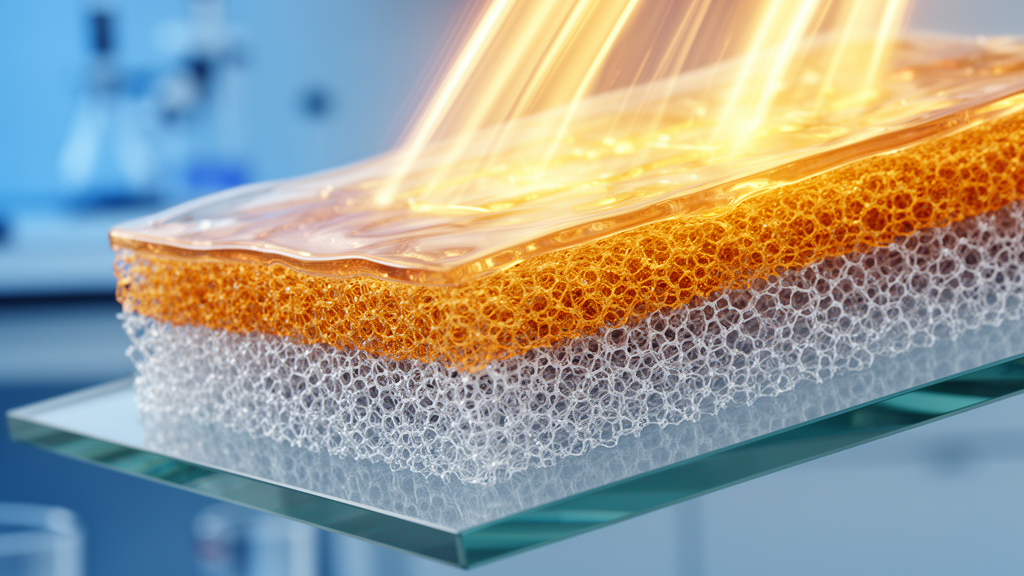
The porogen strategy exploits a neat piece of thermal chemistry. When the coated films are heated, the PMMA decomposes and escapes as gas, leaving behind the voids it once occupied. The more PMMA in the starting solution, the more pores riddle the finished ZnO film, and the more air is trapped within the coating. Because air has an extremely low refractive index of almost exactly 1.0, each pocket of air lowers the effective optical density of the film. The researchers varied the PMMA concentration in the dip-coating solution and tracked how the pore structure, crystal structure, and optical behavior of the films changed in response, coating glass slides that served as stand-ins for the cover glass of a solar cell.
Characterization confirmed that the chemistry behaved as intended. X-ray diffraction showed the characteristic crystalline signature of zinc oxide both in pure films and in films prepared with PMMA present, indicating that the polymer did not disrupt the formation of the oxide. Fourier-transform infrared spectroscopy backed this up, verifying the chemical identity of the ZnO phase. Field-emission scanning electron microscopy and optical microscopy then provided the visual payoff: as the PMMA content of the film increased, the number of pores on the surface visibly multiplied, exactly as the porogen mechanism predicts. The films were, in effect, being sculpted from the inside out by a template that destroyed itself on cue.
The optical measurements told the story that matters for photovoltaics. Glass slides coated with the porous ZnO/PMMA films transmitted more visible light and reflected less than slides coated with dense, pure ZnO. The best performer was the film containing 3 weight percent PMMA, which achieved a maximum transmittance of 92.50 percent, a minimum reflectance of 6.35 percent, and a refractive index of 1.64, all measured at a wavelength of 650 nanometers in the heart of the visible spectrum where silicon solar cells harvest much of their current. A refractive index of 1.64 is a substantial drop from that of dense ZnO and moves the film much closer to the ideal intermediate value for matching air to glass, which is precisely what a well-designed single-layer antireflection coating requires.
Crucially, the optical gains translated into electrical gains. When the coated cover glass was applied to solar cells, the device with the 3 weight percent PMMA film showed the most favorable combination of optical and photovoltaic properties among all the samples tested, and the PMMA-containing ZnO coating produced an efficiency improvement of approximately six percent compared with the uncoated reference. In an industry where module efficiencies are measured to the decimal point and incremental gains are fiercely contested, a six percent relative boost from a solution-based dip-coating step applied to the glass is a striking return on such a modest modification. The authors attribute the improvement directly to the pore formation mechanism of PMMA, which enhances light transmittance through the cover glass and thereby increases the photovoltaic conversion efficiency of the cell beneath.
The work fits into a broader and increasingly active research landscape on porous antireflection coatings. Previous studies have used polyethylene glycol as a template to create porous ZnO films, employed phase separation to make porous polymer surfaces, and built porous silica and titania coatings with various sacrificial additives. Others have explored ZnO nanorods, ZnO-silica composites, and double-layer stacks combining ZnO with porous silicon to cut reflection losses on silicon cells. What distinguishes the new study is its systematic focus on how the concentration of the porogen tunes the optical constants and the device-level outcome, and its demonstration that a widely available, inexpensive polymer can serve as the pore-forming agent in a ZnO matrix deposited on ordinary cover glass.
The practical appeal of the approach lies in its low barrier to adoption. Sol-gel dip-coating requires no vacuum equipment, no high-temperature processing of the completed cell, and no exotic precursors, and the technique is already used industrially for applying coatings to flat glass. Because the coating is applied to the cover glass rather than to the delicate semiconductor surface, it does not interfere with the electrical engineering of the cell itself and could in principle be retrofitted into existing module manufacturing lines. The authors suggest that ZnO/PMMA coatings represent a promising alternative approach for antireflection applications in silicon solar cells, and the simplicity of the route means that tuning the PMMA loading offers a single dial for adjusting porosity, refractive index, and transmittance together.
Challenges remain before such coatings reach the factory floor. Real modules must survive decades of ultraviolet exposure, humidity cycling, thermal stress, and abrasion, and sol-gel films can be prone to cracking if stresses build up during drying and heat treatment. The long-term durability of a porous film, with its high internal surface area, will need to be validated under accelerated aging conditions. Still, the underlying idea is elegant in its economy: let a polymer do the work of building air into a transparent oxide, then let heat erase the scaffold. If the durability questions can be answered, the humble acrylic sheet’s chemistry may find a second career quietly squeezing a few more watts of sunlight out of every panel on every rooftop.
Subject of Research: Porous ZnO/PMMA antireflection coatings for improving silicon solar cell efficiency
Article Title: Enhancing solar cell efficiency through ZnO antireflection films
Article References: Enhancing solar cell efficiency through ZnO antireflection films. (n.d.). https://doi.org/10.1007/s11051-026-06786-9
Image Credits: AI Generated
DOI: 10.1007/s11051-026-06786-9
Keywords: solar cells, antireflection coating, zinc oxide, PMMA, porous films, sol-gel, dip-coating, photovoltaic efficiency, refractive index, optical transmittance, nanoparticles, photovoltaics
Cite Scienmag News
Neil Sanderson. (October 9, 2026). Porous ZnO Films Boost Solar Cell Efficiency with a Simple Polymer Trick. Scienmag. https://scienmag.com/porous-zno-films-boost-solar-cell-efficiency-with-a-simple-polymer-trick/
Neil Sanderson. "Porous ZnO Films Boost Solar Cell Efficiency with a Simple Polymer Trick." Scienmag, 9 October 2026, https://scienmag.com/porous-zno-films-boost-solar-cell-efficiency-with-a-simple-polymer-trick/. Accessed 9 October 2026.
Neil Sanderson. "Porous ZnO Films Boost Solar Cell Efficiency with a Simple Polymer Trick." Scienmag. October 9, 2026. https://scienmag.com/porous-zno-films-boost-solar-cell-efficiency-with-a-simple-polymer-trick/


