


Deep in the night, when the atmosphere settles into stable stratification, the wind that strikes a modern wind turbine is not a single, coherent current. Instead, the direction of the wind shifts gradually with height, a phenomenon known as wind veer, driven by the Coriolis force and suppressed vertical mixing in the stable boundary layer. For rotors that now span 200 to 300 meters, this means the top of the disk can face a wind direction tens of degrees away from the bottom. A new wind tunnel study from Delft University of Technology, published in Wind Energy Science, provides the first controlled laboratory demonstration of how this directional shear transforms the wake behind a turbine, and the results carry a provocative implication for one of wind energy’s most celebrated control strategies.
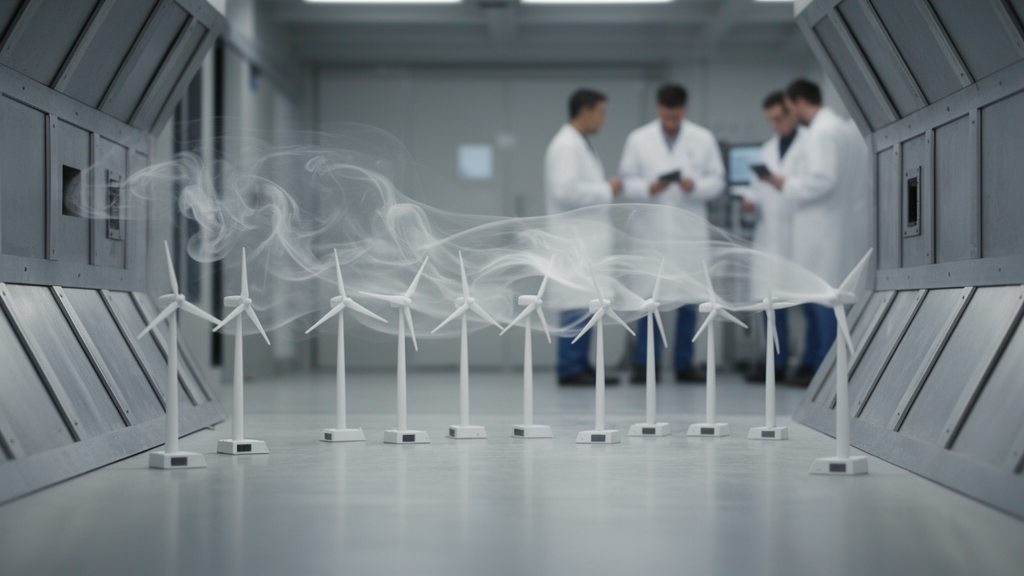
The research team, led by Shantanu Purohit together with Haoyuan Sun, Andrea Sciacchitano and Wei Yu, used a porous disk as a stand-in for an operating turbine. Porous disks have long served as wind turbine analogues because, when their porosity is tuned to match the thrust coefficient of a real rotor, they reproduce the essential far-wake characteristics of a spinning machine without the complexity of rotating blades. The team 3D printed a uniform disk of 10 centimeters in diameter with a porosity of 0.6, yielding a thrust coefficient of approximately 0.69, a value consistent with the porosity-to-thrust relationships established in prior literature.
The genuinely novel element was the inflow. To generate wind veer in the laboratory, the researchers installed a bank of twisted NACA 0014 airfoil vanes at the exit of the open-jet W-tunnel. Because the vanes were twisted in opposite directions above and below the disk centerline, the flow emerged with an angle of attack that varied linearly with height, producing a total direction change of roughly 10 or 20 degrees across the disk. Flow characterization without the disk confirmed that the generated veer profiles closely matched the idealized linear profiles used in atmospheric simulations, with turbulence intensity remaining below 2.5 percent across the disk area in the veered cases.
Measuring the three-dimensional wake required a demanding diagnostic technique. The team employed high-resolution stereoscopic particle image velocimetry, using two sCMOS cameras viewing a laser-illuminated plane from different angles to reconstruct all three velocity components. Smoke particles of roughly one micrometer seeded the flow, and the researchers captured 100 vector fields at each measurement plane, mapping wake cross-sections at four downstream stations and streamwise evolution across three overlapping fields of view. This full-field view was essential because, under the combined action of yaw and veer, the wake deforms in ways no single-component measurement could capture.
The results reveal a striking geometric transformation. Under uniform inflow and no yaw, the wake is nearly circular and symmetric, apart from a modest downward shift caused by the tower. When the disk is yawed by 30 degrees, the familiar curled, kidney-bean shape appears, produced by a counter-rotating vortex pair shed from the top and bottom edges of the disk that induces strong spanwise velocity and deflects the wake laterally. But when veer is introduced, the wake stretches into an ellipse, elongated along one lateral axis and compressed along the other, because the spanwise velocity points in opposite directions above and below the disk center. With 20 degrees of veer, the stretching becomes dramatic, and the wake thins into a narrow band.
When yaw and veer act together, the curled shape from yaw is superimposed on the elliptical stretching from veer, producing a complex three-dimensional wake topology. Crucially, as the magnitude of veer increases, it exerts dominant control over the wake shape, progressively overshadowing the influence of yaw. The vorticity measurements reinforce this picture: the background veer, which carries streamwise vorticity of opposite orientation to the upper vortex of the yawed disk, weakens the counter-rotating vortex pair, reducing both peak vorticity and circulation compared with uniform inflow. The vortex sheet also breaks down faster under veered conditions, with peak vertical vorticity disappearing within five disk diameters downstream rather than persisting beyond six.
To understand why veered wakes recover faster, the researchers performed a budget analysis of the streamwise momentum equation, decomposing wake recovery into contributions from lateral advection, vertical advection, and turbulent mixing through Reynolds stress divergence. Under uniform inflow, lateral advection of momentum dominates the recovery process, particularly for yawed disks. Under veered inflow, however, vertical advection becomes the leading mechanism, with its contribution approximately five times higher for the 20-degree veer case than for uniform inflow at three diameters downstream. The sharper velocity gradients created by the elliptical wake shape also enhance turbulent kinetic energy production along the wake edges, and turbulent transport then carries this energy into the wake core, re-energizing the deficit more rapidly.
The practical consequences emerge most clearly in the analysis of available power, a metric that integrates the cube of the streamwise velocity over the frontal projection of a hypothetical downstream rotor. For a turbine placed directly inline at five disk diameters behind the first, available power under 20-degree veer was 45 percent higher than under uniform inflow with no yaw. Combining veer with 30 degrees of yaw pushed the gain to 77 percent at that location, and up to 85 percent at seven diameters downstream. Yet the comparison that matters most for control engineers is subtler: under strong veer, adding yaw yielded only modest additional benefit, roughly 9 percent more available power at 30 degrees of yaw compared with no yaw under the same veered inflow, because the wake had already substantially recovered on its own.
This finding strikes at the heart of wake steering, the strategy of deliberately misaligning upstream turbines to deflect their wakes away from downstream neighbors. Wake steering performs best under low-turbulence conditions, which occur precisely at night in stable boundary layers, the same conditions under which wind veer is most pronounced. Field observations show veer occurring more than 70 percent of the time in offshore environments, with average gradients around 0.07 degrees per meter, meaning a 200-meter rotor routinely experiences roughly 18 degrees of direction change across its span. If veer alone already re-energizes the wake to a large degree, the marginal value of yawing upstream turbines diminishes, and control look-up tables that ignore veer risk suboptimal farm performance and unnecessary loading.
The study is not without limitations, which the authors discuss candidly. The vanes shed their own periodic wake structures that locally distort the inflow, and the discrete spacing of the vanes produces a wavy variation in veer angle across the span, unlike the spanwise-uniform veer of the real atmosphere. Future work will explore finer vane spacing, mesh screens to homogenize the flow, and the interaction between rotor rotation direction and veered inflow. Still, as the first experimental reproduction of wind veer in a wind tunnel, the study delivers validation data for high-fidelity simulations and a foundation for extending analytical wake models. Its central message is likely to resonate across the industry: the atmosphere itself, through the quiet rotation of wind direction with height, already performs a portion of the wake recovery that engineers have been trying to achieve with yaw.
Subject of Research: Experimental wind tunnel investigation of how wind veer affects the wakes of yawed and non-yawed porous disk turbine models
Article Title: Wind tunnel study of yawed porous discs subjected to veered inflow
Article References: Purohit, S., Sun, H., Sciacchitano, A., & Yu, W. (2026). Wind tunnel study of yawed porous discs subjected to veered inflow. Wind Energy Science, 11(9), 3671-3701. https://doi.org/10.5194/wes-11-3671-2026
Image Credits: AI Generated
Keywords: wind energy, wind veer, wake steering, wind tunnel, porous disk, stereoscopic PIV, atmospheric boundary layer, turbine wake recovery, yaw control, turbulent kinetic energy, available power, Delft University of Technology
Cite Scienmag News
Faith Mcneil. (October 9, 2026). Wind Veer Reshapes Turbine Wakes and May Outperform Yaw Control, Wind Tunnel Study Finds. Scienmag. https://scienmag.com/wind-veer-reshapes-turbine-wakes-and-may-outperform-yaw-control-wind-tunnel-study-finds/
Faith Mcneil. "Wind Veer Reshapes Turbine Wakes and May Outperform Yaw Control, Wind Tunnel Study Finds." Scienmag, 9 October 2026, https://scienmag.com/wind-veer-reshapes-turbine-wakes-and-may-outperform-yaw-control-wind-tunnel-study-finds/. Accessed 9 October 2026.
Faith Mcneil. "Wind Veer Reshapes Turbine Wakes and May Outperform Yaw Control, Wind Tunnel Study Finds." Scienmag. October 9, 2026. https://scienmag.com/wind-veer-reshapes-turbine-wakes-and-may-outperform-yaw-control-wind-tunnel-study-finds/


