


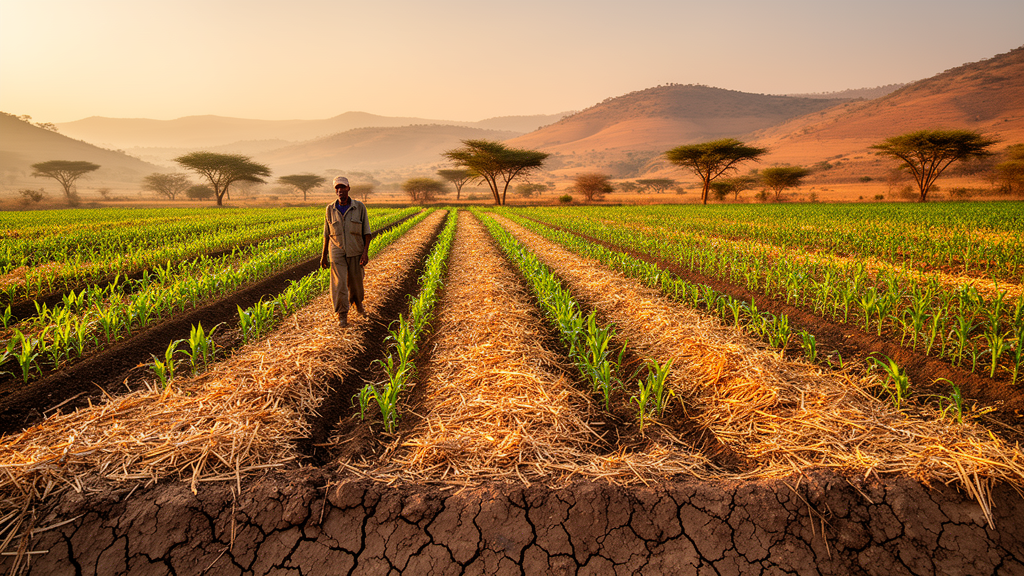
In the fragile highlands of northern Ethiopia, where generations of ox-drawn plowing have stripped the land of its fertility, a two-year field experiment has delivered some of the most striking evidence yet that a simple change in how farmers prepare their soil can transform harvests. The study, conducted at the Shire-May-Tsebri Agricultural Research Center in the Tselemti district of Tigray, found that conservation tillage practices—particularly strip tillage and mulch tillage—dramatically outperformed the traditional Maresha plowing system in both water retention and maize productivity. Strip tillage alone delivered a 47.9 percent yield premium, producing an average of 4.60 tonnes of maize grain per hectare compared with just 3.11 tonnes under conventional tillage. In a region where rainfall during the critical Belg and Kiremt seasons has declined by an estimated 15 to 20 percent since the 1970s, that difference is not merely agronomic. It may determine whether smallholder families can feed themselves in the decades ahead.
The stakes could hardly be higher. Across sub-Saharan Africa, agriculture sustains the livelihoods of more than 60 percent of the population, yet barely 2 percent of arable land is irrigated, leaving the entire regional food system hostage to erratic rainfall and recurrent drought. Ethiopia’s Tigray region sits at the sharp end of this crisis. Intensive cultivation of steep, fragile slopes has driven soil loss rates estimated at between 20 and 80 tonnes per hectare per year, with cultivated lands alone shedding an average of 42 tonnes annually—a pace that vastly exceeds the natural rate of soil formation. The culprit, in large part, is the Maresha, an ancient ox-drawn plow that is culturally ingrained but physically destructive. Repeated cross-plowing inverts the soil, shatters surface aggregates, expands the vapor-active surface area, and accelerates moisture loss precisely where crops need it most.
What makes the new research distinctive is its deliberate shift in focus. Most previous studies in the region have concentrated on slow-moving soil chemical properties such as organic carbon and total nitrogen, or have relied on broad global meta-analyses that lack the resolution needed for moisture-limited, high-altitude drylands. The new trial, led by Mulat Kebede of the Tigray Agricultural Research Institute, took what the author describes as a physics-first approach: rather than waiting years for chemistry to change, it targeted the soil’s physical architecture—bulk density, porosity, and moisture dynamics—which can be altered almost instantly through reduced disturbance. The hypothesis was straightforward. If farmers preserve pore space and shield the surface from raindrop impact and evaporation, crops can achieve higher water-use efficiency even as rainfall declines, effectively decoupling productivity from the immediate vagaries of a changing climate.
The experimental design was rigorous. Five tillage treatments—zero tillage, mulch tillage, reduced tillage, strip tillage, and conventional tillage—were arranged in a randomized complete block design with four replications across 20 plots during the 2019 and 2020 cropping seasons. Zero tillage left the soil entirely uncultivated, with seeds placed in narrow hand-made furrows. Mulch tillage combined local plowing with an application of two tonnes per hectare of maize straw, covering more than 30 percent of the surface. Reduced tillage involved a single cultivation pass before sowing. Strip tillage left most of the soil undisturbed from harvest through planting, cultivating only narrow planting lines spaced 0.75 meters apart using modified Maresha equipment. Conventional tillage, the control, followed local practice with three to four plowings dictated by weather. All plots received identical fertilizer—100 kilograms of NPSB at planting and 100 kilograms of urea split between planting and 35 days later—and were sown with Melkassa-2, an improved, drought-tolerant, open-pollinated maize variety widely used in Ethiopia’s low-moisture areas.
The moisture results were unambiguous. Soil water content, measured gravimetrically at four depths down to 60 centimeters, 72 hours after rainfall events, was consistently higher under all four conservation treatments than under conventional tillage. The effects were strongest near the surface. In the top 15 centimeters, mulch tillage boosted seasonal moisture retention by 103.5 percent over conventional plowing, with zero tillage close behind at 76.8 percent. The mechanism is intuitive: residue cover intercepts solar radiation and disrupts the vapor pathway, while undisturbed aggregates preserve the hydraulic continuity that allows water to infiltrate rather than run off. In the sub-surface layers, strip tillage established what the study calls a definitive hydrological buffer, securing independent moisture premiums of 32.5 percent in the 15 to 30 centimeter zone and 36.3 percent in the 30 to 45 centimeter layer. These middle depths correspond to the active root zone of maize during critical growth stages, meaning the conserved water arrives exactly when the crop can use it.
The physical soil data reinforced the picture. Strip tillage minimized bulk density and raised total porosity to 51.75 percent, against 49.65 percent under conventional tillage—an increase in pore space that improves infiltration, aeration, and root proliferation. Zero tillage, by contrast, initially showed higher bulk density, consistent with earlier observations that untilled soils exhibit temporary compaction before biological porosity develops. Notably, the short two-year duration did not produce significant changes in stable chemical parameters: organic carbon, total nitrogen, soil pH, cation exchange capacity, and exchangeable bases remained statistically similar across treatments. The study is candid about this limitation, noting that meaningful shifts in carbon and nitrogen stocks typically require five to ten years of monitoring. But that is precisely the point of the physics-first framing. Farmers facing dry spells next season cannot wait a decade for chemistry; they need structural and hydrological gains now, and the trial shows those gains arrive within a single cycle.
The yield data translated these soil improvements into grain. Strip tillage produced the highest grain yield in both seasons, reaching 4,562 kilograms per hectare—roughly 87 percent above the 2,440 kilograms achieved under conventional tillage in the comparison—and the highest biomass yield at over 10 tonnes per hectare. Germination rates told a similar story: 89.1 percent under strip tillage versus just 68.8 percent under conventional plowing, suggesting that the seed-zone microenvironment under reduced disturbance, with better moisture retention and less crusting, gives seedlings a decisive head start. Mulch tillage, while strong on germination, suppressed plant height, likely because heavy residue cover lowers soil temperature and can temporarily immobilize nitrogen through high carbon-to-nitrogen ratios. Strip tillage appears to offer a best-of-both-worlds compromise: localized loosening for root development, with residue cover maintained between the rows to conserve moisture. The 4.6 tonnes per hectare average also exceeds Ethiopia’s national maize yield average of 4.2 tonnes for the same period.
Statistical validation strengthened the findings. A Kaiser-Meyer-Olkin index of 0.74 confirmed good sampling adequacy for multivariate analysis, and Bartlett’s test of sphericity was highly significant. Coefficients of variation stayed below 10 percent across all measured parameters, indicating high experimental precision, and the analysis revealed a significant tillage-by-year interaction for grain yield, soil moisture, and bulk density—evidence that the benefits of conservation practices are amplified in moisture-stressed years, effectively buffering the crop against drought. Correlation analysis added further depth: bulk density correlated negatively with organic carbon and organic matter, while organic matter showed strong positive relationships with cation exchange capacity and the carbon-to-nitrogen ratio, underscoring how residue retention triggers cascading benefits across multiple soil quality indicators.
The study does not overstate its case. The authors acknowledge that the trial spanned only two seasons, was confined to a single moist lowland agro-ecology, relied on manual labor and modified traditional tools rather than specialized no-till machinery, and omitted a cost-benefit analysis of labor requirements—critical questions for widespread adoption. Even so, the implications are hard to ignore. In a region losing soil faster than it can form, and where the twin rainy seasons are shrinking, the finding that minimized soil disturbance can act as a biological dam against evaporation offers smallholders an immediate, low-capital lever for climate resilience. The recommendation is direct: strip tillage and mulch tillage should be adopted at broad scale across semi-arid Ethiopian farming systems. For millions of farmers betting each season on uncertain rain, the difference between 3.1 and 4.6 tonnes of grain per hectare is not an abstraction. It is the margin between a failed harvest and a full granary.
Subject of Research: Conservation tillage effects on soil moisture, soil physical properties, and maize yield stability in Ethiopian dryland agriculture
Article Title: Evaluating conservation tillage as a strategy for soil and water conservation and yield stability in Ethiopian dryland agriculture
Article References: Kebede, M. (2026). Evaluating conservation tillage as a strategy for soil and water conservation and yield stability in Ethiopian dryland agriculture. Discover Agriculture, 4(1), Article 317. https://doi.org/10.1007/s44279-026-00801-2
Image Credits: AI Generated
DOI: 10.1007/s44279-026-00801-2
Keywords: conservation tillage, strip tillage, mulch tillage, soil moisture, maize yield, Ethiopia, dryland agriculture, Tigray, soil porosity, climate resilience, smallholder farming, conventional tillage
Cite Scienmag News
Alan Morgan. (October 9, 2026). Strip Tillage Boosts Maize Yields Nearly 48% in Ethiopia’s Dying Drylands. Scienmag. https://scienmag.com/strip-tillage-boosts-maize-yields-nearly-48-in-ethiopias-dying-drylands/
Alan Morgan. "Strip Tillage Boosts Maize Yields Nearly 48% in Ethiopia’s Dying Drylands." Scienmag, 9 October 2026, https://scienmag.com/strip-tillage-boosts-maize-yields-nearly-48-in-ethiopias-dying-drylands/. Accessed 9 October 2026.
Alan Morgan. "Strip Tillage Boosts Maize Yields Nearly 48% in Ethiopia’s Dying Drylands." Scienmag. October 9, 2026. https://scienmag.com/strip-tillage-boosts-maize-yields-nearly-48-in-ethiopias-dying-drylands/


