


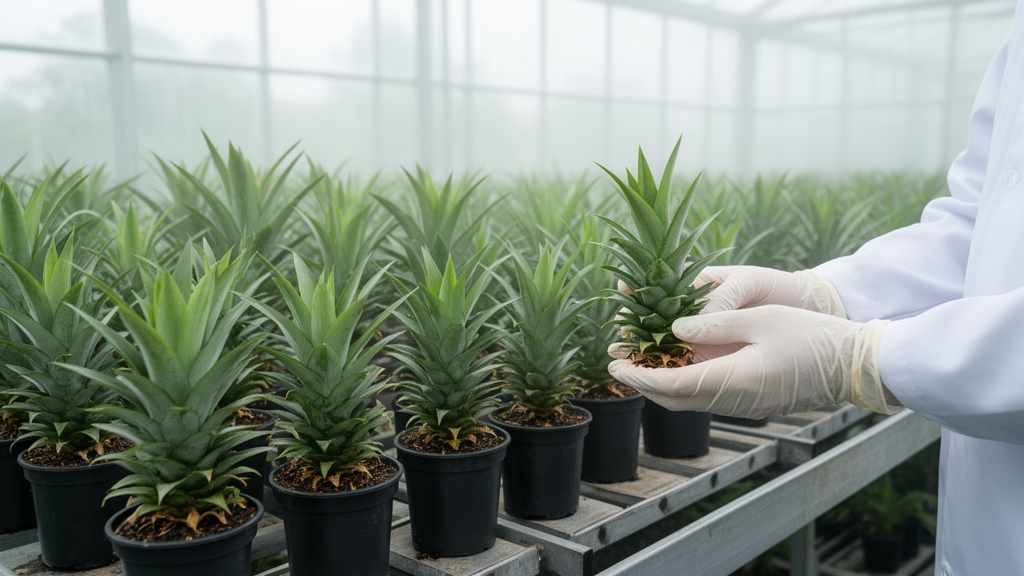
Pineapple growers have long faced a stubborn bottleneck: the tropical fruit that dominates global fresh-fruit markets is notoriously slow to multiply. Now, a team of researchers in the Philippines has put one of horticulture’s most widely used growth regulators to the test in the world’s most important pineapple cultivar, and the results offer both a caution and a tantalizing possibility. In a study conducted at Central Mindanao University, scientists found that paclobutrazol, a triazole compound that suppresses gibberellin biosynthesis, left the survival and emergence of ‘MD2’ pineapple plantlets essentially untouched, but dramatically reshaped their roots and shoots at higher concentrations. At 500 parts per million, root length collapsed to less than a fifth of that seen in untreated plants, while treated plantlets grew into compact, tightly packed rosettes with shortened leaves.
The research, published in Discover Plants, is the first documented examination of paclobutrazol’s effects on ‘MD2’ pineapple plantlets propagated through the split crown technique, a low-cost macropropagation method that turns discarded fruit crowns into dozens of new planting materials. The team, led by Eidenwin V. Canoy with Marchelle C. Rodriguez and Vences C. Valleser, set out to answer a deceptively simple question: could a chemical nudge make an already efficient propagation system even better? The answer, it turns out, is more nuanced than a simple yes or no, and it underscores how species-specific and dose-dependent plant growth regulator responses can be.
To understand why the study matters, it helps to grasp the scale of the propagation problem. Pineapple is propagated almost entirely by vegetative means, using crowns, slips, suckers, and ratoons rather than seeds. Conventional reliance on suckers and slips imposes slow multiplication rates, which limits how quickly farms can expand and how uniformly fields can be planted. For small-scale farmers and producer groups, the shortage of high-quality planting material is a persistent constraint on improving fruit quality, increasing yield, and introducing new varieties. The split crown technique addresses part of this problem by slicing a crown into sections and damaging the apical meristem, which releases axillary buds from apical dominance so they can develop into independent propagules. The method requires no specialized skills, costs little, and can produce large quantities of uniform plantlets in a relatively short time.
Paclobutrazol entered the picture because of its well-established reputation in perennial fruit crops. As an antigibberellin agent, it blocks the conversion of ent-kaurene to ent-kaurenoic acid in the gibberellin synthesis pathway, suppressing internode elongation while allowing cell division to continue. The result is a shorter, more compact plant with darker green leaves and, in many species, a higher root-to-shoot ratio. The compound also carries triazole-mediated stress protection, partly through hormonal shifts that include elevated cytokinin levels, and it exhibits fungicidal activity by inhibiting sterol biosynthesis. Previous work had shown paclobutrazol improving rooting in olive cuttings when combined with auxin, promoting root development in Phoebe bournei by raising auxin and lowering abscisic acid, and regulating shoot growth in tissue-cultured tulips and potatoes. But its track record is inconsistent; in loquat, for example, it improved rooting without translating into plant survival.
The Philippine team designed a single-factor, completely randomized experiment with four paclobutrazol concentrations, 0, 100, 200, and 500 ppm, and seven replications, for a total of 28 experimental units. Fresh ‘MD2’ pineapple crowns purchased from a local market in Valencia City, Bukidnon, were trimmed and cut into four macrosections of roughly 2.5 by 2.5 centimeters each. Because paclobutrazol is highly hydrophobic and tends to bind organic matter in growth media, the researchers chose relatively high concentrations to ensure sufficient uptake. Each unit’s medium, a 1:1:1 mix of garden soil, rice hull, and well-decomposed cow manure, was drenched with 250 milliliters of the assigned solution before planting. The trial ran for 63 days under a rain shelter at the university’s Musuan campus, which sits at an elevation of about 384 meters.
The headline finding is what did not change. Survival rates remained consistently high across all treatments, ranging from 85.71 to 96.43 percent, with no statistically significant differences among concentrations. Days to plantlet emergence, recorded when visible plantlets of roughly two millimeters appeared, ranged from 41.82 to 51.92 days but again showed no significant treatment effect. The number of plantlets emerging per macrosection, counted weekly from first emergence, was likewise statistically indistinguishable across treatments at every sampling interval. In other words, paclobutrazol neither accelerated nor delayed the early phases of propagation in any measurable way, suggesting limited influence during the initial establishment period.
Where the compound made its presence unmistakably known was below the soil line. Untreated control plantlets produced the greatest mean number of roots, 3.89 per plantlet, significantly more than the 1.27 roots observed at 500 ppm, while the intermediate concentrations of 100 and 200 ppm yielded comparable counts of 3.57 and 3.36. Root length told an even starker story, declining steadily with dose: 4.88 centimeters in the control, 3.39 centimeters at 100 ppm, 2.58 centimeters at 200 ppm, and a mere 0.94 centimeter at 500 ppm. This dose-dependent suppression contrasts sharply with findings in sunflower and tomato, where paclobutrazol restricts shoots while enhancing roots, and with reports of promoted lateral and secondary root formation in other species. The authors conclude that pineapple’s response is both species-specific and concentration dependent, with higher doses intensifying inhibitory effects on root development.
Above ground, the morphology shift was equally striking. Untreated plantlets developed open, elongated, spirally arranged leaves with a vigorous appearance, while paclobutrazol-treated plantlets grew into compact forms with closely arranged, smaller leaves and limited shoot elongation. This is textbook antigibberellin physiology: cell division proceeds while cell elongation is curtailed, producing shorter plants with compressed internodes. Similar responses have been documented in species ranging from Syzygium campanulatum and canola to mango, wheat, mung bean, and sesame, where treated plants show shorter stems, denser growth, and darker foliage. Such growth regulation can be beneficial for uniformity and for controlling excessive vegetative growth, but the authors caution that reduced leaf expansion may limit photosynthetic efficiency and, over the long term, overall productivity, making a balance between regulation and vigor essential.
Perhaps the most intriguing observation came from the highest dose. At 500 ppm, some macrosections failed to initiate roots at all, yet they remained alive throughout the experimental period. The researchers hypothesize that paclobutrazol may induce a state of dormancy in pineapple macrosections within the growth media. If confirmed, this opens a genuinely practical avenue: paclobutrazol could potentially be used to prolong the dormancy of pineapple planting material when environmental conditions are unfavorable for growth, effectively banking propagules until conditions improve. Testing that hypothesis, the authors note, will require determining whether gibberellic acid can reverse the root inhibition, a question that directly probes the gibberellin-mediated mechanism at work.
The study arrives at a moment when ‘MD2’ dominates the global fresh pineapple trade. Developed through a long-term breeding program at the Pineapple Research Institute in Hawaii and later commercialized by Del Monte, the cultivar is prized for its cylindrical fruit, golden-yellow low-acid flesh, high vitamin C content, long shelf life, and transport durability, and it is widely grown in the Philippines for both fresh consumption and canning. Because the split crown technique turns a waste product, the crown left over after fruit purchase, into a propagation resource, any chemical treatment that modulates its performance has implications for farmers and exporters alike. The authors recommend extending the work to other pineapple varieties and investigating the long-term effects of paclobutrazol on growth, development, yield, and fruit quality. For now, the message for propagators is clear: paclobutrazol will not boost how many ‘MD2’ plantlets you get or how fast they emerge, but at high doses it will shrink their roots and compact their tops, and it might just hold them in suspended animation until you are ready to plant.
Subject of Research: Effects of the plant growth regulator paclobutrazol on clonal propagation of MD2 pineapple plantlets via the split crown technique
Article Title: Effects of paclobutrazol treatment on the growth regulation and propagation of pineapple plantlets derived from crown macrosections
Article References: Canoy, E. V., Rodriguez, M. C., & Valleser, V. C. (2026). Effects of paclobutrazol treatment on the growth regulation and propagation of pineapple plantlets derived from crown macrosections. Discover Plants, 3(1), Article 451. https://doi.org/10.1007/s44372-026-00940-2
Image Credits: AI Generated
DOI: 10.1007/s44372-026-00940-2
Keywords: pineapple, Ananas comosus, paclobutrazol, plant growth regulator, split crown technique, macropropagation, MD2 cultivar, gibberellin biosynthesis, root development, plant morphology, clonal propagation, horticulture
Cite Scienmag News
Alan Morgan. (October 9, 2026). Growth Regulator Paclobutrazol Reshapes Pineapple Plantlets but Spares Survival in Propagation Trial. Scienmag. https://scienmag.com/growth-regulator-paclobutrazol-reshapes-pineapple-plantlets-but-spares-survival-in-propagation-trial/
Alan Morgan. "Growth Regulator Paclobutrazol Reshapes Pineapple Plantlets but Spares Survival in Propagation Trial." Scienmag, 9 October 2026, https://scienmag.com/growth-regulator-paclobutrazol-reshapes-pineapple-plantlets-but-spares-survival-in-propagation-trial/. Accessed 9 October 2026.
Alan Morgan. "Growth Regulator Paclobutrazol Reshapes Pineapple Plantlets but Spares Survival in Propagation Trial." Scienmag. October 9, 2026. https://scienmag.com/growth-regulator-paclobutrazol-reshapes-pineapple-plantlets-but-spares-survival-in-propagation-trial/


