


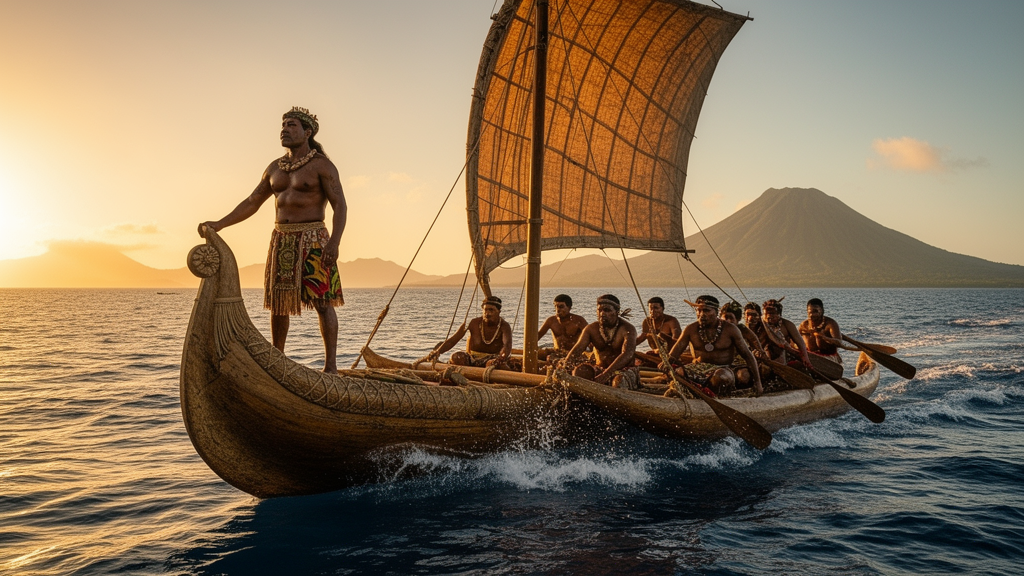
For centuries, Polynesian navigators crossed thousands of miles of open ocean, reading the stars, currents, birds, clouds and the sea itself to find islands invisible from any horizon. A new study from the University of California San Diego, published Oct. 8 in Science and featured on the journal’s cover, shows that this extraordinary seafaring history is also written into the DNA of Polynesian people today. By analyzing whole-genome sequences from 1,050 individuals across Polynesia, the researchers reconstructed the genetic consequences of one of humanity’s most remarkable expansion stories, and in doing so uncovered clues that could reshape how clinicians screen for disease in Pacific Islander communities.
The central genetic mechanism the study documents is the founder effect, a well-known phenomenon in population genetics in which a small group that splits off from a larger population carries only a fraction of that population’s genetic diversity. Each time Polynesian voyagers departed an established island community to settle a new one, they took with them a reduced sample of the gene pool they left behind. A group leaving Mangareva for Hawaiʻi or Rapa Nui, for example, would have carried only a smaller genetic selection of the people living on Mangareva. When later groups set out from those newly settled islands, they carried an even smaller subset of that already reduced variation. The researchers liken the resulting pattern to a set of Russian nesting dolls: the largest population contains the most genetic variation, while each successive population contains a smaller genetic subset nested within it.
“As we go from one island to the next, we’re selecting a subset of a gene pool, and that is shaping our genome over time,” said Keolu Fox, an associate professor of anthropology at the UC San Diego School of Social Sciences and a corresponding author of the study. The effect compounds with every step of the settlement process. The team found evidence of multiple founder effects, and also of bottlenecks, events in which disease or another major shock sharply reduces a population and leaves survivors with less genetic variation than before, accumulating across the course of Polynesian settlement. The cumulative result, the authors report, is one of the strongest cumulative founder effects ever observed in human population genetics.
The analysis drew on genomic data from populations across French Polynesia, including the Austral, Society, Marquesas and Tuamotu islands as well as Mangareva, and incorporated data from Rapa Nui, Native Hawaiians, Samoans and Tongans. One of the most striking findings concerns Hawaiʻi and Rapa Nui, two of the most geographically distant Polynesian populations studied. Despite being separated by approximately 7,000 kilometers, and each lying more than 3,000 kilometers from the nearest inhabited Polynesian island, these two populations turned out to be the most closely genetically related among the remote island groups in the analysis.
That genetic similarity carries a powerful historical message. The researchers say it suggests both populations were ultimately settled by voyagers whose deeper ancestral roots trace back to Mangareva, supporting the existence of an ancient culture capable of repeated, long-distance voyaging across the Pacific. The team refers to this hypothesized tradition as Holomoana Nui, meaning “great ocean voyaging.” Crucially, the genetic pattern was not produced by a single, one-way migration. Polynesian voyaging involved repeated movement among island populations, with navigators carrying provisions, knowledge and genetic material back and forth across the ocean, so that the genetic history of the Pacific records ongoing contact as well as initial settlement.
The same demographic history that makes Polynesian genomes scientifically fascinating also has direct medical consequences. Because rare genetic variants carried by a small founding population can become relatively common in later generations, founder effects can concentrate disease-associated variants in specific communities. The researchers identified three variants associated with autosomal recessive diseases at relatively high frequencies in French Polynesia. Among them, a variant in the FAN1 gene, linked to karyomegalic interstitial nephritis, a rare condition that can progress to kidney failure, was found in more than 11 percent of the French Polynesian cohort. Remarkably, that variant was entirely absent from gnomAD, a major international database containing genomic data from more than 800,000 individuals.
That absence illustrates a structural blind spot in modern genomic medicine. Much of today’s clinical genetics has been built on data from populations of European ancestry, and variants that are medically important within a specific founder population can remain invisible in large global reference databases. Without more detailed information about Polynesian populations, clinicians may simply not know which variants to screen for, or how frequently certain disease-associated variants occur in the patients in front of them. The study also underscores why broad population categories can be inadequate for clinical genetics: grouping Native Hawaiian and Pacific Islander populations together may obscure important differences among individual island populations, each shaped by its own distinct settlement history.
Fox, who is the first Native Hawaiian to earn a Ph.D. in Genome Sciences, has a longstanding interest in Polynesian history and the health needs of Pacific Islander communities. During a 2017 visit to French Polynesia, a conversation about the legacy of French nuclear testing prompted him to consider how genomic research might help clarify disease risks in communities exposed to environmental hazards and underserved by modern medical infrastructure. The French government conducted 193 nuclear tests in French Polynesia between 1966 and 1996, and Fox said the experience pushed him to think more deeply about how precision medicine could serve communities that have not always had access to comprehensive cancer screening, genetic testing or specialized care. He added that the findings could eventually help researchers develop more precise approaches to screening, diagnosis and treatment, including for diseases such as cancer, although the study itself does not establish new clinical guidelines or treatments; rather, it identifies genetic information that could guide future research and clinical work.
The project was equally shaped by a second question: how could such research be conducted in a way that protected Indigenous communities and allowed them to share in the benefits of discovery? The answer became Variant Bio, a biotechnology company Fox joined as a senior advisor while conducting the research, which develops partnerships with populations historically underrepresented in genomic research and gives participating communities greater control over how their data are collected, stored and used. “We want to build trust first,” Fox said. “Making you a partner and not a subject in this allows us to expedite the development of these projects.” The approach treats community members as partners rather than sources of biological material, and includes explaining the potential uses and risks of genomic data, building relationships with community leaders and involving local health professionals in the research process. The study includes contributions from Indigenous and Pacific Islander communities in Hawaiʻi, Rapa Nui and French Polynesia, and its authors acknowledge the French Polynesian clinicians, nurses and community health workers who made the work possible. “None of this is possible without the contributions of these partners,” Fox said.
Variant Bio’s model also includes a formal benefit-sharing commitment of 4 percent of the company’s revenue and 4 percent of equity-derived value designated for partner communities, an arrangement intended to ensure that communities contributing genetic data share in the value created by research and future commercial partnerships. Those funds can support priorities identified by the communities themselves, including health care, education, infrastructure, food sovereignty, energy projects and data infrastructure. For Fox, benefit-sharing is not separate from the science but part of the research design. “If you want to recruit communities into research, you have to make them stakeholders in the technology you are building,” he said. Having spent nearly a decade on the endeavor, Fox says the paper in Science reflects a broader vision for the future of genomic medicine, one in which Indigenous communities help shape the research questions, govern the use of their data and participate in the benefits of discoveries made from their genomes. “It is remarkable to say that our achievements as voyaging people have shaped our genomes over time,” he said. “And to have that recognized on the cover of Science is incredibly validating.”
Subject of Research: Genomic analysis of founder effects from Polynesian voyaging settlement across Pacific island populations
Article Title: Polynesian wayfinding is written in the genomes of island populations
Article References: Polynesian wayfinding is written in the genomes of island populations. (n.d.). Original publication
Image Credits: AI Generated
DOI: Not provided
Keywords: Polynesia, genomics, founder effects, population genetics, wayfinding, Rapa Nui, Hawaii, Mangareva, FAN1 gene, precision medicine, Indigenous data governance, benefit sharing
Cite Scienmag News
Juliet Wilcox. (October 9, 2026). Ancient Polynesian Voyaging Left Its Mark in the Genomes of Island Populations. Scienmag. https://scienmag.com/ancient-polynesian-voyaging-left-its-mark-in-the-genomes-of-island-populations/
Juliet Wilcox. "Ancient Polynesian Voyaging Left Its Mark in the Genomes of Island Populations." Scienmag, 9 October 2026, https://scienmag.com/ancient-polynesian-voyaging-left-its-mark-in-the-genomes-of-island-populations/. Accessed 9 October 2026.
Juliet Wilcox. "Ancient Polynesian Voyaging Left Its Mark in the Genomes of Island Populations." Scienmag. October 9, 2026. https://scienmag.com/ancient-polynesian-voyaging-left-its-mark-in-the-genomes-of-island-populations/


