


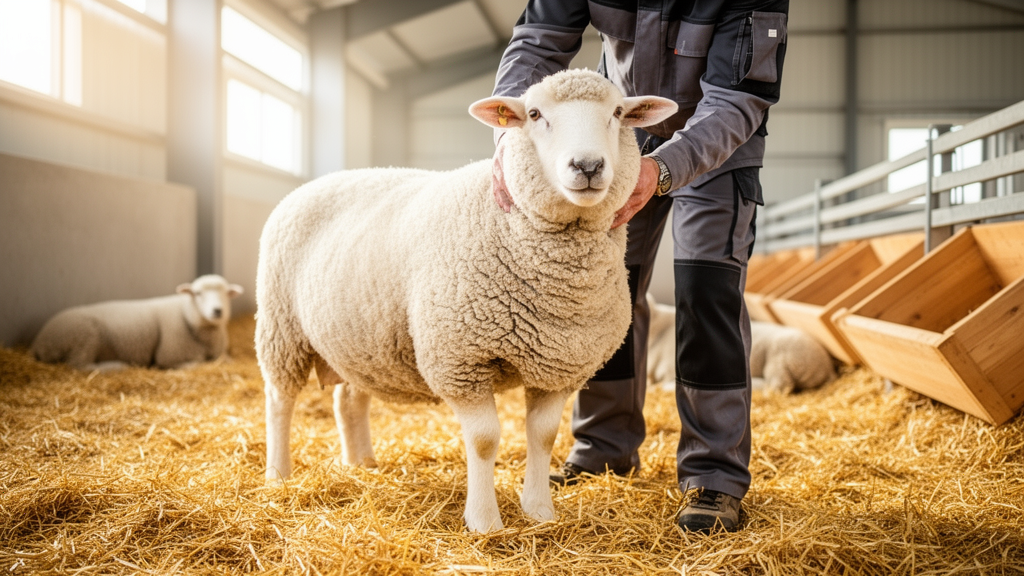
In the semi-arid steppe of central Türkiye, animal scientists have been quietly engineering a sheep for the future of lamb meat. The Lalahan sheep, a crossbred genotype combining roughly three-quarters Kıvırcık and one-quarter Akkaraman ancestry, was developed specifically to thrive in steppe conditions where feed is scarce and summers are harsh. Now, in the first study of its kind, researchers at Ankara University have put the breed’s meat-producing credentials to a rigorous test, tracking how lambs grow, how efficiently they convert feed into body mass, and how their carcasses change as they get heavier. Their verdict, published in Archives Animal Breeding, is strikingly precise: slaughter the lambs at 40 kilograms and you capture the best of everything the breed has to offer.
The research team, led by Rabia Arslan together with Necmettin Ünal and Akın Yakan of Ankara University’s Faculty of Veterinary Medicine, worked with 36 healthy male Lalahan lambs, all born as singletons during the same lambing season and weaned at about 90 days of age. The lambs were randomly divided into three groups and fed intensively until each group reached an average live weight of 35, 40, or 45 kilograms. Six lambs from each group, those closest to the group mean, were then selected for slaughter, giving the team 18 carcasses to dissect, weigh, and analyze joint by joint. Every animal received the same treatment before the experiment began: raised alongside their mothers under identical herd management, with ewes that had given birth at least twice, ensuring the lambs genuinely represented the Lalahan genotype.
The feeding regime was carefully standardized. Fattening started with 400 grams of concentrate per lamb per day plus 300 grams of alfalfa hay, after which the lambs were individually fed concentrate ad libitum with the same limited hay ration. Feeders were weighed morning and evening, leftovers collected and deducted, and body weights recorded every 14 days before feeding. Each lamb enjoyed 2 square meters of space, 50 centimeters of feeder length, and unlimited drinking water. From these meticulous measurements the researchers calculated the two numbers that matter most in fattening economics: daily weight gain and feed conversion rate, the kilograms of concentrate needed to produce one kilogram of body weight.
The growth numbers tell a story of steady, efficient performance. Average daily weight gains were 241.50, 243.33, and 235.45 grams in the 35, 40, and 45 kilogram groups respectively, figures that sit comfortably within the 230 to 265 gram range reported for intensively fattened Kıvırcık lambs, the breed from which Lalahan sheep largely descend. More impressive was the feed conversion. The Lalahan lambs needed just 3.590, 3.958, and 4.392 kilograms of concentrate per kilogram of gain in the three groups, substantially better than the 5.29 to 6.14 kilograms reported for Kıvırcık lambs in comparable intensive systems. In plain terms, these crossbred lambs turned feed into meat considerably more cheaply than one of their parent breeds, a trait with obvious economic value for producers operating on thin margins.
As expected, feed conversion worsened as the lambs grew heavier, because larger animals devote more of each meal to maintenance rather than growth. The jump from 3.590 to 4.392 kilograms of feed per kilogram of gain between the lightest and heaviest groups illustrates the classic diminishing returns of extended fattening. Yet the daily gain barely budged across the three groups, hovering around 240 grams regardless of target weight. That combination, flat growth rate but rising feed cost, is precisely why the question of when to stop fattening is so consequential, and why the carcass data that followed would prove decisive.
Slaughter characteristics were assessed both against pre-slaughter body weight and against empty-body weight, a refinement that accounts for the variable fullness of the digestive tract. Hot dressing percentages, the proportion of live weight that becomes a fresh carcass, were 46.22, 45.49, and 47.05 percent across the three groups, with cold dressing percentages of 45.26, 44.66, and 46.11 percent after 24 hours of chilling at 4 degrees Celsius. None of these differences reached statistical significance, though there was a slight upward trend with weight, likely reflecting greater muscle and fat deposition in heavier animals. The researchers also tracked how individual body components shifted with weight: feet and empty rumen proportions fell, while omental and mesenteric fat depots and testicle proportions rose, the latter a sign that the longer-fattened lambs were approaching puberty.
The carcass dissection delivered the study’s most consequential findings. Lean meat content was 61.82 percent in the 35 kilogram group and 61.04 percent in the 40 kilogram group, but dropped significantly to 57.53 percent at 45 kilograms. Fat told the mirror-image story: 13.57 and 14.05 percent in the two lighter groups, then a statistically significant leap to 19.46 percent in the heaviest lambs. Bone percentages stayed essentially constant at around 18 percent. The lean-to-fat ratio, a key index of carcass quality, was 4.56 and 4.35 in the 35 and 40 kilogram groups but collapsed to 2.98 at 45 kilograms. Notably, the lean percentages exceeded those reported for most Turkish native breeds, while the fat percentages were lower, an advantage the authors highlight as particularly important for modern consumers who increasingly prefer leaner carcasses.
Prime cuts shifted with weight as well. The hind leg, the most valuable joint, accounted for 31.57, 30.04, and 28.41 percent of the carcass in the three groups, a significant decline, while the loin fell from 8.41 to 7.19 percent. The back cut bucked the trend, rising from 13.39 to 14.72 percent. Meanwhile, the cross-sectional area of the longissimus dorsi muscle, the prized eye muscle running along the spine, grew steadily and significantly with slaughter weight, from 14.29 to 16.16 to 17.73 square centimeters, outperforming values reported for Kıvırcık lambs at comparable weights. Back fat depth also climbed, from 1.13 to 1.57 to 2.43 millimeters, though it remained generally lower than in other native breeds. The fact that muscle area expanded faster than fat thickness is, the authors argue, a genuine strength of the genotype.
Placing all the evidence side by side, the case for 40 kilograms becomes compelling. At that weight the lambs achieved their highest average daily gain, maintained a lean percentage above 61 percent, kept carcass fat near 14 percent, and avoided the steep feed conversion penalty that sets in beyond it. The 45 kilogram lambs delivered bigger eye muscles but paid for them with nearly a fifth of the carcass as fat and the worst feed efficiency of the trial. The 35 kilogram lambs were lean and efficient but left growth potential unrealized. The authors note that their recommendation aligns with international literature suggesting that around 38 to 42 kilograms represents the optimal balance between muscle development and fat deposition in medium-sized native and crossbred genotypes, even as European meat-type breeds are pushed to heavier weights.
Beyond the headline number, the study carries broader significance for Turkish agriculture, where sheep meat accounts for only 9.1 percent of red meat production despite growing demand for high-protein foods. The Lalahan genotype was bred for exactly this gap: an animal with good herding instinct, easy management, adequate fertility, and the hardiness to prosper on steppe pastures. Previous work had documented the breed’s reproductive performance, including estrus rates near 99 percent and twin births at just over 25 percent, but its meat traits had never been systematically measured. This first comprehensive assessment shows the Lalahan lamb matching or exceeding its Kıvırcık parentage in fattening performance, slaughter yield, and carcass composition, with a muscle-to-fat balance that suits contemporary market preferences. For a country seeking to raise its lamb output under challenging climatic conditions, a genotype that converts feed efficiently, deposits fat sparingly, and hits its peak value at a well-defined weight offers producers something rare: a clear, evidence-based target for profitability.
Subject of Research: Fattening performance, slaughter traits, and carcass characteristics of Lalahan-genotype lambs at different slaughter weights in Türkiye
Article Title: Meat production traits of Lalahan sheep: fattening, slaughter, and carcass characteristics of lambs
Article References: Arslan, R., Ünal, N., & Yakan, A. (2026). Meat production traits of Lalahan sheep: fattening, slaughter, and carcass characteristics of lambs. Archives Animal Breeding, 69(3), 431-439. https://doi.org/10.5194/aab-69-431-2026
Image Credits: AI Generated
Keywords: Lalahan sheep, lamb meat production, slaughter weight, carcass characteristics, feed conversion rate, daily weight gain, Kıvırcık, Akkaraman, crossbreeding, Türkiye, steppe conditions, animal breeding
Cite Scienmag News
Drew Townsend. (October 9, 2026). New Turkish Sheep Breed Hits the Sweet Spot: 40 Kilograms for Perfect Lamb Meat. Scienmag. https://scienmag.com/new-turkish-sheep-breed-hits-the-sweet-spot-40-kilograms-for-perfect-lamb-meat/
Drew Townsend. "New Turkish Sheep Breed Hits the Sweet Spot: 40 Kilograms for Perfect Lamb Meat." Scienmag, 9 October 2026, https://scienmag.com/new-turkish-sheep-breed-hits-the-sweet-spot-40-kilograms-for-perfect-lamb-meat/. Accessed 9 October 2026.
Drew Townsend. "New Turkish Sheep Breed Hits the Sweet Spot: 40 Kilograms for Perfect Lamb Meat." Scienmag. October 9, 2026. https://scienmag.com/new-turkish-sheep-breed-hits-the-sweet-spot-40-kilograms-for-perfect-lamb-meat/


