


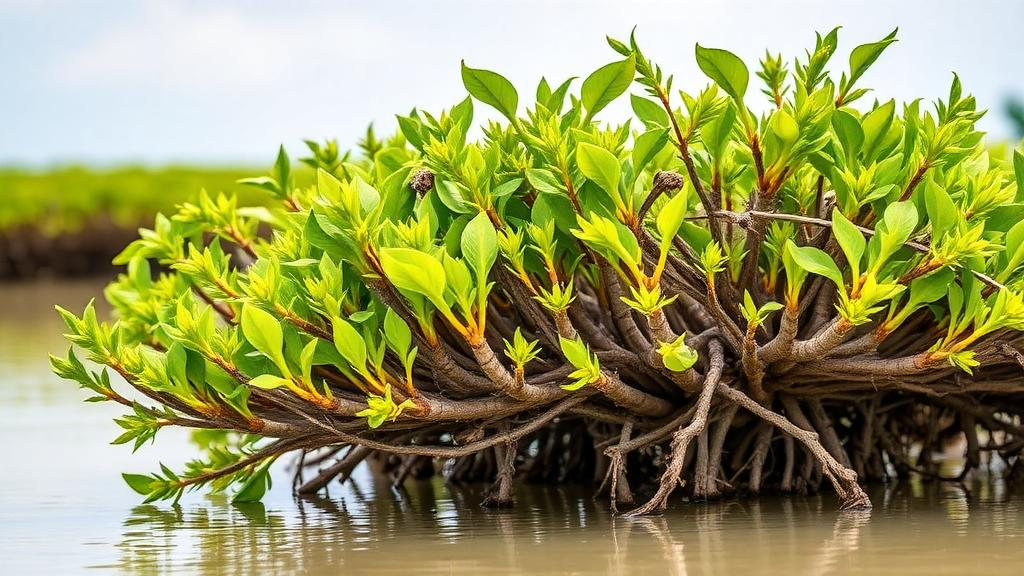
When the ocean creeps inland and salt poisons farmland, most plants shrivel and die. Mangroves, however, stand rooted in seawater twice a day, flourishing where agriculture fails. A new systematic review published in Discover Plants has now pulled together the scattered evidence explaining how these remarkable trees chemically survive one of the harshest environments on Earth, and the answer may hold the key to breeding salt-tolerant crops for a world of rising seas and degrading soils.
Researchers Malini Bhattacharyya and Abinash Roy of the Central University of Kerala in India conducted what they describe as the first PRISMA-guided systematic review of plant secondary metabolites, or PSMs, in mangroves under salinity stress. Following the strict reporting standards of PRISMA 2020, they searched Scopus, Web of Science and PubMed for original experimental studies published between 2005 and 2025 on true mangrove species exposed to defined salinity challenges with quantified secondary metabolites. The criteria were deliberately stringent: reviews, commentaries, mangrove associates, halophytes and studies of other stresses were all excluded.
The result is as revealing for what it found as for what it did not. Out of the vast literature on mangroves, only four experimental studies met the inclusion criteria. These covered four species: Kandelia candel, Bruguiera gymnorhiza, Avicennia marina and Laguncularia racemosa. The authors are candid that this small evidence base, combined with a taxonomic bias toward K. candel and wide methodological variation, prevented any formal meta-analysis. Yet across all four studies, a coherent chemical story emerges.
Phenolics and flavonoids were the most frequently measured metabolite classes, followed by lignin, triterpenoids and compatible sugars. In K. candel, salinity of 500 millimolar sodium chloride drove total phenolics up by 17 percent, while proanthocyanidins surged by more than 75 percent, peaking at 12.31 milligrams per gram fresh weight. Anthocyanins climbed in parallel. Along a natural salinity gradient of 0.5 to 30 parts per thousand in the Sundarbans, Avicennia officinalis populations showed zone-specific, two-fold differences in phenolic content. Root lignin deposition in K. candel rose dramatically from 40.6 micrograms per milligram in freshwater conditions to 145.1 micrograms per milligram at 20 parts per thousand, thickening cell walls against the combined assault of salt and tidal force.
These metabolites are not passive byproducts. Salinity triggers the accumulation of reactive oxygen species, or ROS, inside plant cells, particularly in mitochondria but also in chloroplasts, peroxisomes and other compartments. Unchecked, ROS attack membranes, proteins and DNA, causing lipid peroxidation and programmed cell death. Phenolics and flavonoids act as molecular sponges for these radicals, quenching them through proton transfer and restricting radical generation by modulating enzymes such as lipoxygenase and glutathione S-transferase. Some flavonoids can even reshape the three-dimensional structure of globular proteins. By keeping ROS in check, mangroves preserve the redox environment on which critical ion transporters depend.
The ion connection is crucial and technically elegant. The SOS1 sodium-proton antiporter and the plasma membrane proton pumps that drive sodium exclusion and vacuolar sequestration both require intact cellular membranes and a stable redox balance to function. If ROS damage goes uncontrolled, these transporters fail, and the delicate potassium-to-sodium ratio inside the cytosol collapses. Secondary metabolites thus support salt tolerance in two ways: indirectly, by shielding the machinery of ion homeostasis, and directly, by chelating excess sodium in the apoplast and vacuole and by contributing modestly to osmotic adjustment alongside dominant compatible solutes such as proline and glycine betaine.
Behind these chemical shifts lies a cast of biosynthetic genes. Transcriptomic evidence points to a core set including KcMS, a multifunctional terpene synthase from K. candel whose messenger RNA is upregulated by salt in both roots and leaves; BgbAS and BgLUS, the beta-amyrin and lupeol synthases of B. gymnorhiza, which are induced under salt stress; and a suite of flavonoid-pathway enzymes, including chalcone synthase, flavanone 3-hydroxylase, flavonoid 3-prime-monooxygenase and flavonol synthase. In Rhizophora stylosa, a broad family of terpene synthases, from limonene synthase to isoprene synthase, shows salinity-associated expression, and in Sonneratia alba, flavone and flavonol biosynthesis genes are upregulated at high salinity.
But the authors are careful to draw a scientific line here. Almost all of this evidence is transcriptional correlation, not functional proof. No overexpression, silencing or knockout study has yet demonstrated that any of these genes is necessary or sufficient for salinity tolerance in the mangroves where they were found. The one partial exception is enzymatic: KcMS, expressed in a lanosterol-synthase-deficient yeast strain, was confirmed to produce lupeol, beta-amyrin and alpha-amyrin, validating the gene’s identity as a triterpene synthase without proving its role in salt tolerance. Triterpenoids themselves are strongly implicated, as free triterpenoids in mangrove membranes increase with salinity and appear to limit salt entry, while lanosterol and sitosterol correlate positively with salt stress in K. candel roots.
Pathway-level analysis reveals an interconnected metabolic web rather than isolated routes. The phenylpropanoid pathway, branching from L-phenylalanine through the enzymes PAL, C4H and 4CL, feeds both flavonoid biosynthesis and lignin production. Terpenoids arise from the mevalonate and methylerythritol phosphate pathways via the universal precursors IPP and DMAPP. Under salt stress, shifts in carbon allocation, redox status and enzyme activity redirect flux toward antioxidant phenolics, structural lignin, membrane-stabilizing sterols and osmoprotective sugars. The review also notes that drought stress triggers hexose accumulation with concurrent sucrose depletion, a signature of osmotic adjustment in water-stressed tissue.
The translational promise is clear: genes and metabolic markers from mangroves could guide the engineering or selection of salt-tolerant crops for increasingly saline coastal and degraded farmland, a concern the IPCC ties directly to sea level rise and warming-driven evaporation. But the authors temper expectations. Four studies cannot represent the biochemical blueprints of dozens of mangrove species, colorimetric assays for phenolics varied across four different methods, sample sizes were often six plants or fewer per treatment, and no experiment combined metabolic profiling with functional readouts such as ROS levels or growth metrics. Their call is for harmonized salinity protocols, replication across ontogenetic stages and integrative omics linking metabolite shifts to physiological performance. Until then, mangroves remain what they have always been: living laboratories of chemical resilience whose secrets science is only beginning to catalogue.
Subject of Research: Plant secondary metabolites and biosynthetic genes underlying salinity tolerance in mangrove species
Article Title: A systematic review of plant secondary metabolites and associated genes underlying salinity tolerance in mangroves
Article References: Bhattacharyya, M., & Roy, A. (2026). A systematic review of plant secondary metabolites and associated genes underlying salinity tolerance in mangroves. Discover Plants, 3(1), Article 428. https://doi.org/10.1007/s44372-026-00901-9
Image Credits: AI Generated
DOI: 10.1007/s44372-026-00901-9
Keywords: mangroves, plant secondary metabolites, salinity tolerance, flavonoids, phenolics, lignin, triterpenoids, biosynthetic genes, reactive oxygen species, systematic review, salt-tolerant crops, abiotic stress
Cite Scienmag News
Alan Morgan. (October 1, 2026). Mangrove Chemical Secrets Could Help Breed Salt-Proof Crops. Scienmag. https://scienmag.com/mangrove-chemical-secrets-could-help-breed-salt-proof-crops/
Alan Morgan. "Mangrove Chemical Secrets Could Help Breed Salt-Proof Crops." Scienmag, 1 October 2026, https://scienmag.com/mangrove-chemical-secrets-could-help-breed-salt-proof-crops/. Accessed 1 October 2026.
Alan Morgan. "Mangrove Chemical Secrets Could Help Breed Salt-Proof Crops." Scienmag. October 1, 2026. https://scienmag.com/mangrove-chemical-secrets-could-help-breed-salt-proof-crops/


