


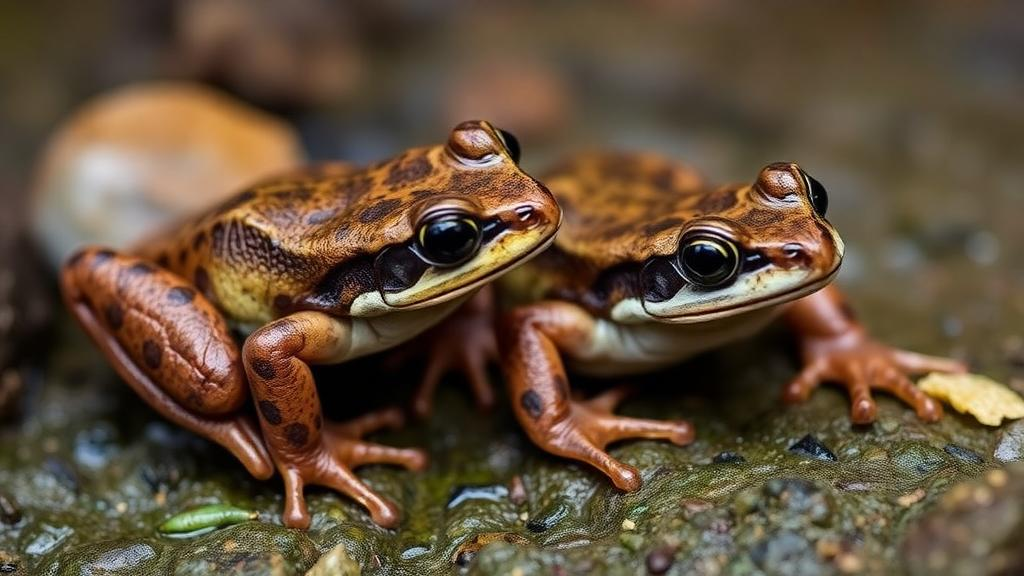
High in the streams of the Darjeeling Hill Region, where monsoon rains swell mountain torrents and mist clings to forested slopes, lives a frog that local communities have harvested for generations. The marbled cascade frog, Amolops marmoratus, is a large, strikingly patterned amphibian known locally as Sisne Paha, prized both as a delicacy and as traditional medicine. Now, the first genetic study of this species in the region has revealed something alarming: the Darjeeling frogs are among the most genetically impoverished populations of their species anywhere in Asia, a finding that transforms a familiar culinary tradition into a potential conservation crisis.
The research, published in BMC Genomics by a team led by Kumaresh Mandal and Rakesh Tamang of the University of Calcutta, combined classical morphology with DNA barcoding to paint the first comprehensive picture of the species in this corner of the Himalaya Biodiversity Hotspot. The team surveyed 57 sites across the Darjeeling and Kalimpong districts, spanning altitudes from 200 to 2,400 meters above sea level, and collected 60 specimens during the rainy season when the frogs emerge at night to feed on boulders beside fast-flowing streams. Thirty-five of these frogs were analyzed genetically using two standard DNA barcoding markers, the 16S ribosomal RNA gene and the cytochrome c oxidase subunit I gene, while 44 adults were measured across 36 morphological characters.
The morphological work confirmed the frogs’ identity with precision. Amolops marmoratus, first described by Edward Blyth in 1855, is built for life in torrents: a streamlined body, long legs, a flat head, and adhesive pads on the fingers and toes that grip wet rock. Its tadpoles possess a remarkable gastromyzophorous sucker, a ventral adhesive disk that anchors them to stones in rushing water. Regression analysis of the 36 measurements against snout-vent length showed that most traits scale predictably with body size, but three characters, eye-nostril distance, horizontal eye diameter, and total foot length, showed weaker allometric relationships, hinting at functional adaptations for nocturnal vision and locomotion in rocky streams that the authors suggest merit future ecological testing.
Altitude emerged as a powerful predictor of abundance. Using a negative binomial generalized linear model, the researchers found a statistically significant negative relationship between elevation and frog numbers, with a regression coefficient of -0.00067 and a p-value of 0.0013. The frogs were most abundant between 200 and 400 meters, and their numbers declined steadily as elevation increased. This ecological preference matters for conservation planning, because it identifies the low-elevation hill streams, precisely where human access and harvesting pressure are likely greatest, as the species’ stronghold in the region.
The genetic results were far more dramatic. Nucleotide diversity in the Darjeeling population measured just 0.001244, the lowest of any regional population examined, compared with 0.103280 in Southeast Asian frogs, a difference of nearly two orders of magnitude. Gene diversity told the same story: 0.4487 in Darjeeling against 0.7352 in Myanmar. Mean pairwise genetic differences among Darjeeling frogs were a mere 0.55, while Southeast Asian and Myanmar populations showed values of 38.83 and 33.50 respectively. The fixation index, F_ST, which quantifies genetic differentiation between populations, reached 0.93945 between Darjeeling and China, an extraordinarily high value indicating almost no gene flow, while Myanmar and Southeast Asian populations, separated by far greater distances, showed an F_ST of only 0.15330, reflecting substantial connectivity.
Phylogenetic trees built from the 16S rRNA sequences placed the Darjeeling frogs in their own distinct clade, clearly separated from Chinese, Myanmar, and Southeast Asian lineages. Crucially, the branches within the Darjeeling clade were conspicuously short, a classic signature of a founder event in which a small number of individuals established the population and its descendants have remained genetically uniform ever since. A median-joining haplotype network reinforced this picture, showing minimal haplotype sharing between Darjeeling and other regions. The researchers also generated the first COI sequences ever deposited for this species from the region, filling a conspicuous gap in global genetic databases and opening the door to future DNA barcoding and environmental DNA monitoring.
Bayesian molecular clock analysis using the BEAST platform traced the species’ deep history. All Asian Amolops marmoratus lineages coalesce to a common ancestor approximately 17.40 million years ago, with a 95 percent highest posterior density interval of 11.44 to 23.53 million years. The Southeast Asian and South Asian branches split around 11.23 million years ago, and the Darjeeling lineage diversified only around 0.94 million years ago, during the early Pleistocene. This timeline is particularly evocative because it postdates the main uplift of the Himalaya, which occurred roughly 40 to 20 million years ago, suggesting the frogs diversified after a stable Himalayan ecosystem had formed, with their divergence shaped by the mountain-building and climatic upheavals of the Miocene.
Demographic tests added a subtle but important nuance. A significantly negative Fu’s Fs statistic of -4.819, together with a unimodal, left-skewed mismatch distribution, indicates that the Darjeeling population departed from mutation-drift equilibrium long ago, consistent with a historical expansion from a small founding population. Tajima’s D was also negative at -1.703 but lost significance after Bonferroni correction. The authors are careful to note that these statistics integrate demographic history over deep coalescent timescales; the recent practice of frog harvesting has not yet had time to leave the characteristic genetic fingerprints of a modern bottleneck. In other words, the low diversity is ancient in origin, the product of geographic isolation at the range periphery, founder effects, and possibly Pleistocene bottlenecks, but contemporary exploitation now threatens a population that entered the Anthropocene already genetically depauperate.
The cultural dimension of this finding is impossible to ignore. Frog consumption has deep roots in the Darjeeling Hill Region, where Amolops marmoratus and the higher-altitude Nanorana liebigii have been caught at night during the rainy season for generations. The marbled cascade frog, being larger and more widely available, has historically borne the brunt of this pressure, and oral histories describe its use as nourishment for lactating mothers and the ailing when other meat was scarce or unaffordable. Across Asia, from Myanmar and Thailand to Northeast India, Amolops species are eaten, sometimes with attributed medicinal properties, and the international frog-leg trade has driven declines elsewhere. Because harvesting in Darjeeling concentrates on just two species, the impact on one already vulnerable population could be disproportionate.
The authors acknowledge the limitations of their cross-regional comparisons. Reference sequences from public databases came from vastly unequal sample sizes, and the Amolops marmoratus complex is notorious for cryptic lineages, meaning some of the elevated diversity in Southeast Asian reference samples may reflect hidden species-level differences rather than within-population variation. More than half of the known Amolops species have been described since 2000, largely through DNA-based delimitation, and the genus remains taxonomically unsettled. Yet even with these caveats, the core conclusion stands firm: the Darjeeling population is isolated, genetically uniform, and uniquely vulnerable. The researchers call for conservation guidelines tailored to the region, regulation of uncontrolled harvesting, and awareness campaigns among local communities whose traditions could, with modest adaptation, become part of the solution. Frogs are sensitive bioindicators of water quality and ecosystem health, and protecting this marbled sentinel of the Himalayan streams may ultimately safeguard far more than a single species. As the first genetic window into the amphibians of this understudied Himalayan region, the study also serves as a reminder that biodiversity hotspots still harbor populations whose vulnerabilities we are only beginning to measure.
Subject of Research: Population genetics and phylogeography of the traditionally harvested marbled cascade frog Amolops marmoratus in the Darjeeling Hill Region of the Himalaya Biodiversity Hotspot
Article Title: Genetic divergence and signatures of historical isolation of the traditionally harvested Amolops marmoratus from the Darjeeling Hill Region in the Himalaya Biodiversity Hotspot
Article References: Mandal, K., Tamang, S., Subba, S., Rai, D., De, S., Desai, S., Subba, S., Mahapatra, A. S., Nargis, N. A., Deuti, K., Chaubey, G., & Tamang, R. (2026). Genetic divergence and signatures of historical isolation of the traditionally harvested Amolops marmoratus from the Darjeeling Hill Region in the Himalaya Biodiversity Hotspot. BMC Genomics, 27(1), Article 783. https://doi.org/10.1186/s12864-026-13367-6
Image Credits: AI Generated
DOI: 10.1186/s12864-026-13367-6
Keywords: Amolops marmoratus, Darjeeling Hill Region, Himalaya Biodiversity Hotspot, population genetics, phylogeography, DNA barcoding, 16S rRNA, COI gene, founder effect, frog harvesting, conservation, cryptic species
Cite Scienmag News
Juliet Wilcox. (October 1, 2026). Himalayan Cascade Frogs Carry Genetic Scars of Ancient Isolation and Modern Harvesting. Scienmag. https://scienmag.com/himalayan-cascade-frogs-carry-genetic-scars-of-ancient-isolation-and-modern-harvesting/
Juliet Wilcox. "Himalayan Cascade Frogs Carry Genetic Scars of Ancient Isolation and Modern Harvesting." Scienmag, 1 October 2026, https://scienmag.com/himalayan-cascade-frogs-carry-genetic-scars-of-ancient-isolation-and-modern-harvesting/. Accessed 17 October 2026.
Juliet Wilcox. "Himalayan Cascade Frogs Carry Genetic Scars of Ancient Isolation and Modern Harvesting." Scienmag. October 1, 2026. https://scienmag.com/himalayan-cascade-frogs-carry-genetic-scars-of-ancient-isolation-and-modern-harvesting/


