


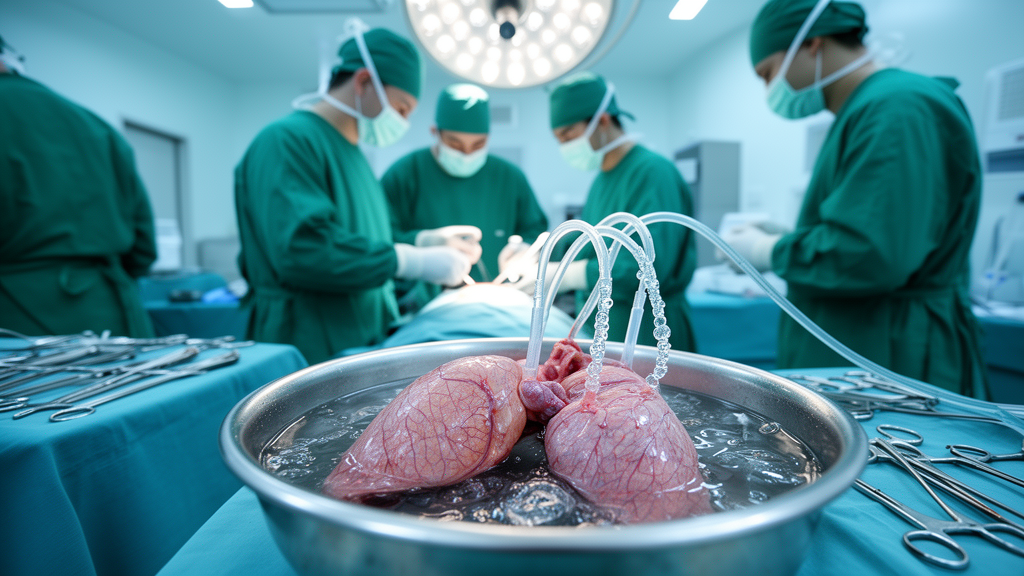
When a donor’s heart stops in a controlled donation after circulatory determination of death (cDCDD) protocol, the transplant clock begins ticking for every organ in the chest and abdomen. A newly published Forum article in Transplant International, written by thoracic surgeons Carlos Jordá Aragón and Alilis Fontana Bellorín of Hospital Universitari i Politècnic La Fe in Valencia, Spain, argues that the lung is being systematically shortchanged in this process. Writing in response to the European Society for Organ Transplantation (ESOT) Bucharest consensus statements on cDCDD standards and normothermic regional perfusion (NRP), the authors contend that while abdominal and cardiac preservation are now strictly protocolized, the lung allograft’s unique physiology is frequently overlooked, with potentially devastating consequences for graft viability and transplant waiting lists.
The consensus documents in question represent a genuine milestone. They establish standardized protocols for cDCDD across Europe, including detailed recommendations for abdominal NRP (a-NRP) and, more recently, thoraco-abdominal NRP (TA-NRP), in which donor blood is circulated via extracorporeal membrane oxygenation (ECMO) to reanimate abdominal organs and even the heart itself. In both scenarios, abdominal and cardiac graft management follows rigorous, written procedures. The lungs, however, are treated almost as an afterthought. Current clinical practice typically alternates between regional perfusion and immediate static cold storage, delaying lung reinflation until sternotomy and pulmonary artery cannulation in the operating room, long after the critical post-mortem window has closed.
The physiological argument at the heart of the Forum is elegant and, the authors insist, conceptually decisive. Unlike other solid organs, lung parenchyma does not depend on continuous blood perfusion to sustain aerobic cellular metabolism. Instead, the alveolus functions as its own oxygen delivery system: direct alveolar oxygen diffusion into the interstitial space and vascular endothelium is sufficient to prevent ATP depletion and ischemic cell collapse. This mechanism, sometimes described as the so-called pulmonary privilege, means the only truly effective way to preserve cellular metabolism during the immediate post-mortem period is alveolar oxygenation, achieved either through protective mechanical ventilation or continuous positive airway pressure (CPAP) with a high fraction of inspired oxygen. Framing lung preservation strategy exclusively around the a-NRP versus TA-NRP debate is, from a pulmonary perspective, conceptually flawed, because the lung’s preservation needs are met through the airway, not the vasculature.
Timing, however, is everything, and this is where the bioethical safeguards become inseparable from the physiology. The mandatory post-mortem observation or no-touch period, during which no intervention is permitted after cardiac arrest, varies internationally from 3 to 20 minutes, with a global average of 5 minutes. From both ethical and physiological standpoints, a minimum of 5 minutes must be respected to avoid auto-resuscitation of the heart. Initiating mechanical ventilation prematurely within this window is strictly forbidden, because hypoxic cardiac arrest might otherwise be reversed in the donor, or residual cerebral oxygenation could be compromised, violating the dead donor rule that underpins the entire ethical framework of donation after circulatory death.
Once the mandatory standoff period has been fully respected and death has been legally declared, the authors argue that initiating mechanical ventilation or CPAP represents minute zero of lung preservation. This early alveolar recruitment must not be deferred until chest opening in the operating room. Pathophysiological principles strongly support the strategy, international donor procurement guidelines advise it, and current ethical and legal regulations fully permit it as a post-mortem preservation maneuver. In other words, the simplest, cheapest, and most physiologically rational intervention available, reconnecting the ventilator or applying CPAP with a high fraction of inspired oxygen the moment death is declared, is already ethically sanctioned and guideline-endorsed, yet remains unrecognized as a standardized frontline maneuver in cDCDD protocols.
The authors insist that the lung cannot remain an overlooked organ in global DCD standards. In cDCDD cases managed with abdominal NRP, the overall preservation environment should be recognized as a dual-temperature preservation: abdominal normothermia combined with thoracic hypothermic or ischemic oxygenated preservation. Rather than relying solely on hypothermia to slow metabolic rates, early alveolar oxygen supply delivers what the authors call true oxygenated ischemia, which preserves pneumocyte viability and allograft quality over extended periods. This approach has been successfully demonstrated in uncontrolled donation after circulatory death, where long ischemic times have been managed with simple normothermic ventilation and ex vivo lung perfusion assessment, offering a template for what controlled donation protocols could achieve.
Technical standardization in cDCDD managed with TA-NRP, however, must extend beyond ventilatory parameters to address pulmonary hydrostatic safety, and here the picture becomes considerably more complex. Reanimating the donor heart inherently exposes the pulmonary vasculature to active perfusion. The ESOT Bucharest Consensus explicitly acknowledges the threat of lung congestion and cardiac distension during TA-NRP, and its guidelines rely on indirect right-sided decompression by optimizing venous return to the ECMO circuit via a centrally inserted dual-stage venous cannula. This approach, however, fails to prevent post-capillary congestion caused by left ventricular stunning or transient contractility failure. When antegrade perfusion is restored, blood pools retrogradely into the left heart while the ventricular apparatus is still arrested or stunned, causing devastating post-capillary damage if an active outflow tract is not provided.
To address this, Van Raemdonck and colleagues argue that direct and immediate venting of the left atrium, by inserting a venting catheter via the interatrial groove at the initiation of TA-NRP, is required to prevent hydrostatic pulmonary edema. This direct approach, however, introduces significant surgical complexity and suffers from a profound lack of standardization. The 2024 American Association for Thoracic Surgery (AATS) Expert Consensus confirms that clinical utilization of lungs after TA-NRP remains highly controversial and data are limited, pointing directly to inconsistent venting practices as the primary cause of hydrostatic edema and variable graft outcomes. To date, there is no high-quality clinical evidence confirming that this in situ surgical maneuver increases the rate of valid donors. On the contrary, its technical difficulty in an unstable donor, combined with the absence of a uniform protocol, frequently deters transplant teams from accepting these grafts altogether out of fear of acute hydrostatic edema.
How to reliably protect the pulmonary vascular bed during TA-NRP therefore remains a poorly standardized frontier, as current guidelines fail to offer a clear, consensus-driven protective roadmap. Within this gap, inconsistent venting practices represent a critical technical failure and a lapse in procedural leadership that acts as a powerful deterrent for transplant teams, unnecessarily limiting lung graft utilization. The authors also raise the strategic allocation of high-cost healthcare resources: while ex vivo lung perfusion (EVLP) is an indispensable, vital safety net to evaluate and rescue borderline grafts, particularly those with suspected hydrostatic edema, it must never serve as a routine, high-cost bypass for suboptimal in situ preservation. Shifting the burden of graft protection from the donor’s bedside to ex situ platforms is both logistically and financially unsustainable, and clinical priority must remain focused on rigorous, proactive in situ donor care.
Ultimately, the Forum delivers a pointed challenge to the transplant community. While current consensus guidelines remain heavily focused on complex hepatic or cardiac preservation protocols, they frequently overlook simple, cost-effective, and highly viable maneuvers to safeguard the lung graft. While the community debates highly invasive and poorly standardized in situ surgical venting procedures to mitigate hydrostatic injury, the simplest protective strategy of all, early in situ alveolar oxygenation via ventilation or CPAP immediately following the mandatory 5-minute no-touch period, remains unrecognized as a standardized frontline maneuver. A paradigm shift is urgently required, the authors conclude: transitioning from static cold storage toward early in situ oxygenated preservation, as successfully demonstrated in uncontrolled donation after circulatory death. The lung, they insist, must no longer be the forgotten organ in regional perfusion strategies and cDCDD consensus guidelines.
Subject of Research: Transplantation
Article Title: Don’t forget to safeguard the lungs during DCD multi-organ retrieval! Early in situ oxygenated preservation matters
Article References: Jordá Aragón, C., & Fontana Bellorín, A. (2026). Don’t forget to safeguard the lungs during DCD multi-organ retrieval! Early in situ oxygenated preservation matters. Transplant International, 39, Article 17507. https://doi.org/10.3389/ti.2026.17507
Image Credits: AI Generated
Keywords: lung transplant, DCD donation, normothermic regional perfusion, organ preservation, ESOT consensus, transplant surgery, forget, safeguard, lungs, during, multi-organ, retrieval
Cite Scienmag News
Drew Townsend. (October 17, 2026). Don’t Forget the Lungs: Early In Situ Oxygenated Preservation Matters in DCD Multi-Organ Retrieval. Scienmag. https://scienmag.com/dont-forget-the-lungs-early-in-situ-oxygenated-preservation-matters-in-dcd-multi-organ-retrieval/
Drew Townsend. "Don’t Forget the Lungs: Early In Situ Oxygenated Preservation Matters in DCD Multi-Organ Retrieval." Scienmag, 17 October 2026, https://scienmag.com/dont-forget-the-lungs-early-in-situ-oxygenated-preservation-matters-in-dcd-multi-organ-retrieval/. Accessed 17 October 2026.
Drew Townsend. "Don’t Forget the Lungs: Early In Situ Oxygenated Preservation Matters in DCD Multi-Organ Retrieval." Scienmag. October 17, 2026. https://scienmag.com/dont-forget-the-lungs-early-in-situ-oxygenated-preservation-matters-in-dcd-multi-organ-retrieval/


