


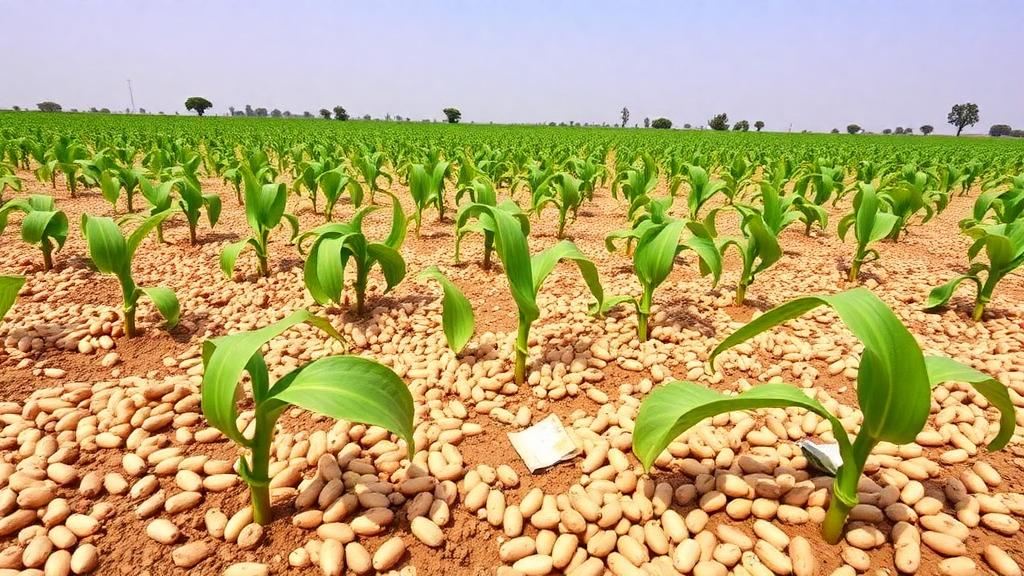
Bambara groundnut, a humble underground legume that has sustained communities across sub-Saharan Africa for centuries, is quietly emerging as one of the most promising weapons against food insecurity in a warming Sahel. Now, a field trial conducted in the Sudano-Sahelian zone of Burkina Faso has delivered a message that could reshape how smallholder farmers grow this neglected crop: pairing the right genotype with the right dose of poultry manure can dramatically lift yields on soils that are otherwise among the most depleted on Earth. The study, published in the journal Discover Agriculture, evaluated eight Bambara groundnut genotypes under three fertilization regimes during the 2023 rainy season at Pamtaga, a village in the rural commune of Dapélogo, roughly 34 kilometers from Ouagadougou.
The crop itself is remarkable. Bambara groundnut (Vigna subterranea (L.) Verdc.) is often described as a nutritionally complete food, packed with protein and starch, rich in minerals, low in fat, and unusually well balanced in essential amino acids such as lysine and methionine, which are limiting in many other legumes. It thrives across an extraordinary range of climates, from semi-arid zones to humid tropics, and it is a particularly important source of income for women across sub-Saharan Africa. Yet despite a theoretical yield potential of 3,000 to 4,000 kilograms per hectare, actual yields in Burkina Faso have stagnated at around 1,600 kilograms per hectare, a gap driven largely by declining soil fertility and the absence of varieties genuinely adapted to current climatic conditions.
The starting point of the trial was sobering. Laboratory analysis of the unfertilized control soil revealed alarming poverty in essential nutrients: organic matter of just 0.553 percent, total carbon of 0.321 percent, total nitrogen of 0.043 percent, available phosphorus of 5.83 parts per million, available potassium of 37.57 parts per million, a cation exchange capacity of 6.05 milliequivalents per 100 grams, and a slightly acidic pH of 5.4. Every one of these values fell below the critical thresholds considered necessary for optimal Bambara groundnut development, which include nitrogen of 0.1 to 0.2 percent, phosphorus of 15 to 25 parts per million, potassium of 80 to 120 parts per million, a cation exchange capacity above 10, and a pH between 5.5 and 6.5. In other words, the researchers were working with soil that should, on paper, barely support the crop at all.
Into this depleted ground the team introduced poultry droppings, an organic amendment prized for being inexpensive and rich in nitrogen, phosphorus, and potassium, which become rapidly available to plants without composting. The manure used in the trial was itself a chemical powerhouse, containing 88.436 percent total organic matter, 4.191 percent total nitrogen, 2.211 percent total phosphorus, 2.420 percent total potassium, along with substantial calcium and magnesium. The experimental design was a split-plot layout with three replicates: an unfertilized control, a moderate dose of 4,000 kilograms of manure per hectare, and a higher dose of 6,000 kilograms per hectare. Each main plot was subdivided into eight sowing rows, one for each genotype drawn from the gene bank of the Institute for the Environment and Agricultural Research, including six accessions and two registered varieties.
The results on soil chemistry were unambiguous. After the application of poultry manure and harvest, the fertilized soil showed notable increases in organic matter, carbon, available phosphorus, available potassium, and a slight rise in pH from 5.4 to around 5.7. Nitrogen increased only modestly, a shift the researchers attribute to substantial uptake by plants during the vegetative cycle. The correction of soil acidity likely improved the availability and uptake of nutrients across the board, while secondary elements such as calcium, magnesium, and sulfur contributed further to plant nutrition. The carbon-to-nitrogen ratio also rose in the fertilized soil, reflecting the enrichment of the growing medium with organic residues that can be transformed into humus, a genuine reservoir of water and nutrients on sandy Sahelian ground.
When it came to the plants themselves, the analysis of variance revealed a story of interlocking factors. Fertilization treatments had a highly significant influence on most traits studied, including grain yield, the number of pods per plant, the timing of 50 percent flowering and maturity, and the weight of 100 seeds. Genetic differences among the eight genotypes were significant to highly significant for nearly all traits, from flowering date to seed size and yield, confirming substantial variability that breeders can exploit. Crucially, significant genotype-by-fertilization interactions emerged for key traits such as days to 50 percent flowering, 100-seed weight, and grain yield, meaning that the effect of any given manure dose depended on which genotype was growing in it. For traits such as maturity date and seed dimensions, the two factors acted independently.
The performance rankings shifted with the environment, and this is where the practical implications become vivid. Under the unfertilized control, grain yield ranged from 784 kilograms per hectare for genotype E114 to 1,258 kilograms per hectare for KVS246, though the differences were not statistically significant. Under the moderate 4,000-kilogram dose, yields jumped dramatically, with genotype E62-a topping the trial at 2,951 kilograms per hectare, nearly tripling the best unfertilized performance, followed closely by KVS259. Under the higher 6,000-kilogram dose, the picture changed again: KVS115 led with 2,676 kilograms per hectare, and genotypes E17 and KVS259 also performed strongly. Individual genotype responses told the same story of specificity. Genotype E114, for example, produced only 784 kilograms per hectare unfertilized but 2,287 kilograms per hectare under the moderate dose, while KVS115 climbed from 1,112 to 2,676 kilograms per hectare between the control and the highest dose.
One genotype carried a particularly telling pedigree. KVS246, the most productive variety under unfertilized conditions, is one of the most widely grown local varieties in Burkina Faso precisely because of its resilience under variable rainfall. Farmers call it Komkoul-zaalem in the Mooré language, meaning that whatever the harshness of the environmental conditions, a minimal yield is guaranteed. The researchers note that this reputation is no coincidence: KVS246 is a population variety composed of several constituent genotypes, giving farmers a built-in portfolio of adaptations to different conditions. Its stability across fertilization regimes, alongside that of KVS115, suggests that such varieties offer a dependable baseline even where inputs are scarce, while targeted fertilization can unlock far higher ceilings for other genotypes.
The broader lesson the authors draw is that neither genetics nor soil management alone can close Bambara groundnut’s yield gap; the two must be matched. The expression of a genotype’s potential depends on environmental factors, including cultivation practices, and the distinct responses observed across the three fertilization environments point to a synergistic effect between variety and amendment that the researchers say warrants further investigation. Some genotypes may simply assimilate nutrients more efficiently or tolerate abiotic stress better, but the precise mechanisms remain speculative. What is clear is that evaluating genotypes across multiple fertilization environments is essential before making recommendations to farmers, because a variety that excels with manure may be mediocre without it, and vice versa.
The study also carries a caution. Because it was conducted at a single site during a single season, the findings are context-specific, and the authors call for multi-location, multi-season trials with larger plots to validate consistency across the Sudano-Sahelian zone. Still, in a region where cereals dominate production yet fail to guarantee food and nutritional security, and where decades of exclusive mineral fertilizer use have acidified soils, the case for agroecological intensification is compelling. Poultry droppings, cheap and locally abundant, could serve as an alternative to synthetic inputs, reviving a nutrient-dense legume whose underground pods demand little from fragile soils while giving much back. For smallholders facing climate change head-on, the message from Pamtaga is one of pragmatic hope: the seed and the manure, chosen together, can do far more than either can alone.
Subject of Research: Agronomic performance of Bambara groundnut genotypes under organic fertilization with poultry droppings in Burkina Faso
Article Title: Agronomic performance of Bambara groundnut genotypes [Vigna subterranea (L.) Verdc] under organic fertilization in the Sudano-Sahelian zone of Burkina Faso
Article References: Ouoba, A., Bougma, A. L., Nikiema, D., Kambou, D. J., Ouedraogo, M. H., Sawadogo, N., & Ouedraogo, M. (2026). Agronomic performance of Bambara groundnut genotypes [Vigna subterranea (L.) Verdc] under organic fertilization in the Sudano-Sahelian zone of Burkina Faso. Discover Agriculture, 4(1), Article 303. https://doi.org/10.1007/s44279-026-00674-5
Image Credits: AI Generated
DOI: 10.1007/s44279-026-00674-5
Keywords: Bambara groundnut, Vigna subterranea, poultry manure, organic fertilization, Burkina Faso, Sudano-Sahelian zone, genotype-environment interaction, grain yield, soil fertility, plant breeding, sustainable agriculture, food security
Cite Scienmag News
Alan Morgan. (October 1, 2026). Poultry Manure and Smart Genotype Choices Boost Bambara Groundnut Yields in Burkina Faso. Scienmag. https://scienmag.com/poultry-manure-and-smart-genotype-choices-boost-bambara-groundnut-yields-in-burkina-faso/
Alan Morgan. "Poultry Manure and Smart Genotype Choices Boost Bambara Groundnut Yields in Burkina Faso." Scienmag, 1 October 2026, https://scienmag.com/poultry-manure-and-smart-genotype-choices-boost-bambara-groundnut-yields-in-burkina-faso/. Accessed 4 October 2026.
Alan Morgan. "Poultry Manure and Smart Genotype Choices Boost Bambara Groundnut Yields in Burkina Faso." Scienmag. October 1, 2026. https://scienmag.com/poultry-manure-and-smart-genotype-choices-boost-bambara-groundnut-yields-in-burkina-faso/


