


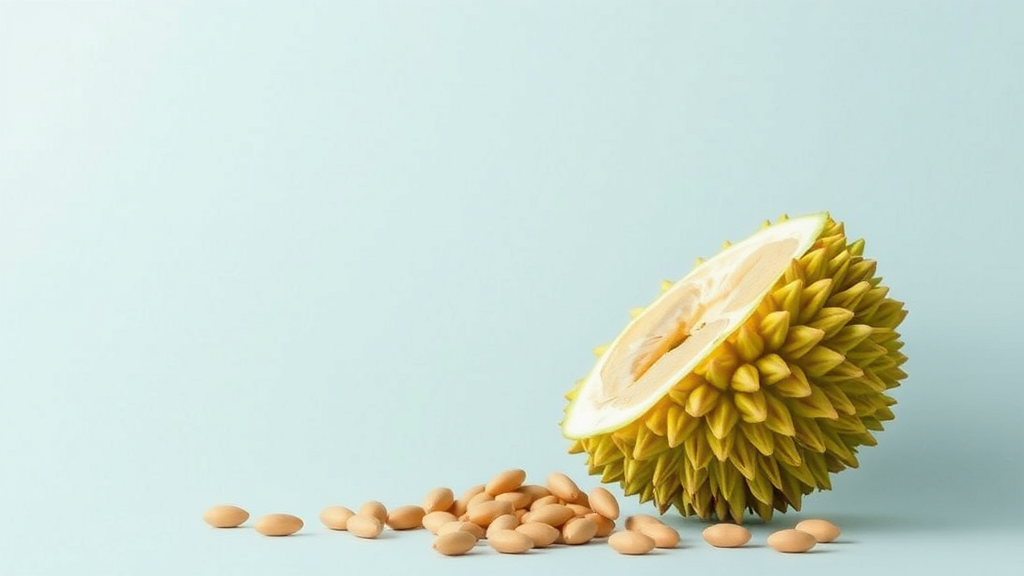
The durian is famous for polarizing the world with its smell, but in Southeast Asia it generates something less discussed: mountains of agricultural waste. Every season, durian processing leaves behind husks, seeds, and other by-products that are mostly discarded or fed into low-value applications. A new critical review published in Food Science and Biotechnology argues that one of these overlooked fractions, the seed, may hold untapped commercial promise as a source of pectin, the versatile polysaccharide that gels jams, stabilizes yogurts, and thickens countless processed foods. Yet the review, led by Nurul Nor Syaida Mat Nasir and colleagues at Universiti Putra Malaysia, delivers a strikingly honest verdict: despite growing interest, no published study has ever directly extracted, purified, and fully characterized pectin from durian seed itself.
That absence of direct evidence is the central tension of the paper. Pectin is a complex plant cell wall polysaccharide built largely from galacturonic acid units, whose degree of methylation determines whether it behaves as a high-methoxyl pectin, gelling with sugar and acid, or a low-methoxyl pectin, forming calcium-mediated gels. Commercial pectin is produced almost exclusively from citrus peel and apple pomace, which keeps global supply dependent on a narrow industrial base and exposes prices to volatility in those supply chains. Food scientists have therefore spent the past decade hunting for alternative raw materials, from sugar beet pulp and okra to mango peel and cocoa pod husks. The Malaysian team wanted to know whether durian seed, a carbohydrate-rich by-product generated in substantial volumes across the durian industry, deserves a place on that list.
The indirect evidence is genuinely intriguing. Durian seed is known to contain considerable carbohydrate reserves, and prior research on the seed has focused mainly on its starch and on durian seed gum, a polysaccharide that has been extracted, purified, and characterized in earlier studies. Work on durian seed gum has demonstrated that the seed matrix can yield functional hydrocolloids with measurable rheological and viscoelastic properties, and more recent studies have explored tuning durian seed gum with natural deep eutectic solvents for use as edible food coatings. Those findings suggest the seed’s cell wall chemistry is chemically rich enough to warrant a serious look at its pectic components. Meanwhile, the seed’s counterparts elsewhere in the fruit have already delivered results: pectin has been extracted from durian rind, with studies showing that acid type and concentration influence yield, purity, and degree of esterification, and that subcritical water can be optimized as a green extraction medium for rind pectin.
The transferability question is where the review does its most careful work. Pectin from the rind cannot simply be assumed to match pectin from the seed, because pectin structure, yield, and gelling behavior are highly matrix-dependent. Extraction conditions that work for citrus peel may degrade or chemically alter a seed-derived polysaccharide, and the seed’s high starch content poses specific purification challenges that peel-based processes never confront. The authors emphasize that most available evidence for durian seed comes either from other plant matrices entirely, or from durian rind, and that extrapolating those results to the seed remains speculative until targeted experiments are performed. This is a refreshingly conservative stance in a field where waste-valorization claims sometimes outrun the data.
On extraction technology, the review surveys both conventional and green methods and evaluates how each might apply to durian seed. Conventional acid extraction, typically using hot mineral or organic acids to solubilize pectin from the plant matrix, remains the industrial benchmark but carries environmental drawbacks, including acidic effluents and high energy and water demands. The green alternatives are numerous and technically distinct. Ultrasound-assisted extraction uses acoustic cavitation, the rapid formation and collapse of microbubbles, to disrupt cell walls and accelerate mass transfer at lower temperatures. Microwave-assisted heating volumetrically heats the plant-water mixture, rapidly softening tissue and releasing pectin, and has already been demonstrated on industrial scales for other natural product extractions. Subcritical water extraction, which keeps water in a pressurized liquid state at elevated temperatures, has been shown to extract and partially modify pectin simultaneously, and response surface methodology has been used to optimize this approach for cocoa pod husk pectin. Ohmic heating and enzyme-assisted extraction round out the toolkit, with enzymes such as cellulases and pectinases able to loosen cell wall architecture under mild conditions.
Each method trades yield against structural preservation, and the review stresses that this trade-off matters enormously for any seed-derived pectin. Aggressive extraction can depolymerize the pectin backbone or strip methyl ester groups, altering the degree of esterification that dictates gelling behavior. Thermal analysis studies of citrus pectin show that even low-moisture heating can trigger backbone depolymerization, a warning relevant to any high-temperature process applied to a novel matrix. For durian seed specifically, green methods could offer a double advantage: gentler structural preservation of an unknown pectin and a smaller environmental footprint, aligning with the circular economy logic that motivates valorizing durian waste in the first place. Prior reviews of the durian industry’s biomass have identified substantial opportunities for upcycling husk and seed material into green and sustainable applications across the Malaysian context, and pectin extraction would slot naturally into that vision.
The review also lays out the characterization work that any credible durian seed pectin study would need to perform. That includes determining galacturonic acid content, degree of methylation, degree of acetylation, molecular weight distribution, and neutral sugar composition, using techniques such as infrared spectroscopy, which has become a workhorse for polysaccharide structural analysis. Beyond chemistry, functional validation is essential: gelation behavior, rheological properties, emulsification capacity, and thermal stability all determine whether a pectin can compete commercially. The Food Chemicals Codex sets minimum performance standards that any proposed source must meet, and comparisons with established pectins from citrus, apple, and sugar beet would be the ultimate benchmark. Studies on other unconventional sources, such as bitter orange seed, sunflower heads, jackfruit seed sheaths, and tomato seeds, demonstrate that seed tissues can indeed yield viable pectins, providing a tentative template for what durian seed might deliver.
The application landscape adds further motivation. Pectin’s uses extend well beyond the jam pot. Low-methoxyl pectin stabilizes low-fat yogurt and improves its rheology and microstructure, pectin-based edible films and coatings are emerging as biodegradable packaging alternatives, and modified pectins have attracted attention for potential health applications, including antioxidant and anti-cancer activities studied in pH- or heat-modified forms. Pectin has even been explored as a lecithin substitute in chocolate and as a fat replacer in processed meats. If durian seed pectin proved viable, it could serve any of these markets while simultaneously reducing the waste burden of a fruit industry whose processing residues are generated in enormous, concentrated volumes near processing facilities, which is precisely the logistical profile that makes a by-product economically attractive.
The economic feasibility picture remains open, but related analyses suggest the concept is not fanciful. Techno-economic studies of industrial-scale pectin manufacturing from fruit by-products in circular production models, and of microwave-assisted extraction of multiple co-products from single feedstocks, indicate that diversifying a biorefinery’s outputs improves its financial resilience. Durian seed would enter this calculus as a low-cost or even negative-cost feedstock, provided that extraction yields, purification costs, and product quality all clear commercial thresholds. The review’s authors, supported by Universiti Putra Malaysia funding, frame their contribution as a roadmap rather than a proof: by synthesizing seed composition data, seed-derived polysaccharide research, and extraction technology assessments, they define exactly which experiments the field still lacks.
The bottom line is a rare kind of science news story, one about a promising hypothesis that is honestly not yet proven. Durian seed is abundant, carbohydrate-rich, and chemically plausible as a pectin source, and the green extraction toolbox needed to test that idea has matured rapidly across other plant matrices. But until a laboratory actually isolates pectin from durian seed and characterizes its structure and function, the king of fruits’ most ignored component remains a question mark rather than a commodity. Given the scale of durian waste in Southeast Asia and the global appetite for sustainable hydrocolloids, that first extraction study may be one of the most watched experiments in food science’s waste-to-wealth movement.
Subject of Research: Feasibility of durian seed as a pectin source using green extraction methods
Article Title: Durian seed as a prospective source of pectin: a critical review of green extraction, characterization, and feasibility study
Article References: Nasir, N. N. S. M., Shamsudin, R., Anoraga, S. B., Hamzah, M. H., & Basri, M. S. M. (2026). Durian seed as a prospective source of pectin: a critical review of green extraction, characterization, and feasibility study. Food Science and Biotechnology. https://doi.org/10.1007/s10068-026-02304-8
Image Credits: AI Generated
DOI: 10.1007/s10068-026-02304-8
Keywords: durian seed, pectin, green extraction, food waste valorization, polysaccharides, subcritical water extraction, microwave-assisted extraction, ultrasound-assisted extraction, hydrocolloids, food science, by-product utilization, sustainability
Cite Scienmag News
Drew Townsend. (September 24, 2026). Durian Seeds Could Become an Unexpected New Source of Pectin, Review Finds. Scienmag. https://scienmag.com/durian-seeds-could-become-an-unexpected-new-source-of-pectin-review-finds/
Drew Townsend. "Durian Seeds Could Become an Unexpected New Source of Pectin, Review Finds." Scienmag, 24 September 2026, https://scienmag.com/durian-seeds-could-become-an-unexpected-new-source-of-pectin-review-finds/. Accessed 24 September 2026.
Drew Townsend. "Durian Seeds Could Become an Unexpected New Source of Pectin, Review Finds." Scienmag. September 24, 2026. https://scienmag.com/durian-seeds-could-become-an-unexpected-new-source-of-pectin-review-finds/


