


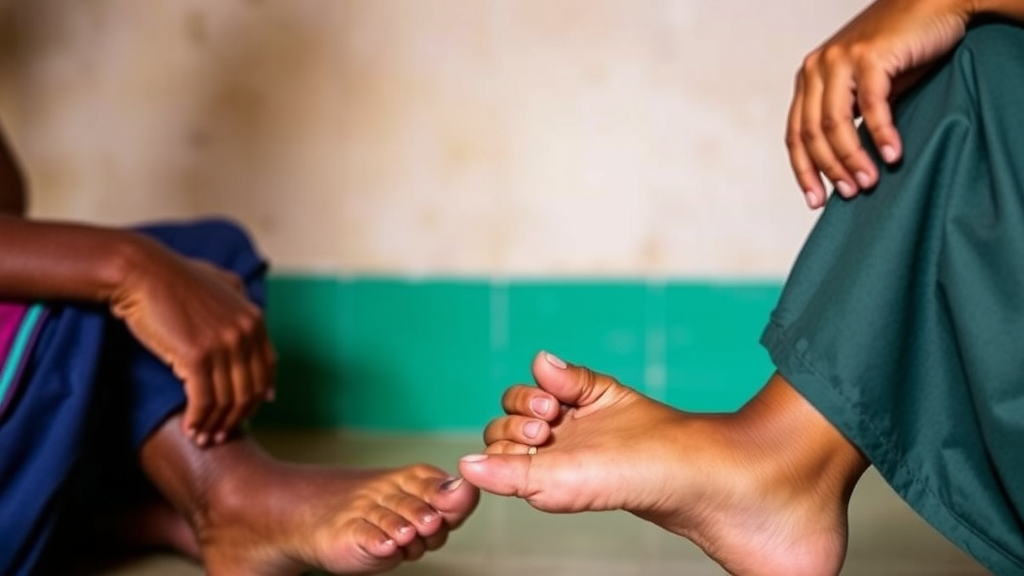
Foot health is one of the most neglected corners of global health. When feet fail, mobility fails, and when mobility fails, people lose access to education, work, and independence. Yet in many low-resource settings, specialized podiatric services simply do not exist, and treatable conditions quietly progress into lifelong disability. A new study published in the International Journal for Equity in Health describes a five-year community-based podiatric health programme implemented in Morocco and Cameroon between 2020 and 2025, offering one of the most detailed pictures to date of the foot health burden carried by vulnerable communities in sub-Saharan Africa and North Africa, and a practical template for how that burden might be reduced.
The research, led by Cristina González-Martín and colleagues at the Universidade da Coruña in Spain, was conducted through international cooperation initiatives in two very different settings: the town of Sangmélima in the South Region of Cameroon, and a partnership with the Complexe Régional des Personnes en Situation d’Handicap in Azrou, Morocco. Rather than importing a short-lived medical mission, the team designed a model built on four complementary pillars: podiatric clinical assessment, health education, capacity building of local healthcare personnel, and referral and care coordination for complex cases. The aim was not only to treat feet but to leave behind a local system capable of continuing the work.
Participants were identified through collaborating healthcare, educational, and disability-support institutions, combined with community outreach activities that brought screening directly to the populations least likely to reach a clinic on their own. This institution-based identification plus outreach approach matters, because foot disorders disproportionately affect people who are already marginalized: children with congenital deformities, people living with neurological conditions, and individuals with disabilities who face physical, financial, and geographic barriers to care. In total, 545 participants were assessed over the programme period, 102 in Morocco and 443 in Cameroon, making this one of the larger descriptive datasets on community podiatric needs in these regions.
The clinical findings reveal two distinct epidemiological profiles. In the Moroccan cohort, neurological disorders were the most common comorbidity, affecting 43.1 percent of participants, a figure that reflects the partnership with a regional disability complex in Azrou. The most frequent podiatric findings were Achilles tendon contracture in 29.4 percent of participants, equinus foot in 28.4 percent, hindfoot valgus in 19.6 percent, and clubfoot in 9.8 percent. These are conditions in which the soft tissues and bony architecture of the foot and ankle become fixed in abnormal positions, often after years without intervention. An Achilles tendon contracture limits the ankle’s ability to dorsiflex, turning every step into a mechanical compromise; equinus foot, in which the foot is held in a downward position, forces compensations at the knee, hip, and spine.
Clubfoot, or congenital talipes equinovarus, deserves particular attention. It is one of the most common congenital musculoskeletal deformities worldwide, and when treated early with serial casting techniques such as the Ponseti method, most children walk normally. Untreated, however, the foot becomes rigidly inverted and adducted, and adults with untreated clubfoot often experience pain, callosities, difficulty with footwear, and profound social stigma. The fact that nearly one in ten assessed participants in Morocco presented with clubfoot underscores how a condition that is largely correctable in infancy continues to produce disability when access to early diagnosis and treatment is missing, a textbook illustration of health inequity expressed in the architecture of the foot.
The Cameroonian cohort in Sangmélima showed a different pattern. The most prevalent podiatric findings were metatarsus adductus in 12.9 percent of participants, a congenital or developmental inward deviation of the forefoot; claw toes in 7.0 percent, in which the toes curl downward at both joints and are prone to pressure lesions; gait adduction in 5.2 percent; clubfoot in 4.5 percent; and hindfoot valgus in 4.5 percent. Hindfoot valgus, an outward tilting of the heel, alters weight distribution across the foot and can lead to flatfoot deformity, plantar pain, and progressive joint wear. Claw toes frequently complicate conditions such as diabetes and neurological disease, where loss of intrinsic muscle balance deforms the toes and creates ulcer-prone pressure points.
From a biomechanical standpoint, the conditions documented in both countries share a common thread: they are progressive and time-sensitive. Soft tissue contractures respond to stretching, casting, orthoses, and minor procedures when addressed early, but become fixed deformities that require complex surgery when neglected. This is precisely why the study’s authors emphasize that insufficient healthcare infrastructure, shortages of trained professionals, and limited rehabilitation resources contribute to preventable disability and reduced quality of life. The clinical assessment component of the programme therefore functioned not merely as a diagnostic exercise but as a triage system, channeling complex cases into a referral and care coordination pathway while simpler problems could be managed through education and conservative measures.
The education and capacity-building components are arguably the most strategically important. The programme trained local healthcare personnel in podiatric assessment and basic management, aiming to embed foot health competencies within institutions that will remain in the communities long after international teams depart. Health education delivered to participants and families addressed hygiene, footwear, early warning signs, and the importance of seeking care before deformities become fixed. This dual investment in human capital and community knowledge is what distinguishes a sustainable health system intervention from a one-off surgical camp, and the authors argue that the model is potentially sustainable and replicable in similar resource-limited settings.
What makes the study notable for the global health community is its framing. Foot disorders are rarely counted among headline health inequities, which tend to focus on infectious disease, maternal mortality, or major non-communicable diseases. Yet mobility is the infrastructure of daily life, and the data from 545 individuals in Morocco and Cameroon give quantitative weight to a burden that has historically been invisible in national health statistics. The researchers used descriptive analyses to characterize participant demographics, comorbidities, and podiatric disorders, and the resulting profiles provide an evidence base that health ministries and non-governmental organizations can use to plan services, allocate rehabilitation resources, and justify investment in training programmes.
The authors conclude that the community-based podiatric health model was feasible to implement in resource-limited settings and provided an integrated approach combining clinical assessment, health education, workforce development, and referral coordination. No specific funding from public, commercial, or not-for-profit grant agencies supported the research, and the authors declare no competing interests. As with any descriptive implementation study, the findings document needs and demonstrate feasibility rather than proving long-term outcomes, and future work will need to track whether trained personnel retain skills, whether referred cases complete treatment, and whether disability outcomes improve. But the central message is clear and urgent: with modest, well-organized investment, the silent epidemic of untreated foot disease in underserved communities can be seen, measured, and treated, one community at a time.
Subject of Research: Community-based podiatric care and foot health equity in low-resource settings in Morocco and Cameroon
Article Title: Community-based podiatric health programme to improve access to foot care and strengthen local health capacity in Morocco and Cameroon
Article References: González-Martín, C., Barreiro, V. B., Garcia-Rodriguez, T., Fernandez-López, U., & Grela-Fariña, M. (2026). Community-based podiatric health programme to improve access to foot care and strengthen local health capacity in Morocco and Cameroon. International Journal for Equity in Health. https://doi.org/10.1186/s12939-026-03030-7
Image Credits: AI Generated
DOI: 10.1186/s12939-026-03030-7
Keywords: podiatry, health equity, global health, community health, capacity building, rehabilitation, clubfoot, Morocco, Cameroon, low-resource settings, foot care, disability
Cite Scienmag News
Courtney Benton. (September 24, 2026). Foot Care for the Underserved: Community Podiatry Model Shows Promise in Morocco and Cameroon. Scienmag. https://scienmag.com/foot-care-for-the-underserved-community-podiatry-model-shows-promise-in-morocco-and-cameroon/
Courtney Benton. "Foot Care for the Underserved: Community Podiatry Model Shows Promise in Morocco and Cameroon." Scienmag, 24 September 2026, https://scienmag.com/foot-care-for-the-underserved-community-podiatry-model-shows-promise-in-morocco-and-cameroon/. Accessed 4 October 2026.
Courtney Benton. "Foot Care for the Underserved: Community Podiatry Model Shows Promise in Morocco and Cameroon." Scienmag. September 24, 2026. https://scienmag.com/foot-care-for-the-underserved-community-podiatry-model-shows-promise-in-morocco-and-cameroon/


