


Leadership in a globalized workplace is no longer an abstract ideal reserved for executives with frequent-flyer miles. It is a daily, practical skill exercised in video calls that span time zones, in teams whose members interpret silence, humor, hierarchy, and directness in strikingly different ways. Yet the training most students and professionals receive for this reality remains stubbornly analog: lectures, slide decks, and occasional role-play exercises that rarely scale beyond a single classroom. A new educational technology developed within the State University of New York system aims to change that equation by turning cross-cultural leadership practice into an interactive, story-driven puzzle delivered entirely online, with an artificial intelligence system watching, evaluating, and coaching players as they play.
The innovation, known as the Cross-Cultural Leadership Story Puzzle Game, is being offered to the marketplace by the Research Foundation for the State University of New York, the private nonprofit corporation that manages research and technology transfer across the SUNY system. The technology is patent pending and currently sits at technology readiness level three, a stage at which the core concept has been demonstrated but is not yet a fully mature commercial product. According to the foundation, the platform is available for licensing, positioning it for adoption by universities, corporate training departments, and professional development providers looking for scalable ways to build intercultural competence.
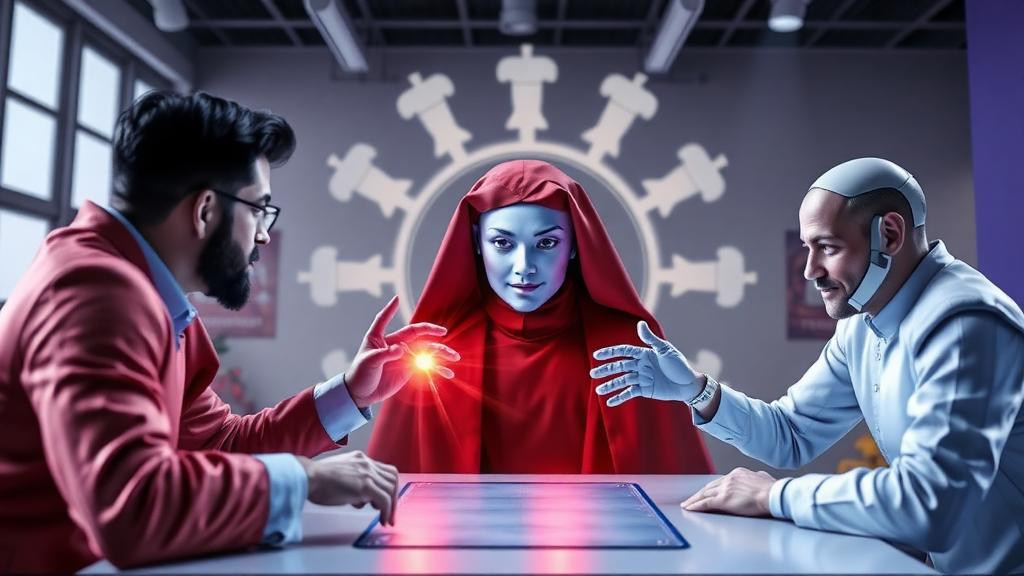
At its core, the game is built on a deceptively simple design principle borrowed from collaborative puzzle games: distributed information. Each participant in a session is assigned a specific role within a simulated workplace incident, and each role comes with its own set of clues that no other player can see. The consequence is structural rather than incidental. No single participant can solve the scenario alone, because the information required to resolve it is deliberately fragmented across the group. To succeed, players must communicate clearly, listen actively, negotiate meaning across perspectives, and coordinate decisions under pressure, which is precisely the skill set that effective leadership in culturally diverse teams demands.
This role-based architecture transforms what could be a passive learning experience into an active one. In a traditional seminar, a student might discuss cross-cultural communication in the abstract, answering hypothetical questions about how a manager should handle a misunderstanding between colleagues from different backgrounds. In the puzzle game, that same student is placed inside the scenario, holding partial knowledge, facing incomplete information from teammates, and needing to bridge gaps in real time. The learning happens through doing rather than through listening, a shift that educational research has long associated with deeper engagement and better retention of complex interpersonal skills.
The delivery platform is Discord, the communication service best known as a hub for gaming communities but increasingly used for structured online collaboration. The choice is technically pragmatic. Discord provides voice, video, and text channels, robust permission controls, and an automation framework through bots and integrations that the game leverages to manage its own flow. The platform distributes role-specific clues to the right participants, sequences the stages of each scenario, and coordinates interaction among players without requiring a human facilitator to run every session manually. That automation is central to the technology’s scalability claim: multiple groups of users can play simultaneously, and the game can accommodate them without a proportional increase in staffing or instructor workload.
The most distinctive component, however, is the AI-supported assessment system embedded within the gameplay. As participants make decisions, exchange messages, and work through the scenario, the AI continuously evaluates observable behaviors related to cross-cultural leadership. It examines how players communicate, how they approach problems, and how their choices reflect leadership competencies in a culturally diverse context. Rather than waiting until the end of an exercise for a facilitator’s debrief, the system delivers feedback in real time, allowing learners to understand how their actions are being interpreted and to adjust their behavior while the experience is still fresh.
That immediacy matters for skill development. Feedback that arrives days after a training exercise tends to lose its behavioral grip; feedback that arrives during the exercise can shape the very decisions it describes. By making assessment continuous and personalized, the platform turns each session into both a practice environment and a measurement instrument. For instructors and training managers, this also means that leadership development becomes something that can be observed and tracked in a measurable way, rather than inferred from self-reported surveys or one-off classroom performances. The system’s designers describe the combination of narrative engagement, automation, and scalable online delivery as the platform’s defining formula for an immersive learning experience.
The intended applications span a wide institutional landscape. In higher education, the game fits naturally into courses on leadership, communication, and intercultural competence, giving students a structured simulation instead of purely theoretical instruction. In corporate settings, it offers training programs a way to strengthen collaboration in global teams, where misunderstandings rooted in cultural difference carry real operational costs. The developers also point to virtual workshops and seminars on diversity, equity, and inclusion, to research initiatives studying how cross-cultural leadership skills develop, and to international educational collaborations, such as joint programs between universities in different countries, where the game can give participants a shared, structured experience despite geographic distance.
The broader context helps explain why such a tool is attracting attention. SUNY describes itself as the largest comprehensive system of higher education in the United States, serving roughly 1.7 million students across 64 campuses, with research expenditures approaching 1.5 billion dollars in fiscal year 2025. The Research Foundation, which supports SUNY researchers working in areas from artificial intelligence for the public good to quantum technologies and biotech, is actively marketing the game through SUNY TechConnect as part of a portfolio of licensable innovations. For the foundation, the platform represents a strand of its broader effort to translate academic work into economic and educational impact, and for potential licensees it arrives with a clear value proposition: a patent-pending, AI-enhanced training environment that requires no physical classroom and scales through software.
Whether the game fulfills that promise will depend on adoption and evidence, and the technology’s early-stage readiness level signals that validation is still unfolding. But the design logic it embodies points to where soft-skills training is heading. Narrative immersion supplies motivation, distributed-information puzzles force genuine collaboration, platform automation removes the logistical barriers that have kept simulation-based training expensive, and AI assessment closes the loop between action and insight. If leadership across cultures can indeed be practiced rather than merely lectured about, the classroom of the future may look less like a lecture hall and more like a well-designed game, one puzzle, one role, and one conversation at a time.
Subject of Research: An AI-assisted, Discord-based story puzzle game for training and assessing cross-cultural leadership skills
Article Title: Cross-Cultural Leadership Story Puzzle Game
Article References: Cross-Cultural Leadership Story Puzzle Game. (n.d.). Original publication
Image Credits: AI Generated
DOI: Not provided
Keywords: cross-cultural leadership, educational technology, Discord, AI assessment, serious games, role-based learning, intercultural competence, corporate training, higher education, SUNY, technology licensing, soft skills training
Cite Scienmag News
Courtney Benton. (October 4, 2026). Discord Puzzle Game Trains Cross-Cultural Leaders With Real-Time AI Feedback. Scienmag. https://scienmag.com/discord-puzzle-game-trains-cross-cultural-leaders-with-real-time-ai-feedback/
Courtney Benton. "Discord Puzzle Game Trains Cross-Cultural Leaders With Real-Time AI Feedback." Scienmag, 4 October 2026, https://scienmag.com/discord-puzzle-game-trains-cross-cultural-leaders-with-real-time-ai-feedback/. Accessed 4 October 2026.
Courtney Benton. "Discord Puzzle Game Trains Cross-Cultural Leaders With Real-Time AI Feedback." Scienmag. October 4, 2026. https://scienmag.com/discord-puzzle-game-trains-cross-cultural-leaders-with-real-time-ai-feedback/


