


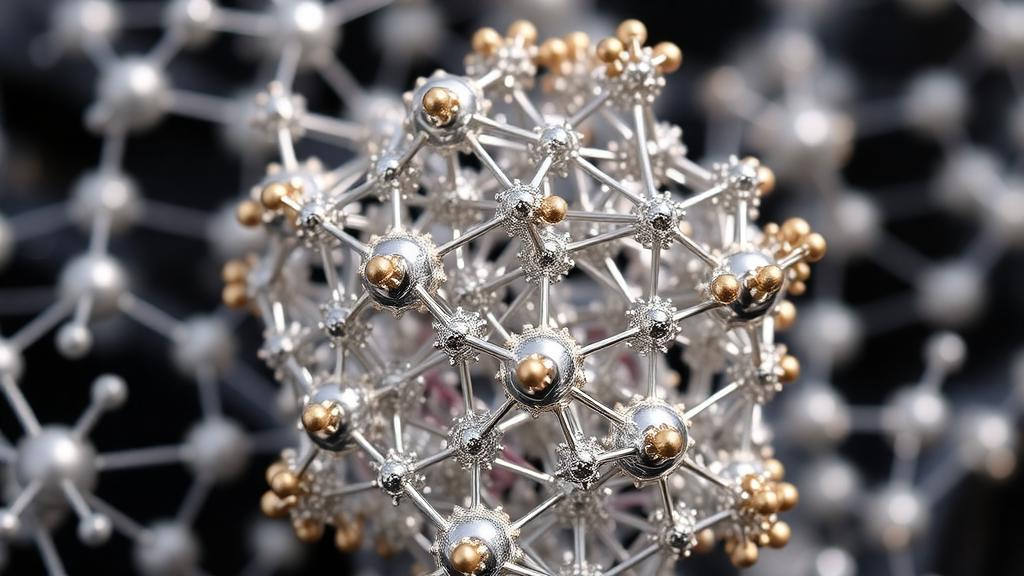
Quasicrystals have fascinated physicists since their discovery because they break one of the oldest rules of crystallography: their atoms are arranged in ordered patterns that never repeat. Decades after that discovery, the magnetic behavior of these strange materials remains stubbornly difficult to predict. Now a team of researchers in Japan has reported a surprisingly simple answer to a long-standing problem. By measuring nothing more exotic than the size of the unit cell, they found they could accurately predict whether a member of an important family of quasicrystal-related compounds will become an antiferromagnet, a ferromagnet, or a spin glass. The work, published in the Journal of the American Chemical Society, proposes the lattice parameter as a unified structural descriptor for magnetic ground state selection in Tsai-type intermetallic compounds.
The study was led by Assistant Professor Farid Labib of the Research Institute for Science and Technology at Tokyo University of Science, together with Associate Professor Kazuhiro Nawa of the Institute of Multidisciplinary Research for Advanced Materials at Tohoku University and Professor Ryuji Tamura of Tokyo University of Science. The team focused on Tsai-type compounds, a class of multi-shell cluster-based structures in which moment-bearing rare-earth atoms occupy an icosahedral site. In these materials, nested atomic shells, including the rhombic triacontahedron, icosidodecahedron, icosahedron, dodecahedron, and an inner tetrahedron, build up a cluster architecture whose rare-earth icosahedral shell carries the magnetic moments responsible for the compounds’ magnetic response.
Historically, materials chemists have relied on chemically tunable parameters to organize the magnetic properties of complex intermetallics. The most influential of these is the valence-electron concentration, commonly expressed as the electron-per-atom, or e/a, ratio. In metallic systems such as Heusler alloys and approximant crystals, the e/a ratio has been widely used to classify magnetic ground states. In gold-based Tsai-type approximant crystals specifically, the e/a ratio was found to control whether the compounds developed long-range antiferromagnetic order, long-range ferromagnetic order, or a spin-glass state in which the magnetic moments freeze in random orientations. But the predictive power of e/a has a serious limitation: it does not transfer cleanly across different alloy families and constituent elements.
That limitation matters because quasicrystal-based intermetallics are considered promising platforms for exploring emergent magnetic phenomena and quantum states not found in ordinary periodic crystals. Without a reliable, experimentally accessible parameter to guide the search, researchers have lacked a systematic way to identify which compositions are worth synthesizing. As Dr. Labib explained, quasicrystals are among the most uniquely structured materials discovered to date and are expected to exhibit novel magnetic states and quantum phenomena not found in ordinary crystals, yet until now there has been no unified guideline for systematically exploring these phenomena in quasicrystals and their approximant crystals.
To close that gap, the team synthesized a family of gold-based 1/1 approximant crystals containing aluminum or gallium and the rare-earth elements terbium, dysprosium, and holmium, and then systematically measured their structural and magnetic properties. Approximant crystals are periodic structures whose local atomic environments closely mimic those of true quasicrystals, making them experimentally tractable stand-ins for the quasiperiodic originals. The measurements revealed a nearly monotonic inverse correlation between the e/a ratio and the lattice parameter, meaning that as the electron concentration per atom rises, the physical size of the cubic unit cell shrinks in a regular, predictable way.
The researchers then extended their experiments to non-Heisenberg Tsai-type compounds containing terbium, dysprosium, and holmium. These compounds are called non-Heisenberg because their magnetic moments do not behave as simple, freely rotating spins; instead, the crystal electric field generated by the surrounding lattice imposes strong uniaxial magnetic anisotropy that favors specific orientations of the moments. Under these conditions, the team observed characteristic whirling antiferromagnetic and ferromagnetic orders, in which the constrained moments arrange themselves in swirling patterns dictated by the interplay of anisotropy and the conduction-electron-mediated interactions between rare-earth moments on the icosahedral shell.
When the researchers plotted the magnetic ground states against the lattice parameter, the result was striking. The compounds organized with high accuracy according to the size of the unit cell, whereas the conventional e/a classification showed systematic shifts depending on which rare-earth element was present and what the alloy composition was. The phase boundaries were sharply defined. Compounds with lattice parameters above approximately 14.72 angstroms adopted the whirling antiferromagnetic state. Those with lattice parameters between 14.62 and 14.72 angstroms became whirling ferromagnets. And those with lattice parameters below approximately 14.62 angstroms froze into spin-glass states. These well-defined thresholds establish the lattice parameter as a unified and experimentally accessible structural descriptor for predicting magnetic ground states in the Tsai-type family.
The physical interpretation is that structural length scales, alongside electron concentration, must be explicitly considered when understanding the conduction-electron-mediated magnetic interactions in these complex alloys. In rare-earth intermetallics, the magnetic moments communicate with one another indirectly through the conduction electrons, and the strength and sign of that communication depend sensitively on the distances between the moment-bearing atoms. A change in the lattice parameter therefore directly reshapes the geometry of the magnetic interaction network on the icosahedral shell, which in turn determines whether the system settles into antiferromagnetic whirling, ferromagnetic whirling, or glassy freezing. The e/a ratio captures part of this physics but conflates it with element-specific electronic effects, which is why it fails to produce a single, element-independent classification.
The practical implications extend well beyond classification. Because the lattice parameter can be tuned through alloy composition and measured with routine structural characterization, it offers materials designers a direct control knob for targeting a desired magnetic ground state. Dr. Nawa noted that the unified magnetic phase diagram constructed in the study can serve as a practical roadmap for the systematic exploration of new magnetic quasicrystals and approximant crystals exhibiting novel magnetic orders and quantum phenomena, and that it can provide a guideline for designing new magnetic materials with targeted magnetic ground states, opening new opportunities for discovering unconventional magnetism in quasiperiodic and complex intermetallic systems.
The study was supported by the Japan Society for the Promotion of Science through multiple Grants-in-Aid for Scientific Research, by the Murata Science and Education Foundation, and by the Japan Science and Technology Agency through its CREST program. The authors declared no competing interests. For a field that has spent decades cataloguing the exotic magnetism of quasiperiodic materials one compound at a time, the message of this work is unusually clean: in the Tsai-type family, the size of the atomic cage appears to decide the fate of the spins inside it. If the lattice-parameter thresholds hold across further alloy families, the search for new magnetic quasicrystals may become far less of a treasure hunt and far more of an engineering exercise, with the next generation of unconventional magnets designed first on paper, in angstroms.
Subject of Research: Lattice-parameter control of magnetic ground states in Tsai-type quasicrystals and approximant crystals
Article Title: Lattice parameter as a unified parameter governing magnetic ground states in Tsai-type compounds
Article References: Lattice parameter as a unified parameter governing magnetic ground states in Tsai-type compounds. (n.d.). Original publication
Image Credits: AI Generated
DOI: Not provided
Keywords: quasicrystals, Tsai-type clusters, lattice parameter, magnetic ground states, antiferromagnetism, ferromagnetism, spin glass, rare-earth intermetallics, electron-per-atom ratio, magnetic anisotropy, approximant crystals, Tokyo University of Science
Cite Scienmag News
Bethany Barker. (October 4, 2026). Lattice Parameter Emerges as Master Key to Magnetic States in Quasicrystal Clusters. Scienmag. https://scienmag.com/lattice-parameter-emerges-as-master-key-to-magnetic-states-in-quasicrystal-clusters/
Bethany Barker. "Lattice Parameter Emerges as Master Key to Magnetic States in Quasicrystal Clusters." Scienmag, 4 October 2026, https://scienmag.com/lattice-parameter-emerges-as-master-key-to-magnetic-states-in-quasicrystal-clusters/. Accessed 4 October 2026.
Bethany Barker. "Lattice Parameter Emerges as Master Key to Magnetic States in Quasicrystal Clusters." Scienmag. October 4, 2026. https://scienmag.com/lattice-parameter-emerges-as-master-key-to-magnetic-states-in-quasicrystal-clusters/


