


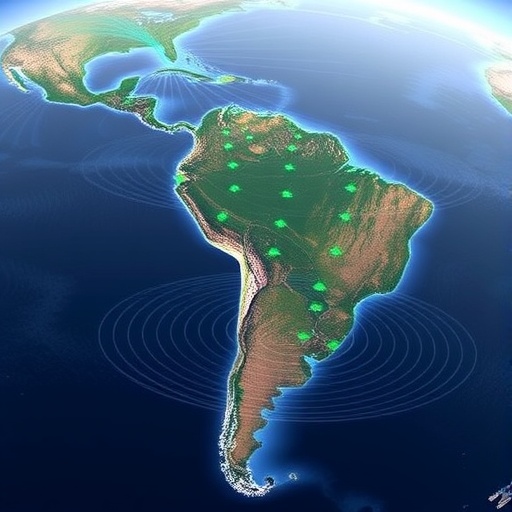
A new study suggests that “planetary trapped waves” traveling through the ocean-atmosphere system may act as a hidden relay, linking climate signals from South America to Africa across thousands of kilometers. Researchers report that these waves can couple with ocean circulation patterns to create teleconnections that span both intercontinental and trans-basin distances.
Using an integrated analysis framework that combines oceanic variability with wave dynamics, the team investigated how large-scale disturbances propagate westward and then become “trapped” in preferred pathways. Such trapping allows specific wave modes to persist long enough to interact with far-field currents rather than dissipating locally.
The findings point to an efficient mechanism for transferring variability from the Atlantic sector near South America toward African waters. Instead of relying solely on winds or surface temperature anomalies, the study emphasizes that wave-guided propagation can reorganize ocean signals deep into the basin, effectively synchronizing remote regions.
Crucially, the researchers describe how the trapped waves modulate the strength and timing of oceanic anomalies by steering the system’s heat and momentum transport. That steering alters upper-ocean conditions first, which then cascade into broader patterns through coupled ocean processes.
Beyond explaining a single event, the results indicate a recurring pathway that can generate climate-relevant correlations between continents. The authors highlight that such connectivity may influence rainfall variability, marine ecosystem conditions, and heat distribution—factors that depend on both large-scale dynamics and regional feedbacks.
From a forecasting perspective, the study raises the possibility that monitoring wave activity could improve early-warning signals for downstream impacts. If the trapped-wave pathways reliably precede teleconnection patterns, they could be incorporated into predictive systems that currently emphasize slower ocean adjustment or local forcing.
The work also underscores why some correlations between South American and African climates have been difficult to interpret with traditional mechanisms alone. By introducing a wave-based conduit, the authors offer a unifying explanation for how signals can appear coherently across distant basins.
Overall, the research reframes oceanic teleconnections as a dynamic, wave-mediated process. The team’s interpretation suggests that planetary trapped waves are not just theoretical curiosities, but practical drivers that can transport climate information across the Atlantic.
The study’s conclusions, published in Communications Earth & Environment in 2026, provide a fresh target for future modeling and observation campaigns. With better detection of trapped-wave signatures, scientists may be able to anticipate intercontinental ocean-climate linkages with greater confidence.
Cite Scienmag News
Violet Maxwell. (July 27, 2026). Planetary trapped waves link South America and Africa through ocean teleconnections. Scienmag. https://scienmag.com/planetary-trapped-waves-link-south-america-and-africa-through-ocean-teleconnections/
Violet Maxwell. "Planetary trapped waves link South America and Africa through ocean teleconnections." Scienmag, 27 July 2026, https://scienmag.com/planetary-trapped-waves-link-south-america-and-africa-through-ocean-teleconnections/. Accessed 4 September 2026.
Violet Maxwell. "Planetary trapped waves link South America and Africa through ocean teleconnections." Scienmag. July 27, 2026. https://scienmag.com/planetary-trapped-waves-link-south-america-and-africa-through-ocean-teleconnections/


