
Wednesday, July 8, 2026
Science
No Result
View All Result
  • Login
  • HOME
  • SCIENCE NEWS
  • CONTACT US
  • HOME
  • SCIENCE NEWS
  • CONTACT US
No Result
View All Result
Scienmag
No Result
View All Result
Home Science News Space

Return exactly one rewritten English science news headline for the original title below. Maximum 12 words. Output plain text only. Do not use HTML, Markdown, quotes, labels, explanations, bullets, numbering, or multiple options. Original title: How tall and short trees can coexist in old growth forests

July 8, 2026
in Space
Reading Time: 4 mins read
0
Return exactly one rewritten English science news headline for the original title below. Maximum 12 words. Output plain text only. Do not use HTML, Markdown, quotes, labels, explanations, bullets, numbering, or multiple options. Original title: How tall and short trees can coexist in old growth forests

Return exactly one rewritten English science news headline for the original title below. Maximum 12 words. Output plain text only. Do not use HTML, Markdown, quotes, labels, explanations, bullets, numbering, or multiple options. Original title: How tall and short trees can coexist in old growth forests

65
SHARES
587
VIEWS
Share on FacebookShare on Twitter
ADVERTISEMENT
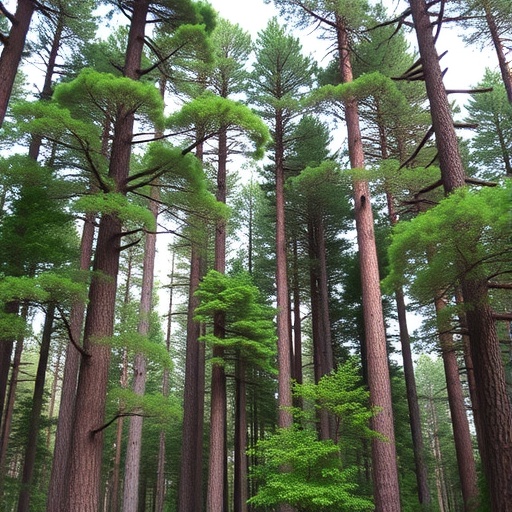
Main image - forest
image: A lush green forest, one of the study sites used in this study. While appearing peaceful at first glance, the forest is a fierce battleground for survival among trees.

view more 

Credit: KyotoU / Yusuke Onoda

Kyoto, Japan — Forests are shaped by light competition. The trees that grow the tallest have access to the most sunlight, blocking the rays and rendering the shaded space around them inhospitable to shorter trees below. In this stem exclusion phase of forest succession, the shorter trees often die. Yet scientists have observed that in old growth forests, trees of vastly different sizes successfully coexist, proving that reaching the top of the canopy is not the sole winning strategy for survival in a forest environment.

The height diversity of trees in mature forests indicates that light competition and species coexistence can balance out in forest succession. To understand how, quantifying light competition among trees is essential, but the complex architectural structures of natural forests and individual crowns have hindered rigorous scientific evaluation. A team of researchers from Kyoto University resolved to take on the challenge and solve this mystery.

“The competition for light among trees is frequently referred to as an evolutionary arms race, but trees of vastly different sizes successfully coexist in mature forests,” says first author Yusuke Onoda. “We became interested in this paradox.”

The team chose an approach with a novel framework analyzing a tree’s relative growth rate, or the speed at which a tree grows relative to its size, separated into two key factors: light interception efficiency, which indicates how much sunlight a tree captures per unit of biomass, and light use efficiency, which describes how effectively a tree converts the intercepted sunlight into biomass. To test their framework in the wild, the scientists mapped the crown shapes and 3D light profiles of each tree within 12 different forest plots of varying ages in Japan, totaling more than 2,000 individual trees of 50 different species.

The results revealed a mechanistic explanation behind how light competition quantitatively drives secondary forest succession. In younger stands, or plots in a forest, taller trees have disproportionate advantages in light capture, forcing rapid height stratification. In older stands, however, the higher light use efficiency of shade-tolerant species enables them to thrive under tall canopies, promoting vertical species coexistence.

By uncovering the hidden mechanics of forest succession, this study offers a new perspective on how trees navigate light competition and establishes a new principle that explains how forests change across time and space. These insights have the potential to improve climate modeling and enable smarter forest management.

The team is applying their approach to other forest sites of different ages across various climate zones, including warm temperate and tropical forests. They hope this will validate and establish their framework as a general, universal principle on a global scale.

###

The paper “Partitioning tree growth into light interception and use efficiencies clarifies the role of light competition in secondary forest succession” appeared on 8 July 2026 in the Journal of Ecology, with doi: 10.1111/1365-2745.70375

About Kyoto University

Kyoto University is one of Japan and Asia’s premier research institutions, founded in 1897 and responsible for producing numerous Nobel laureates and winners of other prestigious international prizes. A broad curriculum across the arts and sciences at undergraduate and graduate levels complements several research centers, facilities, and offices around Japan and the world. For more information, please see: 


Journal

Journal of Ecology

DOI

10.1111/1365-2745.70375

Method of Research

Observational study

Subject of Research

Not applicable

Article Title

Partitioning tree growth into light interception and use efficiencies clarifies the role of light competition in secondary forest succession

Article Publication Date

8-Jul-2026

COI Statement

The authors declare no conflict of interest regarding this work.

Media Contact

Whitney Hubbell

Kyoto University

hubbell.whitney.4a@kyoto-u.ac.jp

bu içeriği 600 ile 800 kelime arasında olacak şekilde ve alt başlıklar ve madde içermiyecek şekilde ünlü bir science magazine için İngilizce olarak yeniden yaz. Teknik açıklamalar içersin ve Viral science news olacak şekilde İngilizce yaz. Haber dışında başka bir şey içermesin. Haber içerisinde 8 ile 10 paragraf olsun ve toplam uzunluk 600 ile 800 kelime arasında kalsın. Cevapta sadece haber olsun. Ayrıca haberi yazdıktan sonra içerikten yararlanarak aşağıdaki başlıkların bilgisi var ise haberin altında doldur. Eğer yoksa bilgisi ilgili kısmı yazma.:
Subject of Research:
Article Title:
News Publication Date:
Web References:
References:
Image Credits:

Keywords

Tags: canopy shading effectsforest canopy structureforest light competitionforest regeneration patternsforest succession dynamicslight availability in forestsold growth forest ecologyold growth forest tree height diversitystem exclusion phasetree coexistence mechanismstree height stratificationunderstory tree survival
Share26Tweet16
Previous Post

Return exactly one rewritten English science news headline for the original title below. Maximum 12 words. Output plain text only. Do not use HTML, Markdown, quotes, labels, explanations, bullets, numbering, or multiple options. Original title: Global warming and increasing wildfire risk threaten viability of elite wine-growing regions in California – but others may boom

Related Posts

Korea Astronomy Institute boosts Giant Magellan Telescope funding
Space

Korea Astronomy Institute boosts Giant Magellan Telescope funding

July 7, 2026
Return exactly one rewritten English science news headline for the original title below. Maximum 12 words. Output plain text only. Do not use HTML, Markdown, quotes, labels, explanations, bullets, numbering, or multiple options. Original title: From the lab to the moon: New research gets man one step to moon living
Space

Return exactly one rewritten English science news headline for the original title below. Maximum 12 words. Output plain text only. Do not use HTML, Markdown, quotes, labels, explanations, bullets, numbering, or multiple options. Original title: From the lab to the moon: New research gets man one step to moon living

July 7, 2026
Autonomous monitor halts drone collisions in real time
Space

Autonomous monitor halts drone collisions in real time

July 7, 2026
Rice and NASA release world’s first open-source space robot simulator
Space

Rice and NASA release world’s first open-source space robot simulator

July 6, 2026
U of A astronomers help shatter record with most distant quasars
Space

U of A astronomers help shatter record with most distant quasars

July 6, 2026
Quark-like waves help stabilize fragile fractional vortices
Space

Quark-like waves help stabilize fragile fractional vortices

July 6, 2026
  • Mothers who receive childcare support from maternal grandparents show more

    Mothers who receive childcare support from maternal grandparents show more parental warmth, finds NTU Singapore study

    27656 shares
    Share 11059 Tweet 6912
  • University of Seville Breaks 120-Year-Old Mystery, Revises a Key Einstein Concept

    1061 shares
    Share 424 Tweet 265
  • Bee body mass, pathogens and local climate influence heat tolerance

    682 shares
    Share 273 Tweet 171
  • Researchers record first-ever images and data of a shark experiencing a boat strike

    546 shares
    Share 218 Tweet 137
  • Groundbreaking Clinical Trial Reveals Lubiprostone Enhances Kidney Function

    531 shares
    Share 212 Tweet 133
Science

Embark on a thrilling journey of discovery with Scienmag.com—your ultimate source for cutting-edge breakthroughs. Immerse yourself in a world where curiosity knows no limits and tomorrow’s possibilities become today’s reality!

RECENT NEWS

  • Postpartum bonding problems tied to abnormal neural processing of infant emotions
  • Salmonella protein SopB curbs early inflammation to slow disease progression
  • Embodied cognition yields interpretable trajectory predictions for autonomous systems.
  • Multi-metal cooperation drives lung cancer chemoresistance, reversed by MiADMSA

Categories

  • Agriculture
  • Anthropology
  • Archaeology
  • Athmospheric
  • Biology
  • Biotechnology
  • Blog
  • Bussines
  • Cancer
  • Chemistry
  • Climate
  • Earth Science
  • Editorial Policy
  • Marine
  • Mathematics
  • Medicine
  • Pediatry
  • Policy
  • Psychology & Psychiatry
  • Science Education
  • Social Science
  • Space
  • Technology and Engineering

Subscribe to Blog via Email

Success! An email was just sent to confirm your subscription. Please find the email now and click 'Confirm Follow' to start subscribing.

Join 5,147 other subscribers

© 2025 Scienmag - Science Magazine

Welcome Back!

Login to your account below

Forgotten Password?

Retrieve your password

Please enter your username or email address to reset your password.

Log In
No Result
View All Result
  • HOME
  • SCIENCE NEWS
  • CONTACT US

© 2025 Scienmag - Science Magazine