

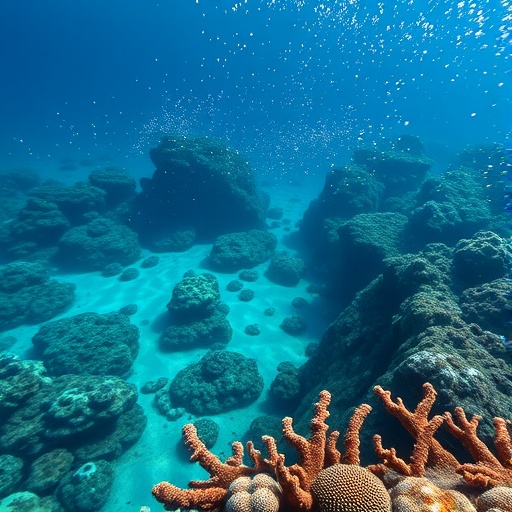
Hidden beneath the turquoise waters of the Andaman Sea, a coral reef has been quietly defying the odds. While marine heatwaves devastated reefs across the globe, this particular ecosystem has often escaped relatively unscathed, cooled by pulses of deep, frigid water that rise from the ocean’s interior. But a groundbreaking new study reveals that this natural air conditioning is anything but reliable—it flickers on and off at the whim of planetary-scale climate patterns, leaving corals with an unpredictable lifeline.
Scientists have long known that internal waves, the submarine equivalents of the surface swells we see above water, can push cold, nutrient-rich water from the depths onto shallow reefs. This process, driven largely by shifts in the thermocline—the boundary layer that separates warm surface water from the cold abyss—can offer a temporary haven from heat stress. However, until now, no one had tracked how the frequency and intensity of this cooling has changed over time, or what ultimately controls it.
To crack the case, researchers turned to an unlikely archive: the coral skeletons themselves. Corals grow slowly, laying down annual bands of calcium carbonate much like trees form rings. As they do, they lock trace elements and isotopes from the surrounding seawater into their skeletons. By drilling pencil-thin cores from massive coral colonies and measuring the ratio of strontium to calcium (Sr/Ca), the team was able to reconstruct subsurface ocean temperatures reaching back decades. Strontium substitutes for calcium more readily in cooler water, providing a natural thermometer with monthly resolution.
The geochemical detective work didn’t stop there. The team also analyzed stable carbon isotopes within the skeletons to deduce how the corals were feeding. Under normal conditions, reef-building corals get most of their energy from microscopic algae living symbiotically inside their tissues. When waters overheat, this partnership breaks down in a process known as bleaching, and corals must increasingly resort to capturing plankton and organic particles from the water column—a backup strategy called heterotrophy. The isotopic signatures left behind revealed when corals switched to this emergency mode.
When the scientists aligned these skeletal records with decades of local subsurface temperature measurements, a startling picture emerged. The cooling events protecting the reef were strongest not during random years, but in sync with two of Earth’s most powerful climate engines: the El Niño–Southern Oscillation and the Indian Ocean Dipole. Together, these phenomena reorganize winds and ocean currents across the tropical Indo-Pacific, causing the thermocline to shoal or deepen. The most dramatic cooling coincided with the legendary 1997/1998 El Niño, which occurred alongside an intense positive phase of the Indian Ocean Dipole. That year, the thermocline rose so close to the surface that internal waves delivered an unusually sustained blast of cold water, drastically reducing thermal stress even as much of the world’s corals were cooking.
Yet the geochemical evidence showed that not all heatwaves were created equal. During many bleaching events preserved in the coral record, carbon isotope values pointed to a clear shift toward heterotrophy, indicating the corals were starving and scrambling for food. But during the 1998 episode, that signal largely vanished. The intense natural cooling appeared to have allowed the coral-algal partnership to remain relatively intact, negating the need for a dietary pivot. It was a powerful demonstration of how effective this thermal refuge can be—when it works.
The trouble, the scientists caution, is that this protection is not guaranteed. The study, published in Scientific Reports, emphasizes that the strength and distribution of thermal refuges like this Andaman reef wax and wane with the rhythm of tropical climate variability. A reef that provides a sanctuary during one El Niño might offer little relief during the next, depending on the state of the broader ocean-atmosphere system. That makes them dynamic features rather than static safe havens.
This discovery has profound implications for conservation planning. As marine heatwaves become more frequent and severe, identifying reefs most likely to survive is a global priority. The research suggests that managers must look beyond local conditions and incorporate large-scale climate forecasts to predict which refuges will activate and when. By combining coral geochemistry with oceanographic monitoring, scientists can begin mapping the temporary shields that nature throws up against climate change.
In a warming world, coral reefs are on the front line. This new perspective from the Andaman Sea reminds us that resilience is not a fixed property but a fleeting gift from the deep, governed by planetary forces we are only beginning to comprehend. For the corals that call these waters home, survival depends as much on the rhythm of the climate system as it does on the heat of the sun.
Subject of Research: Coral reef refugia and the influence of tropical climate modes on thermal stress mitigation
Article Title: Tropical climate modes control strength and distribution of thermal stress mitigation in a coral reef refugia.
News Publication Date: [Not provided]
Web References: 10.1038/s41598-026-52941-6
References: 10.1038/s41598-026-52941-6
Image Credits: Patrick Pollmeier, University of Bremen
Keywords: Coral reef refugia, thermal stress, internal waves, Sr/Ca paleothermometry, carbon isotopes, heterotrophy, El Niño–Southern Oscillation, Indian Ocean Dipole, thermocline, climate variability, oceanography, paleoclimatology


