

Wednesday, July 1, 2026
Science
No Result
View All Result
  • Login
  • HOME
  • SCIENCE NEWS
  • CONTACT US
  • HOME
  • SCIENCE NEWS
  • CONTACT US
No Result
View All Result
Scienmag
No Result
View All Result
Home Science News Archaeology

Were Late Pleistocene Clovis People Skilled Big-Game Hunters or Mere Scavengers?

July 1, 2026
in Archaeology
Reading Time: 3 mins read
0
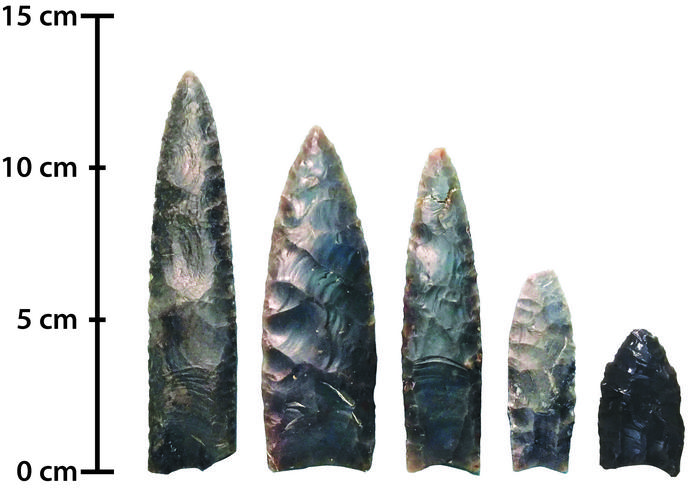
Photo of Clovis fluted points
65
SHARES
587
VIEWS
Share on FacebookShare on Twitter
ADVERTISEMENT

Photo of Clovis fluted points

image: Clovis fluted points from Blackwater Draw, New Mexico.

view more 

Credit: Journal of Archaeological Science: Reports

There are currently 15 well-documented Late Pleistocene localities in North America in which Clovis points are found associated with proboscidean remains (of mammoth, mastodon, and gomphothere). Archaeologists routinely assume these localities represent evidence that Clovis people hunted these multi-tone animals, and in turn invoke that evidence to claim humans had a role in the extinction of these large mammals. Yet, archaeologists have not thoroughly tested their assumption, nor fully considered the possibility that Clovis foragers were facultative scavengers, which might as readily account for the association of artifacts with proboscidean remains at some or even all these localities. A significant obstacle to differentiating hunting from scavenging archaeologically is the challenge of equifinality.

Five researchers from Kent State University, Southern Methodist University (SMU), the Smithsonian, the University of Michigan, and the University of Utah explored whether Clovis foragers hunted, scavenged, or did both, and whether it was possible to tell the difference archaeologically. The new research is now published in the Journal of Archaeological Science: Reports.

To set a broad foundation for considering the question, they began their study showing the near ubiquity of scavenging among non-human animals. They document the fact that the paleoanthropological, ethnohistoric, and ethnographic records showed that scavenging was also quite common among human groups past and present. Following that, they consider the many opportunities scavengers have – and Clovis foragers might have had – in exploiting proboscidean carrion. Lastly, they assess the proposed archaeological evidence for Clovis hunting and scavenging and show that while Clovis foragers likely practiced both. “Researchers cannot currently distinguish the two archaeologically and thus cannot reliably show how many Clovis proboscidean sites represent hunting versus scavenging events,” said Kent State’s Metin I. Eren.

“While Clovis foragers likely hunted mammoths, it would be odd indeed if Clovis foragers – alone among ethnohistoric and ethnographic human groups and nearly all omnivores and carnivores – did not scavenge,” said SMU’s David J. Meltzer. Meltzer added that “scavenging also could possibly explain the high δ15N values recently reported for the Anzick child, which could readily result from his mother eating maggots and not mammoth meat.” The researchers concluded that given the present state of knowledge, the Clovis archaeological record cannot be used to argue that Clovis groups routinely hunted proboscideans, or that there are sufficient “kill sites” to support a human role in proboscidean extinctions.

The Smithsonian’s Briana Pobiner, the University of Utah’s James O’Connell, and the University of Michigan’s John D. Speth were the other contributing authors to the study.

“If we cannot definitively conclude that proboscidean killing took place at any single Clovis site because there is archaeological equifinality with scavenging, then proboscidean overkilling is not supported either,” Eren said. “Despite some archaeologists’ and other scientists’ long-standing beliefs, there is just no definitive scientific evidence for a human role in the North American Late Pleistocene extinction of proboscideans.”


Journal

Journal of Archaeological Science Reports

DOI

10.1016/j.jasrep.2026.105896

Method of Research

Literature review

Subject of Research

People

Article Publication Date

1-Jul-2026

Media Contact

Kedron Trapp

Kent State University


ktaylo57@kent.edu

Office: 3306723697

Journal

Journal of Archaeological Science Reports

DOI

10.1016/j.jasrep.2026.105896

Method of Research

Literature review

Subject of Research

People

Article Publication Date

1-Jul-2026

bu içeriği en az 2000 kelime olacak şekilde ve alt başlıklar ve madde içermiyecek şekilde ünlü bir science magazine için İngilizce olarak yeniden yaz. Teknik açıklamalar içersin ve viral olacak şekilde İngilizce yaz. Haber dışında başka bir şey içermesin. Haber içerisinde en az 12 paragraf ve her bir paragrafta da en az 50 kelime olsun. Cevapta sadece haber olsun. Ayrıca haberi yazdıktan sonra içerikten yararlanarak aşağıdaki başlıkların bilgisi var ise haberin altında doldur. Eğer yoksa bilgisi ilgili kısmı yazma.:
Subject of Research:
Article Title:
News Publication Date:
Web References:
References:
Image Credits:

Keywords

Tags: Archaeological evidence of Clovis huntingBig-game hunting vs scavengingBlackwater Draw Clovis siteClovis archaeological localitiesClovis hunting strategies analysisClovis people and megafauna extinctionClovis points and proboscidean remainsLate Pleistocene Clovis culturePaleoindian subsistence practicesProboscidean species in North AmericaRole of Clovis people in Pleistocene extinctionsScavenging behavior in prehistoric humans
Share26Tweet16
Previous Post

Advancing Weather Intervention Techniques to Enhance Future Disaster Mitigation

Next Post

Innovative UH Technology Uncovers New Targets for Disease Treatment

Related Posts

Altamira ceiling, Spain
Archaeology

Ancient DNA Discovered on Cave Walls Reveals New Insights

June 24, 2026
Goyet Caves, Belgium
Archaeology

Neandertals of North-Western Europe Take Center Stage

June 24, 2026
Neanderthal baby remains
Archaeology

Fossilized Infants Uncover Developmental Connection Between Humans and Neanderthals

June 22, 2026
Experience the Magic of Stonehenge from Your Sofa This Solstice — Archaeology
Archaeology

Experience the Magic of Stonehenge from Your Sofa This Solstice

June 20, 2026
Tracing 10,000 Years of Dietary Inequality in Europe: Insights from an SFU Study — Archaeology
Archaeology

Tracing 10,000 Years of Dietary Inequality in Europe: Insights from an SFU Study

June 17, 2026
Fieldwork on Greenland
Archaeology

Ancient Microbes in Greenland’s Rubbish Heaps Reveal Insights into Old Farms, Seal Hunts, and Toilets

June 17, 2026
Next Post
Innovative UH Technology Uncovers New Targets for Disease Treatment — Medicine

Innovative UH Technology Uncovers New Targets for Disease Treatment

  • Mothers who receive childcare support from maternal grandparents show more parental warmth, finds NTU Singapore study

    Mothers who receive childcare support from maternal grandparents show more parental warmth, finds NTU Singapore study

    27656 shares
    Share 11059 Tweet 6912
  • University of Seville Breaks 120-Year-Old Mystery, Revises a Key Einstein Concept

    1061 shares
    Share 424 Tweet 265
  • Bee body mass, pathogens and local climate influence heat tolerance

    682 shares
    Share 273 Tweet 171
  • Researchers record first-ever images and data of a shark experiencing a boat strike

    546 shares
    Share 218 Tweet 137
  • Groundbreaking Clinical Trial Reveals Lubiprostone Enhances Kidney Function

    531 shares
    Share 212 Tweet 133
Science

Embark on a thrilling journey of discovery with Scienmag.com—your ultimate source for cutting-edge breakthroughs. Immerse yourself in a world where curiosity knows no limits and tomorrow’s possibilities become today’s reality!

RECENT NEWS

  • Cutting-Edge AI Breakthroughs, Digital Health Evolution, and Emerging Medicare Models: Latest Updates from JMIR
  • Ancient Spider Bite: 518-Million-Year-Old Urokodia Fossil Reveals Earliest Evidence
  • UOB and Singapore’s Centre for Quantum Technologies Break New Ground in Quantum Computing for Derivatives Valuation
  • Long Covid Rehabilitation Program Enhances Cognitive Function and Facilitates Return to Work

Categories

  • Agriculture
  • Anthropology
  • Archaeology
  • Athmospheric
  • Biology
  • Biotechnology
  • Blog
  • Bussines
  • Cancer
  • Chemistry
  • Climate
  • Earth Science
  • Editorial Policy
  • Marine
  • Mathematics
  • Medicine
  • Pediatry
  • Policy
  • Psychology & Psychiatry
  • Science Education
  • Social Science
  • Space
  • Technology and Engineering

Subscribe to Blog via Email

Enter your email address to subscribe to this blog and receive notifications of new posts by email.

Join 5,147 other subscribers

© 2025 Scienmag - Science Magazine

Welcome Back!

Login to your account below

Forgotten Password?

Retrieve your password

Please enter your username or email address to reset your password.

Log In
No Result
View All Result
  • HOME
  • SCIENCE NEWS
  • CONTACT US

© 2025 Scienmag - Science Magazine

Discover more from Science

Subscribe now to keep reading and get access to the full archive.

Continue reading
