


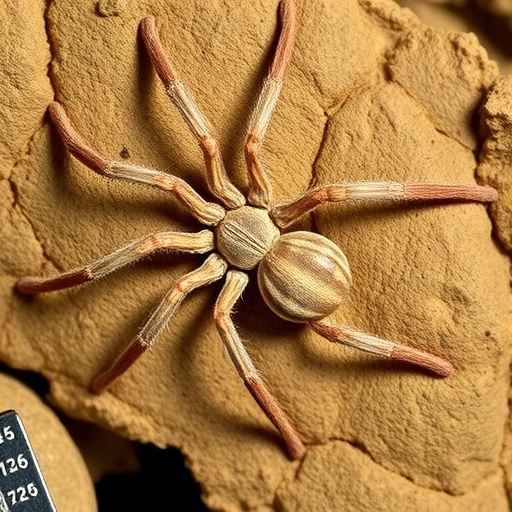
A recent breakthrough in paleontological research has unveiled the earliest known evidence of spider fangs, traced back an astonishing 518 million years to the fossilized remains of an ancient arthropod named Urokodia. This discovery, achieved through advanced X-ray tomography techniques, bridges significant gaps in our understanding of chelicerate evolution, the group that includes spiders, scorpions, and ticks. The findings, published in the prestigious journal Nature, offer unprecedented insights into the morphological origins of chelicerae—the specialized appendages that function as pincers or fangs in modern arachnids.
Urokodia fossils were excavated from the renowned Chengjiang fossil site in Yunnan Province, southern China, a location celebrated for exceptionally preserving soft-bodied organisms from the Cambrian explosion, approximately half a billion years ago. Urokodia itself measured a modest 2-3 centimeters, featuring segmented body parts and jointed limbs, with large, stalked eyes prominently positioned at its anterior. Despite its superficial dissimilarity to modern spiders and scorpions, Urokodia embodies critical ancestral characteristics, underscoring the evolutionary continuum of chelicerates.
Employing cutting-edge X-ray tomography, researchers from the University of Leicester and Yunnan University revealed remarkably preserved soft tissues within the fossilized rock matrix. This non-destructive imaging approach illuminated the fine anatomical details, most notably two prominent pincer-like limbs emerging immediately behind the eyes. These appendages represent the prototypical chelicerae, providing vital evidence of the evolutionary inception of this defining feature among arachnids and their relatives.
Intriguingly, the study uncovered morphological traits indicative of respiratory adaptations similar to book gills observed in extant aquatic chelicerates like horseshoe crabs. The limb structures hint at a dual respiratory and locomotive function, suggesting that Urokodia’s lineage possessed versatile physiological traits facilitating life in ancient marine environments. This sheds light on the complex evolutionary pathways that enabled chelicerates to diversify and colonize terrestrial ecosystems.
Chelicerates, with over 100,000 described species today, exemplify one of the most successful arthropod lineages, thriving in disparate habitats from ocean floors to forest canopies. Their evolutionary triumph is intricately linked to the development of specialized appendages such as chelicerae, which serve as both predatory and defensive tools. The identification of these structures in Urokodia not only pushes back the timeline for their emergence but also refines our understanding of arachnid phylogeny and functional morphology.
The significance of this discovery extends beyond academic circles; spiders and scorpions have long captivated public imagination, often cast as nocturnal predators with lethal venom. While cinematic portrayals dramatize their potential threat, scientific evidence underscores that most modern spiders employ venom and fang mechanisms optimized for subduing smaller prey rather than posing substantial danger to humans. This nuanced understanding enriches public appreciation of arachnid biology and evolutionary history.
Led by Professor Yu Liu of Yunnan University and a visiting professor at the University of Leicester, the research team capitalized on the synergy of international collaboration and technological innovation. Professor Liu emphasized the fortuitous nature of their findings, recounting how initial X-ray analyses unexpectedly revealed the distinctive limb structures, prompting a reevaluation of Urokodia’s taxonomic placement. This exemplifies the transformative power of modern imaging in paleobiology.
Professor Mark Williams from the University of Leicester contextualized Urokodia within the broader tapestry of Cambrian biodiversity, highlighting its part in an ancient marine ecosystem comprising over 200 distinct animal taxa. The extraordinary preservation of these fossils opens a rare window into the ecological dynamics of early animal life, illuminating evolutionary processes at a critical juncture when complex body plans emerged.
The fossilized evidence of Urokodia’s chelicerae fundamentally enhances our comprehension of the morphological innovations that underpinned the adaptive radiation of chelicerates. It allows scientists to trace the lineage-specific modifications in appendage structure that facilitated the evolution from simple aquatic forms to sophisticated terrestrial hunters, bridging molecular phylogenies with morphological data derived from the fossil record.
The study also underscores the enduring scientific value of the Chengjiang fossil site, discovered 42 years ago, for advancing evolutionary biology. Continuous research at this site promises to yield further revelations regarding the origins of key anatomical features and the diversification of early metazoans, reinforcing its status as a global paleontological treasure.
Funding from the Department of Science and Technology of Yunnan Province and support from talent development programs facilitated this ground-breaking research. Such investment exemplifies the critical role of targeted scientific funding in fostering discoveries that refine our understanding of life’s deep history.
This landmark investigation into Urokodia’s anatomy reshapes our perception of early chelicerate evolution, positioning these ancient organisms not merely as distant curiosities but as foundational players in the evolutionary saga that culminated in the diverse and ecologically significant arachnid fauna observed today.
News Publication Date: 1-Jul-2026
Web References: http://dx.doi.org/10.1038/s41586-026-10713-2
Cite Scienmag News
Gavin Prescott. (July 1, 2026). Ancient Spider Bite: 518-Million-Year-Old Urokodia Fossil Reveals Earliest Evidence. Scienmag. https://scienmag.com/ancient-spider-bite-518-million-year-old-urokodia-fossil-reveals-earliest-evidence/
Gavin Prescott. "Ancient Spider Bite: 518-Million-Year-Old Urokodia Fossil Reveals Earliest Evidence." Scienmag, 1 July 2026, https://scienmag.com/ancient-spider-bite-518-million-year-old-urokodia-fossil-reveals-earliest-evidence/. Accessed 3 September 2026.
Gavin Prescott. "Ancient Spider Bite: 518-Million-Year-Old Urokodia Fossil Reveals Earliest Evidence." Scienmag. July 1, 2026. https://scienmag.com/ancient-spider-bite-518-million-year-old-urokodia-fossil-reveals-earliest-evidence/


